


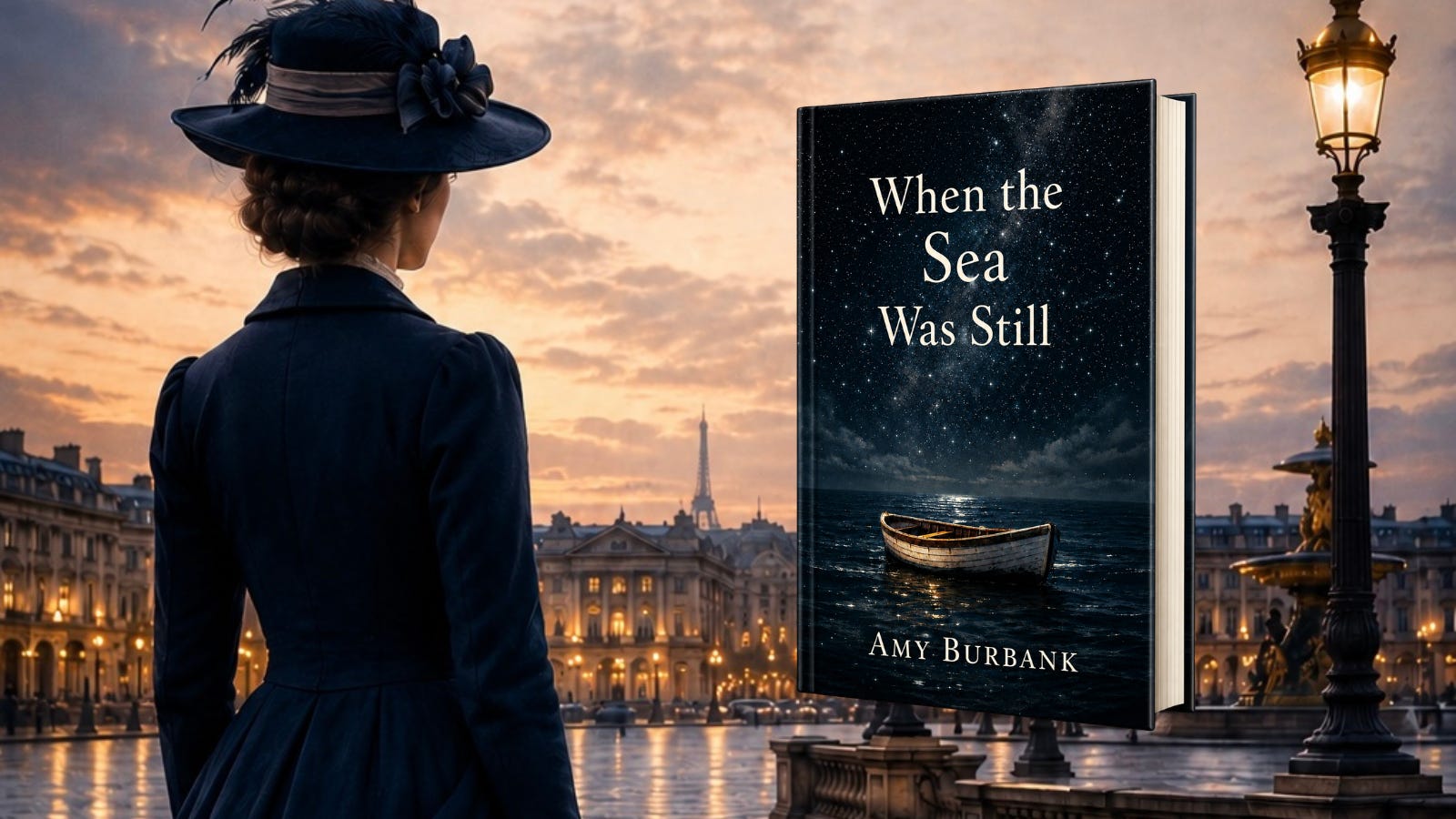
When the Sea Was Still is a historical novel inspired by Titanic survivor Helen Ostby. While the heroine of the story, Nora Osterly, is entirely fictional, her journey draws on the incredible life of Helen Ostby. After surviving the Titanic disaster and losing her father, Helen went on to help run the family jewelry business, Ostby & Barton, which required her to face the sea again for business in Europe. Remarkably, she found herself in Germany on the eve of the First World War.
The novel starts two years after the sinking of the Titanic, when Nora Osterly is forced to cross the Atlantic again—this time aboard Titanic’s nearly identical sister ship, the Olympic. To save her father’s legacy, Nora must do the one thing she swore she never would: return to the sea that nearly killed her.

The Ghost of Another Ship
Nora
June 1914
New York City
Nora Osterly stood on Pier 59, terrified of the ship looming before her. The Olympic’s imposing black hull rose above the dock, her white decks, and red funnels like the ghost of another ship that had once carried the same grandeur.
She drew a deep breath to calm her nerves.
It was nearly identical to the Titanic. Nora scanned the ship until her eyes fell on the lifeboats hanging from their davits. She had not seen a lifeboat in two years. Her instinct was to turn and flee.
She forced herself to look away.
Nora had sailed on the Olympic three years ago, traveling with her father on their annual business trip to Paris. The ship had been hailed by the press as the largest and grandest afloat. She remembered seeing her for the first time. Nothing had prepared her for the sheer scale of it, the sense that something so vast could actually float.
Strolling the Olympic’s promenade deck with her father each morning, they had playfully argued over which White Star Line ship offered the best service. She had always been partial to the Adriatic, but her father insisted that nothing could compare to the Olympic.
Gazing at the Olympic now, she didn’t know how she was going to board without her father by her side. To stop the tears that threatened, she looked around the bustling pier. Breathing in the sea air, thick with the smell of coal smoke, steadied her. She heard the cry of seagulls mingling with the clang of the trolley bells.
Standing beside Nora, Astrid Lund was engaged in conversation with Josie and Charles Harroway, three familiar faces in a sea of strangers. Astrid, neat as always in her tailored traveling suit, gestured crisply as she spoke, while Mrs. Harroway listened with enthusiasm.
“You are awfully quiet, Nora. Are you all right?” Astrid asked, pausing mid-conversation.
“Yes, I’m fine,” Nora said.
“My dear, you are looking rather pale. Are you quite certain you are well?” Mrs. Harroway asked.
“Yes. I hadn’t remembered how very much the Olympic resembles… you know. But I assure you, I shall be fine.” Nora smiled in an attempt to prove it.
Charles Harroway, dignified in his silk top hat, rested his gloved hand over hers.
“You are very brave, dear,” he said.
Nora had known Josie Harroway and her husband, Charles, since childhood. They often attended the same social functions in Providence as Nora and her father. At sixty, Mr. Harroway was still active in his textile business, but he never missed a summer holiday with his wife.
Their housemaid, Bridie, stood just behind them, quietly taking it all in. She gave Nora an encouraging smile.
The boarding queue moved forward as porters hurried past with passengers’ trunks. Together, they ascended the wide first-class gangway toward the open doorway on D-Deck. A small crowd lingered below, waving and calling their farewells. Nora’s gloved hand gripped the rail as they walked toward the ship’s great black hull.
They reached the top of the gangway and stepped aboard through the first-class entrance. Nora paused at the threshold, the familiar oak-paneled walls and blue-green carpets of the reception room closing in around her. Astrid’s hand on her shoulder kept her from faltering. The soft voices of well-dressed passengers in tailored suits and elegant hats surrounded them.
“I never tire of the fresh smell of polished wood,” Mrs. Harroway said as she stepped inside. “Everything is spotless on these ships. I feel so well taken care of.”
“Indeed, my dear.” Mr. Harroway replied as he gave her hand a gentle squeeze.
A steward in a crisp uniform and white gloves greeted the Harroways before checking their names against the ship manifest.
“Mr. and Mrs. Harroway,” he announced smoothly, “and Miss Bridie O’Sullivan.”
A second cabin steward appeared at once to accompany the Harroways to their suite on B Deck.
“Will we see you on deck for the sailing?” Mrs. Harroway asked.
“I’m afraid not. I have some business to attend to,” Nora said.
Mrs. Harroway studied her for a moment, then smiled warmly.
“Very well, dear. We shall see you at dinner,” she said, before following the steward to her cabin with Mr. Harroway.
After being escorted to their staterooms by their own steward, Nora and Astrid retreated to their cabins to rest before luncheon. The walk down to C Deck had unsettled Nora. The cheeriness of the white-painted wood paneling contrasted with the dark memories the corridors elicited. It was like stepping back in time—to a place she had never wanted to return to.
Inside her stateroom, the cabin steward offered to unpack for Nora, but she declined, preferring to attend to it herself. After he withdrew, Nora looked at her surroundings and took a deep breath.
The neatly appointed room, decorated in the Empire style, was smaller than the ones she stayed in when she used to sail with her father. White-paneled walls trimmed in gold surrounded the elegant furnishings. On the desk sat a large arrangement of flowers with a note from Clara.
My dear Nora,
Wishing you a safe and gentle passage. I know this journey will not be an easy one, but I trust in your strength more than you may at this time.
I shall be thinking of you and look forward to seeing you soon in Paris.
With all my affection,
Clara
Clara’s note gave her a small dose of courage just when she needed it most. She had never wanted to sail again. Yet here she was, back on a great ocean liner, because of a letter she received two months ago. A letter she hadn’t been able to stop thinking about. She sat on the edge of the brass-railed bed and closed her eyes silently contemplating its contents.
When her thoughts refused to settle, she opened her eyes and rose to change into her luncheon outfit, a soft gray skirt with an ivory blouse trimmed in lace. She pinned up her auburn hair, then fastened the diamond bar pin her father had given her at the center of her collar, her slender fingers lingering on the cool gold for a moment longer than necessary. She caught a glimpse of herself in the glass, looking directly at her own blue-gray eyes willing herself to be strong.
The blast of the ship’s whistle sounded—deep and resonant, carrying through the walls of the cabin. Above her, she could imagine the scene unfolding on deck: passengers in their fine dresses and tailored suits, hats pinned neatly in place, waving embroidered handkerchiefs and calling out their goodbyes. The Harroways would be among them, no doubt, Mrs. Harroway waving with enthusiasm as the great ship was eased from the dock by a cluster of tugs, their whistles answering in farewell.
She could feel the engine’s vibrations deepen, and her stomach tightened as the ship gathered speed. Nora could hardly believe that she was on a steamer again, heading back across the Atlantic. She had no choice now but to trust the steel hull of the Olympic to keep her safely above the depths of the ocean.
She heard a soft knock on the door and rose to answer it.
Expecting Astrid, she was surprised to see Bridie standing in the doorway, looking somewhat nervous.
“Beggin’ your pardon, Miss Osterly. I don’t mean to intrude, but I wanted to be sure you were all right.”
“Thank you, Bridie. You’re truly kind.”
Bridie gave a small nod. “I know it’s not easy, steppin’ aboard again. So, if you need anything from me, anything at all, you’ve only to ask. Mrs. Harroway will understand.”
Nora was touched that Bridie would risk stepping beyond her station to check on her. She offered the young woman a grateful smile. “It means a great deal that you came,” she said.
As she glanced down, she noticed the corner of a book tucked into the pocket of Bridie’s apron. Its spine was worn, no doubt from countless readings.
“I never see you without a book,” Nora said. “What are you reading now?”
“Oh… just a bit of Miss Alcott,” Bridie replied. “Helps keep me company in the quiet hours.”
“A good story to pass the time suits you,” Nora said.
Bridie looked pleased. “Aye. Books keep the mind sharp, I always say.”
As Nora watched Bridie tuck her book back in her apron, she felt grateful for the quiet kinship between them.
Astrid appeared from her stateroom next door. “Are you ready for luncheon?” she asked.
“Yes. I’m ready,” Nora said. She gave Bridie a small wave goodbye.
As they made their way to the dining saloon, Astrid stopped to make a request with their steward, waving Nora on and promising to catch up. Nora continued down the corridor and turned at the corner, stopping in her tracks at the sight before her.
The Grand Staircase.
A sight so familiar it robbed her of breath.
She paused at the rail and held on for balance. She looked down at the sweeping staircase, its carved oak balustrades spanning the entirety of the impressive space. The intricate gilded wrought-iron railings sparkled in flecks of gold, perfectly accenting the richness of the oak panels. To her artistic eye, it was marvelous. But the memories it stirred quickly extinguished her instinct to admire it.
From where she stood, the staircase stretched down to D-Deck and rose up two levels to A-Deck, each landing repeating the same elegant geometry of oak and wrought-iron. Above the four decks, light cast down from the frosted-glass dome, illuminating the grand staircase in a crown of glory.
At the center of it all was the clock. The great clock surrounded by a sea of oak, embedded in intricate paneling, and flanked by two carved figures, Honor and Glory. Nora walked down the first set of stairs to stand before it. As she gazed at the ticking timepiece, her heart tugged in her chest, and a single tear slid down her cheek.
Standing before the heart of the Olympic, its sibling now resting somewhere beneath the Atlantic, Nora could no longer keep her memories at bay. They surged up in full force, breaking through the walls she had so carefully built.
“Why not, Nora?” her father had said. “They are calling her the Queen of the Ocean. And we shall be on her maiden voyage!”
Nora had been thrilled. A few short days later, they sat in the first-class saloon of the SS Nomadic. As the tender carried them toward the Titanic, moored offshore, she remembered the feeling of being swept into the social event of the year, surrounded by the rich and famous figures she had only ever read about.
Nora took her seat beside her father, alive with excitement.
Her father leaned slightly toward her. “Look ahead, Nora.”
She followed his gaze—and gasped.
Across the saloon, Colonel John Jacob Astor sat with his young wife, Madeleine. Mrs. Astor wore a pale-blue plumed hat, her gloved hand resting elegantly on her husband’s arm. They looked serene, self-possessed… the very symbols of society and success.
Nora felt a flush rise to her cheeks. “They are even more impressive in person,” she whispered.
When the Nomadic moored alongside Titanic, they made their way onto the deck outside. The seagulls were flying high above, as if to get their own views of the grand ocean liner. A chill ran up Nora’s spine as they disembarked their tender boat.
The Titanic had been a floating palace, a marvel of ambition and engineering. The ship looked nearly identical to the Olympic, yet somehow more luxurious. Perhaps it was the sheer wealth on board. Perhaps it was the new Parisian Café staffed with French waiters. Or maybe it was the strawberries. Nora had been amazed at the fresh strawberries, served in mid-ocean, in April. It was unheard of.
She had felt almost giddy as they stepped aboard, caught between disbelief and delight. Seeing the grand staircase, the beating heart of the vessel, she was struck by its similarity to the Olympic, yet it had a personality all its own. Its opulence filled her with a rush of inspiration.
Beside her, her father had squeezed her hand, his eyes bright with joy. “What do you think of her, Nora?”
“She’s magnificent,” Nora said. “She looks so much like her sister.”
“But slightly larger, making her the largest ship in the world,” he said. “And just as safe.”
Standing next to her father, she felt that they were exactly where they belonged. She wanted to capture this moment forever, the feeling that she was stepping into history.
And for one brilliant, unforgettable moment, she believed nothing could ever go wrong.

The Sister Ship’s Story
Welcome to this week’s bonus deep dive. Since this is our very first episode together, this one’s free for everyone—a small preview of what paid subscribers can expect each week going forward.
When I sat down to write Nora boarding the Olympic, I knew the ship itself needed to carry almost as much emotional weight as the story itself. The Olympic isn’t just any ship, she’s Titanic’s nearly identical sister.
When Nora boards the Olympic two years after losing her father, she’s not just facing the sea again, she’s stepping onto a ship that looks, sounds, and feels almost exactly like the one that killed him. Olympic and Titanic shared almost the same layout, down to the famous Grand Staircase, which means many of the areas Nora walks through are spaces she would have recognized instantly.
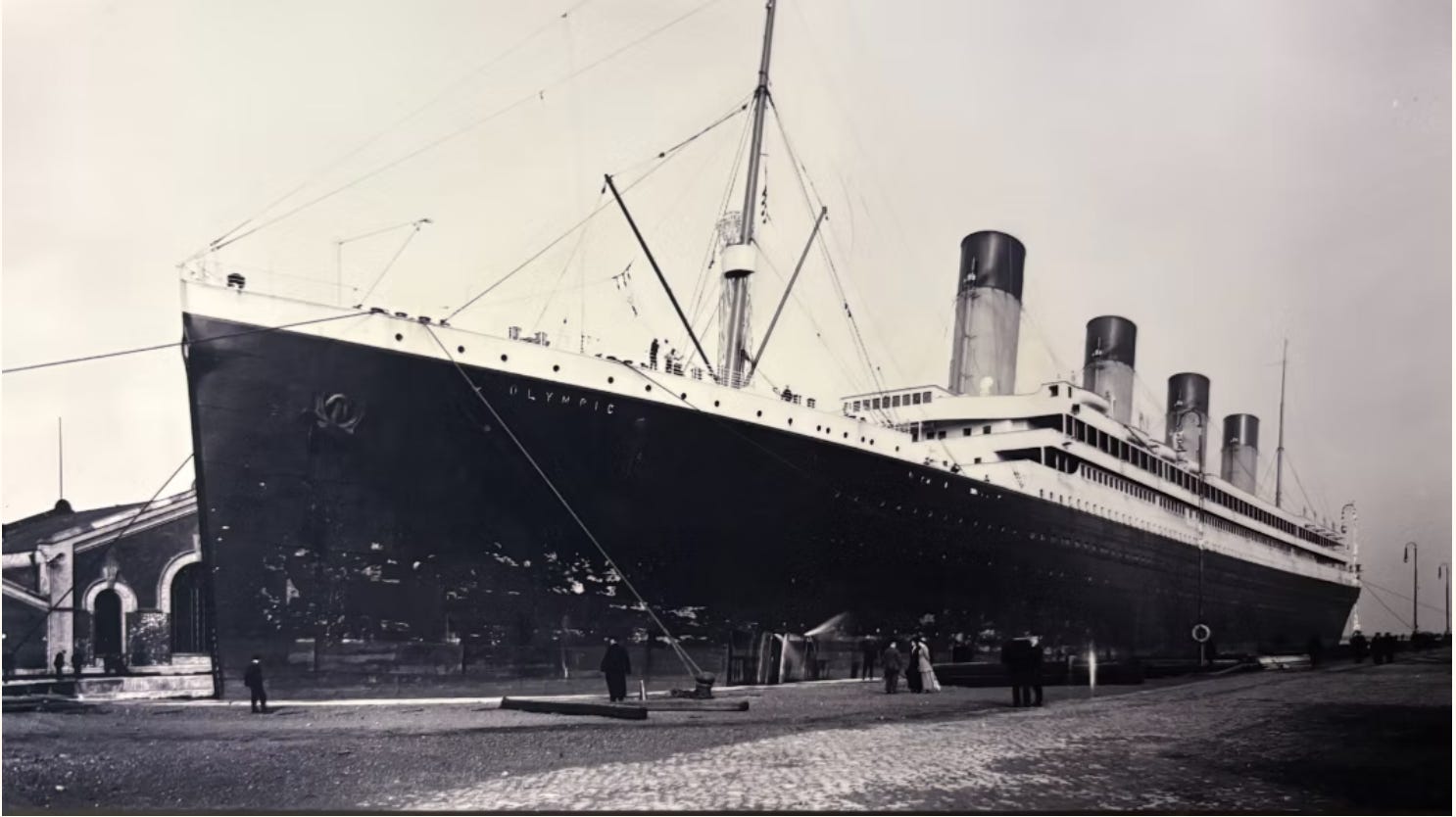
The two sister ships, Olympic and Titanic, were born in the shipyards of Belfast, built side by side in a world that believed deeply in progress, craftsmanship, and unshakable confidence. They represented the highest expression of early-twentieth-century ambition. One would sail for decades, beloved and reliable. The other would sail only once, becoming immortal in tragedy. Together, their intertwined stories remain among the most haunting and compelling chapters in maritime history.
Before Titanic became a legend, she was part of a vision. The White Star Line’s Olympic-class trio—Olympic, Titanic, and later Britannic—was conceived as an answer to the demands of a new era of transatlantic travel. The goal was not speed, but luxury and scale: ships so grand and comfortable that crossing the ocean would feel effortless. Harland & Wolff, under the design leadership of naval architect Thomas Andrews, translated that dream into steel, strength, and grace. In the Belfast shipyards, this vision took shape, one rivet at a time.
The Olympic was the first of the sisters to rise from the slipways of Belfast. Launched in 1911, she debuted as the largest and most luxurious ship at sea—a floating palace of polished oak, grand staircases, and sweeping promenade decks. For nearly a year before her younger sister ever set sail, Olympic was the one drawing crowds at every port. When she docked in New York on her maiden voyage, over 8,000 visitors came aboard to see her for themselves.
Titanic followed closely behind. Launched just ten months later, she incorporated subtle refinements: slightly larger dimensions, updated interiors, and enhanced passenger spaces. Her lines were elegant, her cabins opulent, and her public rooms unmatched in grandeur. On April 10, 1912, she set out on her maiden voyage with a sense of optimism and excitement. Five days later, she struck an iceberg in the North Atlantic, and by the early hours of April 15, she was gone. Her loss, and the 1,512 souls who perished with her, created shockwaves that reshaped maritime safety forever. Titanic became a story of heartbreak, courage, and profound human loss.
Olympic, meanwhile, lived an extraordinary life. During the First World War, she was requisitioned as a troopship and earned the nickname “Old Reliable.” Painted in dazzling camouflage, she carried thousands of soldiers across the Atlantic, survived multiple attacks, and famously rammed and sank a German U-boat in 1918. After the war, Olympic returned to commercial service and sailed for nearly twenty-five years. Where Titanic’s story ended almost as soon as it began, Olympic’s became one of endurance, courage, and quiet heroism.
Though built side by side, the trajectories of the sisters could not have been more different. Olympic’s life was defined by service and survival—through peace and war—while Titanic’s became a single night that changed the world.
While writing this chapter, it was important to me to give the Olympic her moment. History has a way of remembering tragedy more than triumph, and so it’s Titanic who lives on in our collective memory while Olympic has quietly faded into the background. But for almost one full year before her younger sister ever set sail, Olympic was the pride of the White Star Line, the ship everyone wanted to sail on.
What do you think—does Olympic deserve more recognition for her own remarkable story, or will she always live in her sister’s shadow? Let me know in the comments.
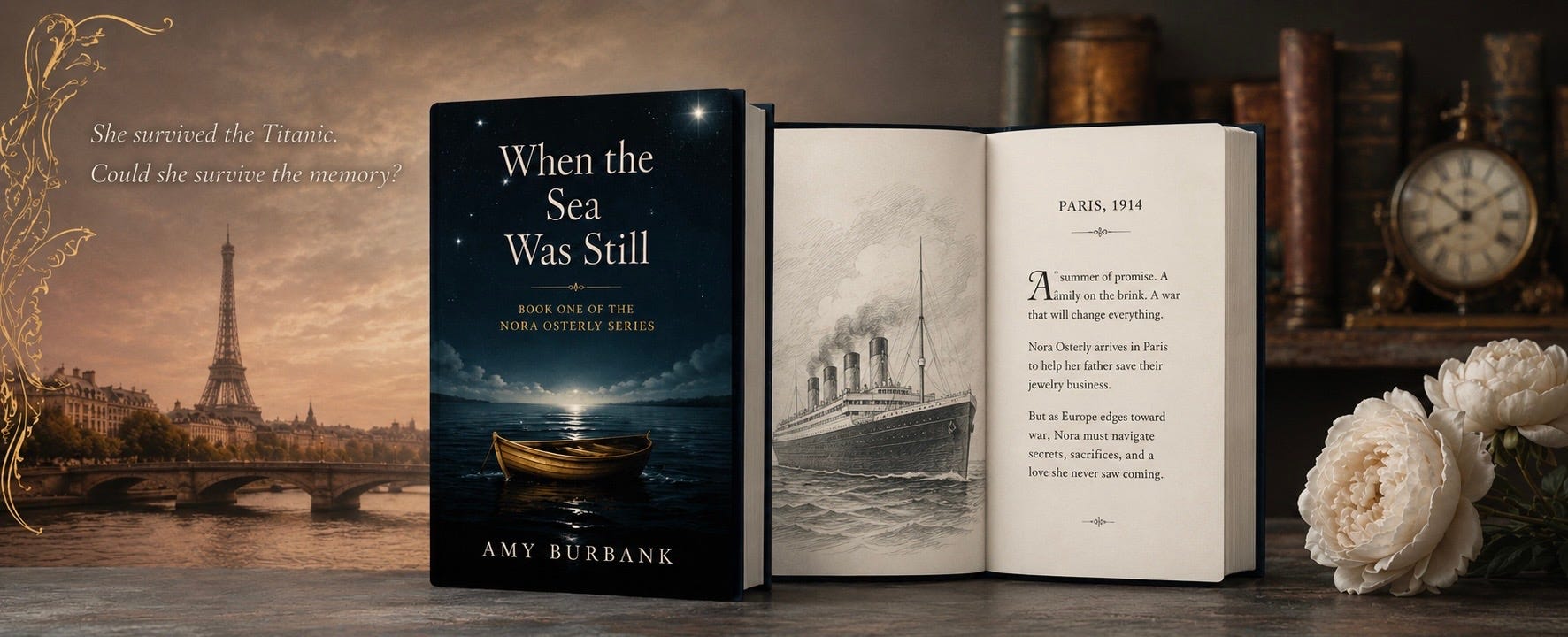
The first chapter was a strong and interesting beginning to the story. It follows Nora, a survivor of the Titanic, as she prepares to take her first sea voyage several years after the disaster. Knowing what she experienced in the past made me curious about how she would handle being on a ship again.
The author did a good job of creating suspense and showing Nora’s emotions. I could imagine the fear, uncertainty, and courage she felt as she faced memories of the Titanic. The chapter grabbed my attention right away and made me want to keep reading.
I liked how the story introduced Nora’s character and hinted at the challenges she may face in the future. The writing was engaging, and the connection to the Titanic made the story even more interesting.
Overall, I thought the first chapter was very good. It was an effective introduction to the main character and the plot, and it left me excited to find out what happens next in the following chapters.