


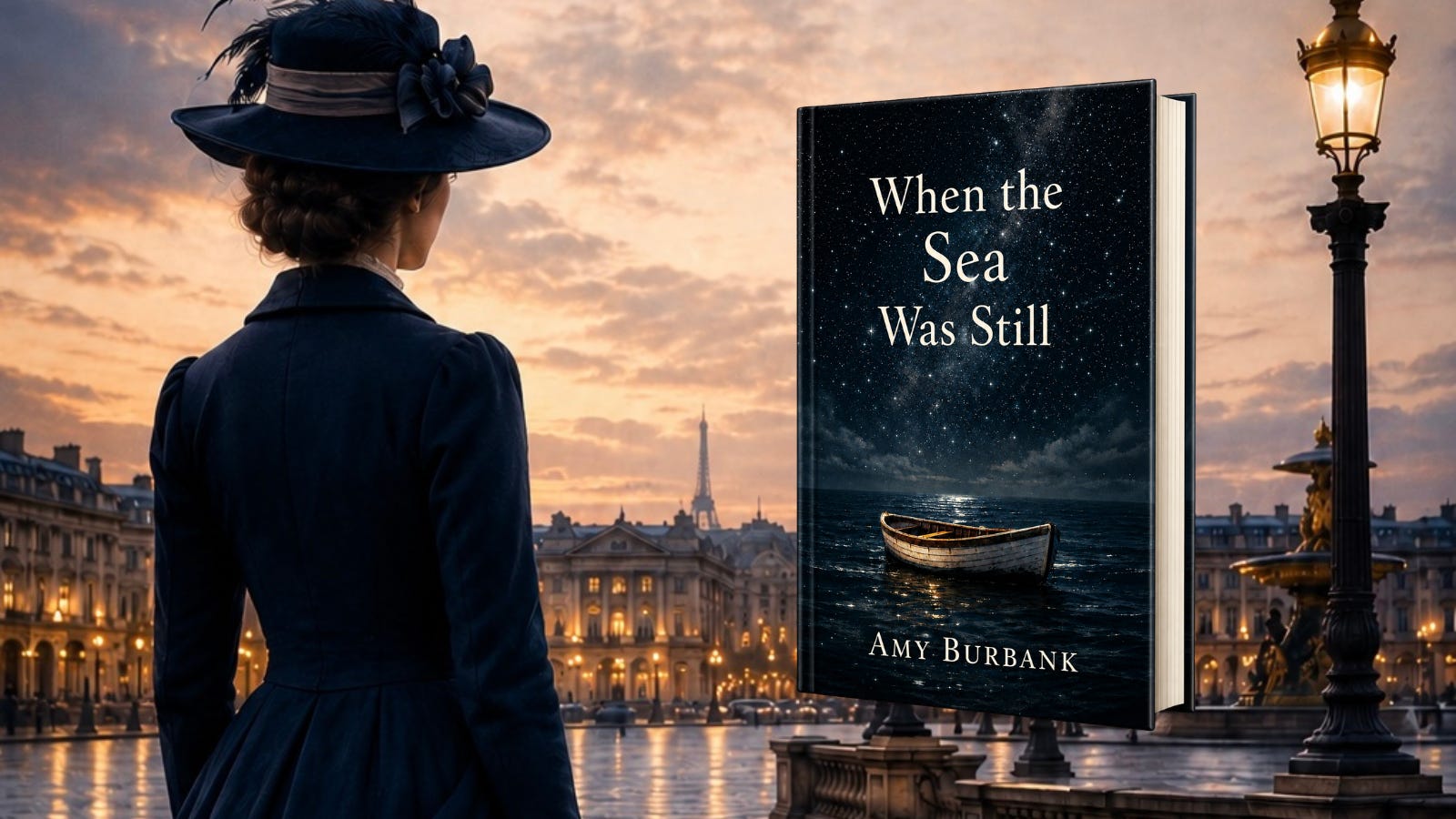
When the Sea Was Still is a historical novel inspired by Titanic survivor Helen Ostby. While the heroine of the story, Nora Osterly, is entirely fictional, her journey draws on the incredible life of Helen Ostby. After surviving the Titanic disaster and losing her father, Helen went on to help run the family jewelry business, Ostby & Barton, which required her to face the sea again for business in Europe. Remarkably, she found herself in Germany on the eve of the First World War.
The novel starts two years after the sinking of the Titanic, when Nora Osterly is forced to cross the Atlantic again—this time aboard Titanic’s nearly identical sister ship, the Olympic. To save her father’s legacy, Nora must do the one thing she swore she never would: return to the sea that nearly killed her.

←Previous Episode | Story Index
Maison Moreau
Anders
June 1911
Paris
The morning sun cast a warm glow over the Hudson as Anders stepped onto Pier 59 with his daughter by his side. It had been three years since their first crossing together, and Nora now carried herself with the confidence of a seasoned traveler. Anders had made a habit of taking her on his annual trip to Paris, still the center of innovation in fine jewelry. They were in pursuit of the precious stones that formed the heart of Osterly & Co.’s most exquisite pieces.
He had booked their passage on the White Star Line’s newest marvel, the RMS Olympic, on her inaugural eastbound voyage. The scene before them was unlike any he had encountered on prior crossings. A full media frenzy engulfed the pier as reporters swarmed to witness the departure of the largest, most advanced ship afloat. A small army of photographers jockeyed for position near the gangway, hoping to catch a glimpse of the first distinguished passengers to board.
Anders had crossed the Atlantic multiple times, but never on a ship this new, this talked about, or this magnificent. The Olympic represented everything he admired—innovation, craftsmanship, forward movement.
Even with all the glowing articles he’d read, nothing had prepared him for the sheer scale of her. The hull dwarfed everything around it, rising higher than the neighboring warehouse rooftops. He found himself thinking—as he often did before a particularly ambitious commission—that some things could only be understood by seeing them.
Nora stood beside him, looking up at the massive ocean liner. “She’s enormous,” she said. “I hear she’s more hotel than ship on the inside.”
Anders raised an eyebrow. “What do you know about her interiors?”
“I’ve been reading the society pages,” she said. “They say first class rivals the Ritz. Did you know she has a Turkish bath? And a swimming pool—on a ship!”
Anders laughed. “I see I’m no longer the only one who prepares for a crossing.”
“I may have done a little research. You taught me well,” Nora said, turning back to the ship. “She’s unlike anything I’ve ever seen, Father.”
“Indeed, she is,” he agreed. “I suspect she will exceed both of our expectations.”
Midway through the voyage, on their way to dinner, Anders took the opportunity to give Nora a lesson in design. The ship itself was a masterpiece worthy of study. Ahead of them, rising through the heart of the ship, stood the Grand Staircase. Its centerpiece, the great clock, framed by the intricate carvings of Honor and Glory, was the subject of his lesson.
“Look closely,” Anders said. “They’re plaster, masterfully painted to appear as oak.”
Nora’s brow furrowed. “Plaster? But it looks carved…”
“True artistry isn’t only what a piece is,” he said. “It’s what it convinces you to believe. White Star Line wanted passengers to experience old-world craftsmanship, even as they sailed on the most modern vessel afloat.”
Nora leaned in, studying the carvings.
“See how the lines of the angel’s robes curve toward the clock?” Anders asked. “Your eye follows them without even realizing it. Everything here is designed with intention.”
“And look at the griffins,” she said. “They’re set just behind the figures—almost hidden.”
Anders paused, following her gaze. “So they are,” he said. “I hadn’t noticed them.”
She glanced at him, a small, pleased smile forming before she turned back to the clock.
“It feels alive,” Nora said. “As if the ship herself has a soul.”
“That is the gift of good design, my dear. It is not meant merely to decorate, but to stir the imagination.”
Later that evening, after Nora had retired to her cabin, Anders stood along the rail of the promenade deck and reflected on how far he’d come since leaving Oslo in 1874. Since then, he had built a life and a reputation he’d scarcely dared to imagine.
After six years at the Royal School of Art, he had apprenticed in a small Oslo workshop where he learned to fine-tune his eye for precision. He came to Providence with a dream and a handful of sketches. His early days were long hours spent repairing watch chains and resizing wedding bands for other jewelers. Within five years, he’d saved $3,000 from his earnings and started Osterly & Co. The modest workshop grew steadily over the years that followed. Soon his jewelry was seen on the necks and fingers of society women across the country. His ambition had carried him across the Atlantic and back again.
Once in Paris, they returned to the Ritz on the Place Vendôme, a place that was beginning to feel like a second home. As was their habit upon arriving in the city, they spent the first few days strolling familiar boulevards, and reacquainting themselves with the rhythm of the city. Paris in June was humming with energy, its cafes full of summer visitors, and the streets alive with vendors.
When the fatigue of travel had lifted, they were ready to begin the work that had brought them across the ocean. Their first appointment took them over the streets of the Right Bank to an atelier on the Île de la Cité. Anders gazed out of the carriage window at the narrow, cobbled lanes winding between old stone buildings. The spires of Notre-Dame Cathedral rose above the surrounding pale façades.
Nora leaned closer to the window. “I am always so fond of this part of Paris,” she said.
“This is where Paris was born. Before the wide boulevards and the uniformity, every house was built one at a time, each with its own character,” Anders replied.
“It feels more intimate,” she said.
It wasn’t long before they arrived at the Quai aux Fleurs, where handsome limestone buildings lined the river, their tall, narrow façades reflected in the green water of the Seine.
“Here we are, Maison Moreau,” Anders said when the carriage came to a stop. As he stepped down, he offered Nora his hand.
The atelier occupied the corner of a six-story building, its dark-painted storefront echoing the iron railings above. In the broad display windows facing the quay, a few pieces of jewelry caught the morning light. Across the river, the towers and sculpted roofline of the grand Hôtel de Ville rose into view.
Inside, the atelier was quiet and cool. A faint scent of metal polish lingered in the air. On display were the shop’s finest pieces: delicate gold filigree combs, enamel pendants in soft pastels, and shimmering opal earrings.
“It’s beautiful,” Nora said. “When you spoke of Maison Moreau, I never imagined anything quite so refined.”
Étienne Moreau stepped out from his office to greet them, impeccably dressed in a well-tailored navy suit with a silk cravat. He looked at Nora, his dark eyes settling on hers, and smiled.
“Bienvenue, Mademoiselle Osterly,” he said, bowing his head. “It is an honor to welcome you at last. I am pleased that you like my atelier.”
Anders watched as Étienne lifted Nora’s gloved hand to his lips. A faint blush rose to her cheeks.
“Bonjour, Monsieur Moreau,” she said. “It is a pleasure to meet you.” She held his gaze a beat longer than necessary before turning to look at the nearest display case.
For the past three years, Anders had been searching for a Parisian atelier worthy of partnership, a house whose artistry matched his own. A collaboration would benefit them both. He would gain the elegance and refinement of Parisian design for his jewels, and his partner would gain access to the flourishing American market.
It wasn’t until he stepped into Maison Moreau for the first time that he knew he’d found the collaborator he had been seeking. Their work was exquisite, bold yet balanced, precisely the sort of artistry he had long hoped to bring to Providence.
“Nora,” Anders said. “Étienne and I have been in discussion for some time about a collaboration between Osterly & Co. and Maison Moreau.”
“A collaboration,” she said. “And what does Maison Moreau gain from Osterly & Co.?”
“All in good time,” Anders said. “First, Étienne has agreed to show you the workshop. I thought you would enjoy watching the craftsmen at work.”
Étienne smiled at Nora. “Would you like to see the workrooms, Mademoiselle Osterly? I think you will find them most instructive.”
“I would like that very much,” Nora said, her tone softening.
Étienne led them through a narrow corridor and into the workrooms beyond. The warm air carried the faint smell of heated metal. Along the benches, artisans bent over their work, tiny flames flickering blue beneath crucibles. The three of them paused near the doorway, watching in silence as the craftsmen worked in steady strokes over the half-finished pieces before them.
Nora’s eye moved along the far wall where the plaster bore a faint line just below the window ledge. “The plaster there,” she said, nodding toward it. “It looks newer than the rest.”
Étienne turned to look. “You have a remarkable eye, Mademoiselle Osterly. Most people would not notice that.”
“Most people are not jewelers,” she said.
“No,” he agreed. “They are not.” He held her gaze for a moment before turning to the wall. “The great flood of last year. The Seine rose nearly to our windowsills. The workrooms were underwater for the better part of a week.”
“How devastating,” Anders said.
“It was,” Étienne said. “We lost several pieces. The benches had to be replaced, the tools dried and cleaned, and the plaster throughout was redone.” He glanced around the room before continuing. “But we restored everything we could.”
“And the business?” Anders asked.
“We are recovering,” Étienne said. “I could not have managed it without my sister. Geneviève kept the atelier running while I oversaw the repairs. She has a remarkable head for the business side of things.”
Nora looked again at the waterline on the wall. “You rebuilt beautifully,” she said. “It would take a careful eye to see what it cost you.”
“Merci, mademoiselle,” he said, and gave her a small smile.
Anders watched his daughter. She had always noticed what others overlooked.
Near the far wall, a fair-haired young man sat beneath the window, carefully securing a row of tiny sapphires into a delicate gold setting. As they approached, he looked up and set aside his tools.
“Henri Lefèvre,” Étienne said. “My closest friend and the finest goldsmith in the atelier.”
Henri wiped his hands on a cloth before offering a polite nod. “Monsieur Osterly. Mademoiselle Osterly.”
“Henri and I studied together at École Boulle,” Étienne said. “I design impossible things, and Henri somehow manages to make them real.”
“Someone must rescue Monsieur Moreau from his own ambitions,” Henri replied.
“It’s a pleasure to meet you, Monsieur,” Nora said. “Your work is exquisite.”
“Have you ever tried setting a stone yourself, Mademoiselle?” Étienne asked. “It requires a steady hand, but I believe you will enjoy it.”
“Then I should like to try, Monsieur Moreau,” Nora said, smiling.
Étienne returned her smile, then reached for a tiny sapphire and placed it on a square of setter’s wax. “First, we gently position the stone. Let the wax hold it.” He handed Nora a small pair of tweezers. “Now, you try.”
Nora leaned in, brow furrowed. She lifted a second stone, trying to hold it steady. It slipped from the tweezers, bouncing off the bench and vanishing onto the floor.
Nora straightened and gave a soft laugh. “That proved more difficult than I expected.”
“It still happens to me from time to time,” he said, then crouched down, scanning the floor.
“I don’t find that particularly comforting,” she replied.
Étienne laughed. He searched the floor some more, then lifted a crate to one side. “There is our runaway sapphire.”
He cleaned the stone with a cloth. “Let’s try again, shall we?”
This time he stood closer to Nora. “Slowly,” he said, guiding her hand gently. “Let the stone settle into its place. Yes, just like that.”
Anders watched as Nora steadied herself. The tweezers hovered over the wax for a moment before she lowered them. The sapphire touched the wax and stayed this time. She looked at it for a moment. Then she looked at Étienne and smiled.
“You have a natural touch, Mademoiselle,” he said.
“Then perhaps there is hope for me yet,” Nora said, smiling at Étienne.
Anders had never seen Nora smile quite like that before.
In the weeks that followed, their time in Paris settled into a comfortable routine. Mornings were devoted to business—meetings with suppliers, the careful selection of fine stones, and a visit to Lalique that left Nora enchanted. Afternoons were spent calling on friends, visiting museums, and lingering in the fragrant Paris gardens.
One afternoon, Anders and Nora made their way through the Luxembourg Gardens, following the gravel paths between the rows of chestnut trees. The gardens were in full summer color, with beds of red roses, yellow dahlias, and white begonias arranged in geometric patterns. Nora walked beside him, holding her parasol to shade her from the summer sun.
“What draws you to a Paris collaboration, Father?” she asked after a while.
He smiled at the question. She had always been curious, seeking to understand rather than to challenge. It was one of the many reasons he trusted her with more than she realized.
“Paris leads the world in design,” he said. “If we want the company to become the finest it can be, we must stand with those who are shaping the future of the craft. Maison Moreau offers that.”
Nora was quiet for a moment. “And you believe it will make a great difference for Osterly & Co.?”
“Yes, I do,” he replied. “Not just what it will bring us now, but what it will mean in the years to come.”
He said nothing of the loan he had taken to secure this opportunity. The sum was significant, though manageable. It would take three years to repay. But Anders had done the calculations again and again, each time arriving at the same conclusion: the risk was worth it.
They walked on in silence for a moment, gravel crunching softly beneath their feet.
“And Étienne?” she asked. “Do you trust him?”
“Yes,” Anders said. “He is ambitious, but not reckless. Talented, but not prideful.”
“I liked his atelier,” she said. “I’ve never seen anything quite like the work being done on the lily brooch.”
“That is what craft looks like when it is loved rather than merely practiced,” Anders said.
Nora took his hand as they turned back along the path.
Anders squeezed it. “One day, Osterly & Co. will be yours to guide. Until then, I will do what I can to strengthen it.”
As summer wore on, they found themselves at Clara’s more and more often. Anders never hesitated to accept her invitations to tea, and the most recent was no exception. The following afternoon, their carriage crossed the Pont Royal on the way to the elegant streets of the 7th arrondissement, where Clara had made her home.
Inside Clara’s townhouse, they sat in her drawing room, a perfect reflection of her impeccable taste. Two Barbizon landscapes in gilded frames hung above a white marble mantelpiece. A silk-covered settee and two fauteuils were arranged around a low table, with a Persian rug in faded pastels underfoot. The windows were open just enough to let in a light breeze from the private garden below.
A maid set the tea tray on the table and withdrew as quietly as she had come. Clara poured tea into three painted porcelain cups with easy grace. Then she set the teapot down and turned her attention to Anders and Nora.
“Now,” she said, passing the sugar to Nora, “have you heard what has happened at the Louvre this week?”
“Da Vinci’s portrait. It is the only thing anyone is talking about.” Nora spooned two lumps of sugar into her tea. “Imagine, stealing a painting from the Louvre. I confess I find myself more impressed than I should be.”
Anders laughed, shaking his head as he reached for a biscuit. “Some people believe it was an inside job. Others say foreign agents,” he said. “And now they are questioning artists.”
“Even Picasso,” Clara said.
Anders had heard the name Picasso before, one of the young radicals challenging the old artistic order. He could not imagine what a modern painter would want with a Renaissance portrait, but Paris had always been a city of contradictions. Boldness and folly often traveled side by side here.
“I’ve seen some of his paintings,” Nora said. “I’m still deciding what I think of them.”
“Apparently Picasso used to keep company with a man connected to stolen antiquities,” Clara said.
Nora set down her cup. “Whatever the truth, I do hope they recover the painting soon,” she said. “The Mona Lisa is one of Leonardo’s masterpieces.”
“I quite agree,” Clara said. “Paris does not like to be without its treasures.”
As the afternoon wore on, Anders found himself watching his daughter more than he listened to the conversation around him. Nora sat across from Clara, her cup forgotten in her hand. He had not told her about the loan. There was no need to trouble her with those details. She had already shouldered more loss than most girls her age. He wanted her future to rest on something steadier, something he had built and secured long before she ever needed to think of it.
The Paris collaboration would ensure that. It would give Osterly & Co. the prestige and reach to sustain it for decades, and allow Nora to live a life worthy of her talents, without the pressure of managing the business. If something were to happen to him, she would not have to marry for security, nor remain in Providence out of necessity.
He had never been more certain of a decision.
Thanks for sharing this. I love when historical fiction is rooted in real lives because it makes history feel much more personal. The idea of someone surviving the Titanic only to willingly cross the Atlantic again, and on the Olympic no less, is such a compelling premise. Looking forward to seeing where Nora’s journey leads. Wishing you lots of success with the series! 📚😊