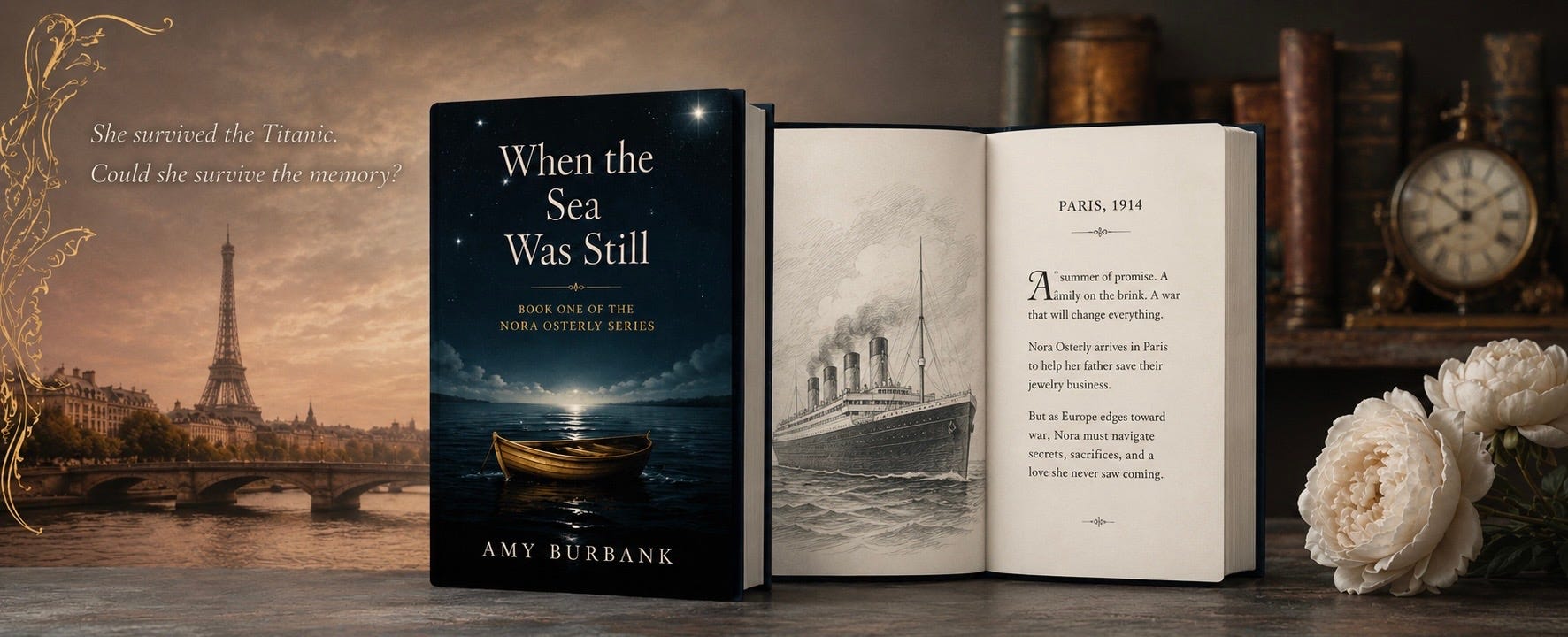

When the Sea Was Still is a historical novel inspired by Titanic survivor Helen Ostby. While the heroine of the story, Nora Osterly, is entirely fictional, her journey draws on the incredible life of Helen Ostby. After surviving the Titanic disaster and losing her father, Helen went on to help run the family jewelry business, Ostby & Barton, which required her to face the sea again for business in Europe. Remarkably, she found herself in Germany on the eve of the First World War.
The novel starts two years after the sinking of the Titanic, when Nora Osterly is forced to cross the Atlantic again—this time aboard Titanic’s nearly identical sister ship, the Olympic. To save her father’s legacy, Nora must do the one thing she swore she never would: return to the sea that nearly killed her.

←Previous Episode | Story Index
A Sorrow in the Air
Nora
June 1914
Onboard the Olympic
By the middle of the voyage, life at sea had taken on a gentle routine. Each morning, Nora and Astrid descended the grand staircase to the first-class dining saloon, where the warm scent of fresh rolls and strong coffee welcomed them. After breakfast, Astrid would join the Harroways for their walk along the promenade, while Nora retreated to the first-class lounge to work on her sketches. It was a pattern they had fallen into without much discussion.
They were seated one morning at their usual table by the window. Their waiter arrived promptly with a steaming cup of coffee for Nora and a pot of tea for Astrid. Nora wrapped her hands around the warm cup, letting the heat soothe her. She sipped slowly, her thoughts drifting to the restless night before, haunted once again by dreams of the past. Last night had been even worse than the others, though she could not have said why.
Astrid watched her closely. “You didn’t sleep.”
Nora hesitated. She turned her cup in her hands and looked out at the water. “Being on a ship again is harder than I had prepared myself for,” she said at last.
Astrid’s expression softened. She laid a hand gently on Nora’s. “I feared as much when we booked passage. But your mind was made up.”
Nora took a small sip of coffee, then set her cup down more forcefully than she intended. “Because what he built cannot end with him,” she said. “The company letterhead bears my name now. I cannot conduct its business, such as it is, from Providence,”
Astrid gave her a small smile. “You are your father’s daughter. He never did shrink from what needed doing, and neither do you.”
“You are kind to say so.” Nora looked down at her cup. “Some mornings I still expect to see him at the table.”
Astrid squeezed her hand. “He is with you still, my dear. In all that you do,” she said. “You are stronger than you know. He would tell you the same.”
Nora met Astrid’s gaze and returned the squeeze. “I do not know what I should do without you, Astrid.”
Astrid gave an approving nod just as the waiter returned with their breakfast. “Now. Let us eat, before the rolls grow cold.”
“Yes, let’s,” Nora said, and she reached for a roll.
After breakfast, they left the dining saloon together, ascending the great staircase at a leisurely pace. The morning light filtered through the dome above, bathing the carved cherub in gold, giving it an almost celestial quality. Around them, the ship was alive with first-class passengers drifting between the decks, engrossed in society gossip.
When they reached the A-Deck landing where they usually parted, Nora automatically turned toward the first-class lounge. Her routine, masquerading as safety, waited there for her. She had already taken two steps when Astrid’s voice stopped her.
“Nora.”
Nora turned back. “Yes?”
“You could join us today, if only for a few turns” she said. “I would be beside you the whole way.”
Nora glanced toward the promenade doors. Her breath caught. The deck outside. The open sea. The place she had avoided since stepping aboard.
“Astrid…” She hesitated. “I do not know if I can.”
Astrid touched her arm lightly. “You have faced harder than this.”
Nora looked through the glass doors, at the vast ocean beyond. She wanted to retreat to the relative safety of the lounge, where the sea could be kept at a distance. But then she thought of her father.
She drew a breath.
“Very well,” she whispered. “I shall try.”
Astrid smiled. “Good.”
They stepped through the doors together. The Atlantic stretched out endlessly beneath the morning sun, with no land in sight. The sea was remarkably still. The only movement Nora felt was the beating of her heart.
Josie Harroway spotted them at once. “Nora! What a delightful surprise,” she said. “I’m so glad you’ll be joining us for our constitutional this morning.”
Mr. Harroway offered a polite nod. “A fine morning for it,” he said.
Nora walked alongside Astrid as they fell into step beside the couple. The wide wooden promenade stretched ahead of them, open to the sea. Nora could feel the wind on her face for the first time since boarding. A few passengers with books were settled in a row of deck chairs. Nora kept her gaze fixed straight ahead, her gloved hand gliding along the teak rail for support.
Mrs. Harroway chatted easily as they walked. “We’ve quite fallen into a routine this week,” she said. “A turn around the deck, a stop by the library, then perhaps a game of bridge if it suits us.”
Nora nodded, then looked out at the clear sweep of unbroken ocean. The morning light glittered on the surface—too bright, too calm. Her pulse quickened.
Mrs. Harroway softened her tone. “You are doing very well, my dear. The first step is the hardest.”
“Thank you. It’s beginning to grow easier,” Nora replied.
As they continued on, the conversation shifted to lighter topics. Discussions of luncheon menus and a charming pianist they’d heard the previous evening made their stroll more pleasant.
Up ahead Nora noticed Bridie O’Sullivan adjusting the canvas back of a deck chair. Her presence was a small comfort. Bridie was the only person Nora knew who truly understood what that night had cost.
She slowed her steps.
“Astrid,” she said, “go on with the Harroways. I’ll join you again shortly.”
Astrid followed her gaze and nodded. “Of course.”
Mrs. Harroway gave an encouraging smile. “Take your time, dear. We shall be just ahead.”
Nora nodded before moving forward, the sound of the trio’s conversation fading as she walked toward Bridie.
As Nora drew closer, Bridie looked up and saw her. “Good morning, Miss Osterly.”
“Good morning, Bridie,” Nora said. “Preparing Mrs. Harroway’s chair?”
“Yes. She likes the sun on this side in the mornings. Says it keeps the chill out of her bones.” Bridie hesitated a moment, then added, “It’s calmer today.”
They both glanced out toward the sea.
Bridie was the eldest of five, originally from Queenstown, Ireland, her story mirrored that of many young Irish women who took work at sea out of necessity. When her father died, she had been only sixteen, yet the responsibility of providing for her mother and younger siblings had fallen squarely on her shoulders. Now twenty-seven, her burden had eased as her brothers were finally old enough to help support the family. She seemed grateful to have traded life at sea for her position with Mrs. Harroway, though Nora knew she still sent money home to Ireland, and likely always would.
Bridie spoke first. “It was in the night,” she said. “We passed the place.”
Nora nodded. “I woke,” she said. “I didn’t understand why.”
“You feel it before you know it. Something in the air changes.” Bridie said.
Nora released a slow breath. “It’s where she sank.”
“Aye,” Bridie whispered. “There’s a sorrow in the air. Anyone who lived through that night can feel it.”
Nora wrapped her hands together. “It felt… so cold. I had to put on another blanket.”
Bridie placed her hand on Nora’s arm. “Once you’ve lived through it, you never forget. No matter how many crossings come after.”
Nora shivered as a heavy silence settled between them, a quiet acknowledgment of the place they had passed and the lives lost beneath it.
Bridie offered a small, steady smile. “Mrs. Harroway will be along shortly. I’ll have her chair ready. If you need anything, Miss Osterly.”
“Thank you, Bridie,” Nora said. “It helps… knowing someone else understands.”
That afternoon, Nora made her way to the first-class lounge to catch up on her letters. She was beginning to feel more at ease in the lounge, which somehow grew both more and less familiar each time she entered it. She chose a small walnut writing table near the tall promenade windows, then reached for her stationery and began her letter to Clara.
My dearest Clara,
I write to you this afternoon from the quiet of the Olympic’s first-class lounge. The room has that familiar elegance these great liners share. I imagine you know this better than anyone, having crossed the Atlantic more times than I can count. I envy your fearless love of travel.
Life aboard the ship has been pleasant enough. The weather has been fine these first few days. The passengers are an interesting mix, some lively, some reserved, all keen to discuss the summer season in Europe.
The voyage itself has been a trying experience. Traveling without Father feels so strange. Being at sea again has stirred more feelings than I expected. The familiar sounds that I once found comforting now carry memories I find hard to face. I tell myself it grows a little easier each day.
There is also the matter of the business I must attend to while in Paris. I confess it weighs heavily on me. I find myself grateful that you will be nearby for counsel. You have always known how to help me see clearly when I cannot.
I am pleased to tell you that Astrid and I will arrive in Paris as planned. I look forward to our long walks and hearing about your latest projects. Until then, know that I think of you with deep affection, dear friend.
Yours ever,
Nora
Clara had come into her life when Nora was fifteen, not long after her mother’s death had left an emptiness in the house that her father, for all his devotion, could not fill. Her father had introduced them one afternoon after a small lecture Clara had given at Brown. At the time, Clara had been in her early thirties, already known in Providence society for her travel essays. Nora had come to respect Clara as a woman who valued intellect over social climbing. She lent Nora books, took her to exhibitions, and treated her as an equal. Over the years, what began as mentorship had blossomed into true friendship.
After reading through the letter to Clara once more, Nora folded the page with care and slipped it into an envelope. Once sealed and addressed, her thoughts drifted to another letter, the one she had received from Etienne two months ago, prompting her to book passage on the Olympic.
Nora thought back to three years ago, in Paris, when her father brought her to Etienne’s atelier on the Île de la Cité. She could still picture standing beside her father inside Maison Moreau, seeing Étienne for the first time. He had stepped out of his office to greet them, handsome in his navy suit. He had smiled at her, one corner of his mouth lifting higher than the other, and something in that asymmetric smile had disarmed her before he said a word. She had not expected that.
At first, she had been skeptical of a partnership with a house so far from Providence. But as Étienne led them through the workshop, his exquisite work spoke for itself. He was assured without being arrogant, attentive in a way that felt genuine. His patience when he’d shown her how to set a stone had left an impression on her. By the time they left Paris, Nora was entirely confident in her father’s judgement. Together, their houses had created a luxury line that rivaled Cartier, pieces that quickly found favor with distinguished clients from New York to London.
After the loss of her father, Étienne had been so kind and understanding. His letters arrived with the regularity of a trusted friend—discussions of design sketches and stone settings, stories from his bustling workshop, gentle encouragement whenever she sent him a new idea. Through their correspondence, they had formed a friendship that extended beyond the business, built on mutual respect and a shared devotion to craftsmanship. She had come to look forward to his letters. They were one of the few things that had made the months after her father’s death bearable.
But in April, his letter had held a message she wasn’t prepared for. She had opened it expecting another discussion of gemstones or a request for her thoughts on a new design. Instead, she had found words that made her sit down at once, her head spinning.
She had read the letter at least a dozen times, hoping each time she had misunderstood. But she never had.
She unfolded it again now.
Ma chère Mademoiselle Osterly,
I trust this letter finds you in good health and enjoying the first pleasant days of spring in Providence. Paris, too, has begun to warm, though the air carries a faint unease that no one speaks of openly. The atelier is busy with our usual work, and I often find myself thinking of the vision your father and I shared for the future of our houses.
If you will permit me, I must now turn to a matter of importance regarding the partnership your late father and I formed in 1911.
To complete the expansion of the Maison Moreau workshop and launch the new luxury line your father envisioned, it became necessary to secure a loan. The principal of this loan—16,500 francs—is due on the 1st of August.
It was the reason she was facing the sea again.
Nora folded Etienne’s letter and placed it back in its envelope. If her father were still alive, she would have gone straight to him, the very man who had set this problem in motion. The irony settled over her with a familiar ache. He had always tried to shield her from the world’s hardships. She wished he had trusted her enough to tell her.
“Miss Osterly,” came a familiar voice.
She looked up to find Lionel Cartwright, hat in hand, impeccably dressed as usual.
“Mr. Cartwright,” she said. “Good afternoon.”
“I hope I’m not interrupting.”
“Not at all,” she replied. “Are you enjoying this calm day at sea?”
“I am indeed.” He gestured to the chair opposite her. “May I?”
“Of course.”
“It seems we are nearly halfway across,” he said. “The days pass more quickly at sea than one expects.”
“They do,” Nora agreed. “Though I confess, I will be glad to see land again.”
“Paris awaits you, does it not?” he asked with interest. “Business to attend to with your family’s firm, Osterly & Co., if I’m not mistaken.”
“Yes,” she said. “Astrid and I will be staying for several weeks. In addition to business, I have friends I look forward to seeing.”
“Osterly & Co. is a distinguished name,” he said. “I have made a number of inquiries. Your firm has an excellent reputation. I take an interest in firms with strong foundations and room to grow.”
Nora raised an eyebrow. “Are you proposing an investment, Mr. Cartwright?”
“A conversation,” he said. “Nothing more. A business of your caliber, navigating the complexities of a transatlantic partnership, may present opportunities worth exploring together.”
Nora studied him for a moment. She was not crossing an ocean to hand any part of her father’s company to a Wall Street financier, no matter how carefully practiced his manner.
“That is a generous thought,” she said. “However, Osterly & Co. is not seeking outside investment at this time. We are quite capably managing our own affairs.”
“Of course,” he said with a polished smile. “The offer stands, should circumstances change.”
“How kind,” she said. She reached for her pen. “Now if you’ll excuse me, Mr. Cartwright.”
He rose, gave a slight bow, and withdrew.
Nora watched him go. She felt a certain satisfaction in having handled Mr. Cartwright’s forward suggestion cleanly with no hesitation or apology. Her father would have approved.
The quiet of the lounge settled around her. Nora looked out of the tall windows beside her, where the late-afternoon light shimmered across the open sea. The water, still so calm, stretched in an unbroken sweep toward the horizon. She had only seen it that still once before.
That night, too, the sea had been impossibly calm. The air was bitterly cold, cutting straight through the thick layers of her coat and settling deep in her bones. As Lifeboat 5 pulled away from the great sinking ship, an icy breeze pierced the stillness of the night.
Nora watched in disbelief as the lights of the forward portholes began to disappear. It felt like a bad dream. She strained to find her father among the figures on the deck, but the distance had grown too great.
Beside her, Mrs. Morris said, “Look, Nora, I see lights over there. It must be another ship coming to rescue us all.”
Nora felt a surge of hope. “Yes,” she said. “I see it.”
A gasp rose from the boat’s occupants as a distress rocket rose high in the sky, loud and bright against the black night. Nora could see other lifeboats scattered around them. Some were full, while others were half empty. All of their occupants stared at the Titanic in horror.
She watched the ship slowly sink lower into the water, one row of deck lights at a time disappearing below the waves. The realization that they would not be returning to the ship settled over her. Suddenly, they heard the screams of people onboard, as they ran out of escape options.
“Dear God,” Mrs. Morris cried. “Lord save us!”
Nora was at a loss for words. As the ship’s fate became inevitable, her thoughts were only of her father. Surely, he had found another lifeboat. She couldn’t let her mind go to the possibility he was among those trapped on the sinking vessel.
Another rocket lit up the sky.
Then the Titanic began to rise at a terrible angle, her stern lifting into the sky like a wounded beast. Her propellers should not have been visible. Yet, the lights still burned in her upper decks as if she wouldn’t go down without a fight.
The ship stood on end, perpendicular to the flat water. They heard a loud rumbling as her beautiful furnishings and grand interiors tore loose from their moorings and were dumped into the sea. The majestic liner stood there for another minute and then went down like an arrow in a final bow of thundering underwater explosions.
The Queen of the Ocean was no longer there.
As Nora watched the unthinkable happen, she silently wept. Her tears were for the souls who had not found a place in a lifeboat. She prayed her father was not among them. She also cried for the magnificent ship lost to a merciless sea on what should have been her triumphant maiden voyage.
Nora clung to Mrs. Morris on that tiny lifeboat, freezing and afraid.
Officer Pitman, standing at the stern, checked his watch. His voice sounded official when he announced, “It is two twenty.”
Two twenty. The moment the world changed.
And then came the cries. Hundreds of people flailing in the water, screaming for help in a deafening roar as they struggled against the icy cold sea. Nora hadn’t seen anyone in the dark water but the sound of those voices had pierced her in a way she would never forget. It was a noise that would ring in her ears for the rest of her life.
After a few stunned, breathless minutes, Pitman gathered himself and called out to the crewmen at the oars. “Now men, we will pull toward the wreck!”
Yes, Nora thought, of course, they would go back. They had to go back.
But then came the protests. A woman toward the bow cried out, “Why should we all lose our lives in a useless attempt to save others from the ship?”
Nora and Mrs. Morris exchanged a meaningful look, as if unsure whether or not to speak up. Mrs. Morris whispered, “We must row back...for Frank…for your father…for the others!”
Nora wanted to say something. She wanted to shout out her support but the words wouldn’t form. She was frozen in place.
Then another protest rose from the dark boat. Then another, and another.
Nora had looked at Pitman, willing him to row back, her words still stuck in her throat. But as she watched him, she saw his shoulders sag and she knew he had given in to the fear of the boat’s occupants. Slowly, he relented and the oars stilled.
They did not go back.
Nora drew a trembling breath as the cries continued across the dark water. There would be no rescue for them. She shivered, though not from the cold.
“Frank!” Mrs. Morris called out repeatedly.
Nora gripped Mrs. Morris’s hand.
As her friend’s cries subsided, so did those in the sea, and a chilling silence followed. The gravity of the quietness weighed heavily on Nora.
Their lifeboat floated alone in the dark, vast sea. Nora didn’t know if it had saved them, or only delayed their fate.

Lifeboat 5
Welcome to this week’s bonus material! One of the most heartbreaking aspects of the Titanic sinking is that there weren’t enough lifeboats for every soul on board. Even more tragic, many of the first boats to launch left with empty seats. Lifeboat No. 5 was one of them.
Lifeboat No. 5 was the second standard lifeboat lowered from Titanic’s starboard side, leaving the ship at about 12:45 a.m right after lifeboat No. 7. At that point, many passengers still didn’t believe Titanic was in serious danger, which explains why the boat left only partially filled—estimated at 35–40 people, despite having room for about 65.
No. 5 was commanded by 34-year-old Third Officer Herbert Pitman, one of Titanic’s senior officers. First Officer William Murdoch shook Pitman’s hand before he boarded and said, “Goodbye, good luck.” Pitman later realized Murdoch already understood he probably wouldn’t survive.
Before the boat was lowered, Pitman repeatedly called for more women to get in. At this stage of the evacuation, a great deal of people still believed the safest place was Titanic herself. Many women didn’t want to leave their husbands.
When no one came forward, Murdoch allowed a few male passengers to enter the boat. As the lifeboat was lowered, a few more men jumped in, causing the boat to jolt violently and injuring one of the boat’s occupants in the process.
Those aboard Lifeboat No. 5 represented a remarkable range of people, each carrying their own story into that small wooden boat.
One of the boat’s best-known passengers was Karl Howell Behr, an American tennis champion and banker. He was traveling to Europe largely because he was courting Helen Newsom, who was also in Lifeboat No. 5 with her parents. Newspapers later claimed he proposed to her in the lifeboat. Whether that happened that night or shortly afterward is debated, but they did marry less than a year later.
Mrs. Annie Stengel desperately didn’t want to leave without her husband. Eventually she entered Lifeboat No. 5. Her husband survived—but only because he later found space in another boat. They were reunited aboard Carpathia.
Also, among the occupants of the Lifeboat No. 5 were stewardesses Mabel Bennett and Hypatia McLaren. Besides Pitman, the boat carried a small group of crew: Quartermaster Alfred Olliver, Fireman Alfred Shiers, First-class steward Henry Etches, and Assistant boots steward Elgar Guy. These men rowed the boat through the night while trying to calm frightened passengers.
Anna Sophia Warren, Helen Newsom’s step-mother, entered Lifeboat No. 5 believing her husband had climbed in behind her. Sadly, he hadn’t. She didn’t realize until after the boat had been lowered that they had become separated. He died in the disaster. Anna Warren became the inspiration for Nora’s friend, Mrs. Morris.
For readers of When the Sea Was Still, the most significant passenger aboard Lifeboat No. 5 was Helen Ragnhild Østby, the real woman who inspired Nora Osterly. She was a 22-year-old first-class passenger from Providence, Rhode Island, traveling with her father, Engelhart Østby, the founder of the jewelry firm Ostby & Barton. They had been touring Europe and North Africa and were returning home aboard Titanic after learning their friends the Warrens were sailing on it.
As the evacuation began, Helen and her father made their way to the boat deck with the Warren family. Then, in a heartbreaking decision, her father said he was going back to their cabin to retrieve warmer clothing. It was the last time Helen ever saw him.
Pitman—who’d been asleep when Titanic struck the iceberg and was awakened to help with the evacuation—later testified that after Titanic sank, he ordered: “Now men, we will pull toward the wreck.”
According to several accounts, he genuinely intended to row back after the ship disappeared but the passengers protested, fearing desperate swimmers would swamp the lifeboat. Pitman yielded to those fears and they didn’t turn back. That choice haunted him for the rest of his life.
More than a century later, historians still discuss that decision not to turn back because it was an impossible choice those in the lifeboats had to face. It can be easy to vilify their decision but these were ordinary people, terrified, trying to survive a night none of them had been prepared for.
That’s what made writing this week’s episode so difficult. The decision not to turn back was just one more heartbreaking detail on a night full of them.