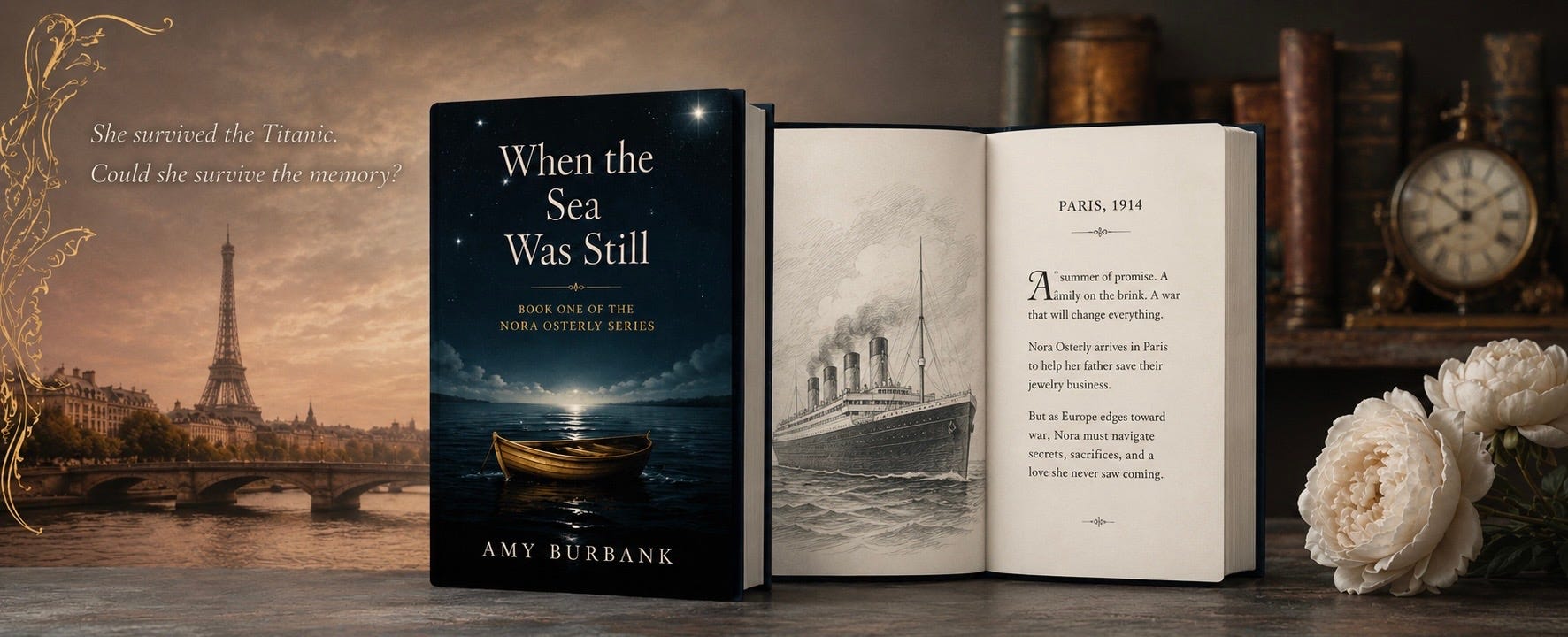

When the Sea Was Still is a historical novel inspired by Titanic survivor Helen Ostby. While the heroine of the story, Nora Osterly, is entirely fictional, her journey draws on the incredible life of Helen Ostby. After surviving the Titanic disaster and losing her father, Helen went on to help run the family jewelry business, Ostby & Barton, which required her to face the sea again for business in Europe. Remarkably, she found herself in Germany on the eve of the First World War.
The novel starts two years after the sinking of the Titanic, when Nora Osterly is forced to cross the Atlantic again—this time aboard Titanic’s nearly identical sister ship, the Olympic. To save her father’s legacy, Nora must do the one thing she swore she never would: return to the sea that nearly killed her.

←Previous Episode | Story Index
Stormy Weather
Nora
June 1914
Onboard the Olympic
Life aboard the Olympic was already in full motion as Nora and Astrid took their morning walk along the promenade deck after breakfast. This time when they had reached the A-Deck landing, Nora had given Astrid a slight nod instead of retreating inside. Now as they strolled along the wide wooden planks, the routine of a first-class sea day unfolded before them like a well-rehearsed dance. The deck chairs were arranged in their precise rows as the stewards moved deftly between them and the murmur of restrained conversations drifted into the sea breeze.
“It looks as though we might have a storm today,” Astrid said, glancing toward the horizon.
Nora followed her gaze. The sea had taken on a deeper color than it had at breakfast and dark clouds hung over the horizon. “Indeed it does. How long do you think before it arrives?”
“By afternoon,” Astrid said. “Perhaps sooner.”
The wind along the rail picked up just enough to tug at the brim of Nora’s hat and seemed to confirm the oncoming storm. Ahead of them, a stewardess stooped to straighten a steamer rug over an elderly gentleman’s knees as he attempted to read his newspaper.
“We’ve enjoyed such nice weather on the crossing so far,” Nora said. “I suppose we were due.”
A pair of children darted past them, giggling, while their nursemaid struggled to keep up, calling after them in vain. Nora laughed as they disappeared around the curve ahead. To be that carefree again was an appealing thought.
“I’ve been thinking about what awaits us in Paris,” Nora said.
“Of course you have, dear,” Astrid replied. “There is still a great deal to be resolved.”
Nora was quiet for a moment, watching the whitecaps begin to gather further out. She had spent the better part of the crossing thinking about Etienne’s letter and the company’s uncertain future it had revealed.
“It is a strange irony,” she said. “We are facing this difficulty because Father partnered with Maison Moreau, yet I’m grateful to have Etienne’s support.”
Astrid gave Nora a knowing look.
“What?” Nora asked. She glanced at Astrid, trying to read her expression, before nodding politely at a few passengers as they passed.
“Nothing, dear,” Astrid said. “I know you respect Mr. Moreau a great deal. That’s all.”
Nora simply nodded. She looked out at the darkening horizon, where the line between the sea and sky had disappeared. “We should go in,” she said. “Before the weather turns.”
By four o’clock that afternoon the storm had arrived. Rain tapped softly against the promenade windows of the first-class lounge. The room was more crowded than usual with passengers who had abandoned the decks as the weather worsened outside. Mrs. Harroway and Mrs. Cartwright were already seated at an elegantly set table with fresh flowers at its center, their bright colors adding a cheerful note.
“I’m relieved to see you feeling better this afternoon, Mrs. Cartwright,” Nora said, sitting next to Astrid.
“I refused to spend another afternoon confined to my cabin while the rest of you enjoyed tea without me,” Mrs. Cartwright replied.
The steward arrived with his polished silver teapot. He filled each of their ivory cups, delicately decorated with the White Star Line pennant and rimmed in gold.
“Now,” Mrs. Harroway said, “tell me you are planning to visit the couture houses while you’re in Paris, Mrs. Cartwright. I shall be devastated if you intend to spend the entire summer in business meetings with Mr. Cartwright.”
“I imagine there will be time for both,” Mrs. Cartwright said, reaching for one of the delicate pastries arranged on the tiered stand in the middle of the table.
“I do hope Paris has not entirely abandoned elegance by the time we arrive,” Astrid said. “The fashions become stranger every season.”
“You dislike the newer styles?” Mrs. Harroway asked.
“I dislike looking as though I’ve been poured into my gown,” Astrid replied. “These narrow skirts make perfectly graceful women walk like penguins.”
Nora hid her smile behind her teacup, while Mrs. Cartwright chuckled softly across from her. Astrid, unbothered, simply spread more butter on her tea cake, as though she’d said nothing worth remarking on.
“And yet every lady in New York insists upon them,” Mrs. Harroway pointed out.
“That is because Paris understands beauty better than the rest of us,” Nora said. “Though I admit some designers push too far.”
A steward paused at their table, refilling their cups with practiced grace, the pleasant aroma of tea drifting upward. As he withdrew with a slight bow, a small orchestra began to play a waltz across the lounge.
“I confess,” Mrs. Cartwright said, “I admire the newer Parisian styles.”
“No need to confess, dear,” Mrs. Harroway said with a smile. “A lady may certainly have her own taste.”
Mrs. Cartwright touched the brim of her hat self-consciously, an elaborate confection of ostrich plumes and silk roses. It was as though it couldn’t settle on which hat it meant to be.
“I quite agree,” Nora said. “I’ve always thought the most poorly dressed woman in the room is the one too afraid to please herself.”
“Quite right,” Mrs. Harroway said. “What other plans do you have while you’re in Paris?”
“I had thought to spend time with my brother. He was living in Paris…” Mrs. Cartwright began.
“Was?” Nora asked.
“He went home to Germany.” A shadow crossed her face. “I received his letter right before we boarded. It was a surprise.”
“How mysterious,” Astrid said.
“Yes,” Mrs. Cartwright agreed, then looked down at her teacup before taking a sip.
Beyond the promenade windows, the rain beat harder against the glass. The lounge gave a faint shudder as the Olympic cut through another swell.
Nora set down her cup and turned to Mrs. Harroway. “Where is Mr. Harroway this afternoon?”
“Reading in the smoking room,” Mrs. Harroway replied with a wave of her hand. “He’s become dreadfully serious all of a sudden, reading The Times and muttering about European diplomacy as if he’s a member of Parliament.”
“There seems to be much talk of it aboard,” Astrid said.
“It is difficult to escape,” Nora said. “The newspapers seem to carry a new headline each day.”
“Let us hope they remain only headlines,” Mrs. Harroway replied.
A brief silence settled over the table. Around them, the lounge had begun to clear as passengers finished their afternoon ritual. Stewards moved between the tables collecting dishes while the storm continued to intensify.
Astrid reached for her gloves. “Shall we go up?”
Nora looked out at the churning gray sea. “You go ahead,” she said. “I think I’ll take a few minutes on the promenade first.”
Astrid raised her eyebrows. “In this weather?”
“It’s enclosed,” Nora said. “I won’t get wet.”
Mrs. Harroway rose, smoothing her skirt. “Sometimes a person needs to watch a storm rather than hide from it.” She touched Nora’s arm. “Don’t stay too long, dear.”
“I won’t,” Nora said.
She watched Astrid, Mrs. Cartwright, and Mrs. Harroway leave together, chatting as they walked toward the corridor. Nora turned back to the windows, where the rain continued to streak steadily against the glass.
She reached for her wrap and stood.
The sheltered corridor of the B-Deck promenade stretched between the two grand staircases, its large glass panels overlooking the raging Atlantic. Above, the boat deck provided cover from the rain. The space was nearly empty. A lone steward moved along the promenade securing deck chairs against the weather. He gave Nora a polite nod when he noticed her.
She moved to the glass and rested her hands lightly on the rail.
The storm had an honest quality to it she hadn’t expected. The sea made no effort to appear anything other than what it was: vast, indifferent, and without mercy. Out here, behind the glass, she could look at it in a way she hadn’t been able to manage in the open air. The panels held the weather—and the ocean—at a distance just sufficient to make it bearable.
There was violence in the storm’s movement, wind tearing across the surface of the sea, waves battering against the hull, the crack of thunder from above. White crests rose and fell in rapid succession, each one erasing the last. The Olympic groaned beneath Nora’s feet, riding the swells, steady and deliberate, as though she had long since made her peace with the Atlantic’s moods.
But the storm didn’t unsettle Nora as much as it would have when she boarded. In its chaos, she felt a strange sort of permission to be restless. The weather, at least, made no pretense of calm. She had spent five days maintaining the composed appearance expected of her at breakfast, at dinner, on the promenade. Here, with the storm swirling all around her and no one watching, she could let herself feel the immense weight of it all.
She stood at the glass watching the storm tear through the Atlantic. She remembered staring across another angry sea two years earlier as the Carpathia carried her back to New York without her father. It had seemed impossible then that they could leave together and not return together. Yet that was exactly what had happened.
As she gazed into the dark horizon now, she thought of the last hope she’d had of seeing him alive.
After Titanic sank, they had drifted for hours. Mrs. Morris had barely spoken a word and Nora likewise was silent, her senses dulled by the shock of the night. Neither of them knew what might happen next or if the sun would ever rise again.
After the calm of the night, the winds started to pick up, sending a shiver through Nora’s already freezing body.
A distant green rocket soared high in the sky.
An occupant in the boat yelled out, “A rocket! They’re looking for us!”
Mrs. Morris finally spoke, “We’re saved. Nora, we’re saved.”
“It seems we are,” The words came out rough and barely audible.
Around her, people who had sat in frozen silence for hours began to stir. A woman near the bow was weeping. One of the crewmen at the oars pulled harder on them.
Nora looked out across the dark sea but could see nothing. Then, at last, a dim light appeared in the distance. As she watched, it slowly grew brighter. A palpable shift passed through the lifeboat. Mrs. Morris, Nora, and all the others weren’t just relieved for themselves. Every one of them believed that once the approaching ship brought them aboard, they would be reunited with their loved ones and could start to put the horror of night behind them.
One of the men yelled, “Row men, she’s stopped because of the ice. We need to row to her.”
As the men took turns at the oars, they rowed for what must have been an hour. In that time, the ship grew from a faint outline into a wall of steel rising out of the sea, her portholes casting warm gold reflections on the water below. Once they were close enough to the ship, Nora could make out the name on the hull.
The Carpathia.
They were saved. The ship had come. They would live. And somewhere out there in the other lifeboats, others had survived too. Her father was among them, she was certain. He had to be.
Faint streaks of dawn lit the horizon as they drew alongside the Carpathia. Nora could see other lifeboats scattered about, rowing toward the ship. Then she saw a cruelly beautiful display that stopped her cold. Icebergs were all around them, white castles of light reflecting the brilliant morning colors.
She looked away from the ice and focused on the ship. The Carpathia was equipped for rescue. Occupants from the lifeboats ahead of them climbed the rope ladder hanging from the side of the ship to safety. Those too weak to climb were hauled up in a seat rigged from rope.
Once aboard, the crew had been kind, wrapping blankets around their shoulders, giving them mugs of hot coffee and tea. She drank mechanically, barely tasting the strong coffee, before leaving Mrs. Morris to rest. She returned to the deck to look for her father.
She stood at the rail as the lifeboats came in, one after the other. She watched the fourth boat come in. Then the fifth. Then the sixth. But each boat held only strangers. Strangers with a stunned gaze that mirrored her own. Strangers who wept into their blankets as they stumbled past her.
It was the saddest gathering of people Nora had ever witnessed. One by one, mothers, daughters, and wives lost hope of being reunited with their loved ones. Mrs. Morris eventually found her on deck, her cheeks streaked with tears.
“He’s not here,” she choked. “My Frank isn’t here.”
“Watch with me.” Nora reached for her hand. “There are more lifeboats to come.”
But the last lifeboat arrived and her father wasn’t on it. Neither was Frank. The lifeboats were all accounted for. The two women went back inside, speechless.
Rumors spread throughout the ship that other vessels, even the Olympic, were sent to help with the rescue. Hope had kept her going through the long frigid night in the lifeboat. Only the possibility that her father was on board another ship kept her standing now.
The Carpathia’s voyage back had not been kind. Fog pressed in from all sides the following morning, thick and disorienting. The seas were rough the second day, the ship rolling heavily through swells that sent unsecured belongings sliding across cabin floors. On the third night, a thunderstorm broke over the Atlantic—lightning splitting the dark water, rain driving hard against the portholes.
On board she had the unexpected comfort of finding friends from Providence among Carpathia’s passengers—a young couple on their honeymoon who gave over their cabin without hesitation. She lay in their borrowed bunk and listened to the storm, unwilling to think the unthinkable.
By the time they pulled into the New York Harbor on the evening of April 18th, they’d learned that there had been no other rescue ships. Nora was faced with the knowledge that she would not see her father alive again.
She stood on deck in the rain, watching the lights of the city come into focus as they drew closer to Pier 54. There must have been tens of thousands of people waiting on the dock. No one cheered. No one called out. They simply stood there in the dark, watching the Carpathia come in.
Rain soaked through Nora’s clothes as she stood at the rail and let the storm wash over her. Her last thread of hope was gone.

Afternoon Tea Aboard the Olympic
Aboard the RMS Olympic in 1914, afternoon tea was an Edwardian high-society custom. It was an elegant affair of refinement and socialization that took place each day at 4:00 pm in either the Verandah Café or the First-Class Lounge. As first-class passengers Nora, Astrid, Mrs. Harroway, and Mrs. Cartwright gather in the First-Class Lounge each day to take part in this ritual, enjoying tea, delicacies, and each other’s company.
The Ritual
For first-class passengers, afternoon tea was one of the day’s premier social occasions. It was an opportunity to visit with friends, make new acquaintances, exchange travel plans, and enjoy the luxury of life at sea.
The lounge at tea time was overwhelmingly a female domain. Edwardian upper-class women used afternoon tea as their primary theater for shipboard socializing, gossiping, showing off late-afternoon tea gowns, and strengthening social connections.
While men could attend, many skipped it entirely, preferring to spend their late afternoons in the First-Class Smoking Room which was strictly forbidden to women. There, they drank scotch, smoked cigars, talked politics or business, and played high-stakes cards.
The Setting
The First-Class Lounge was the glittering crown jewel of the ship’s social life, an opulent space designed in the Louis Quinze style and heavily inspired by the Palace of Versailles. Open from eight in the morning until eleven at night, it was a place for reading, card games, and conversation as much as afternoon tea.
The lounge was paneled in fine English oak with delicate floral carvings and a white ceiling patterned with intricate musical-themed motifs. Underfoot lay a rich Axminster carpet—the carpet of choice for British royalty and aristocracy since the 1700s, gracing palaces like Windsor Castle. Groups of tables, sofas, and armchairs upholstered in plush green-and-gold floral velvet were scattered throughout the room, offering passengers countless small alcoves for private conversation.
During the afternoon tea service, a small ensemble or solo pianist played a mix of classical pieces and operetta airs for background music that perfectly complemented the occasion.
The Service
White Star Line took great pride in its service, and nowhere was that more evident than in the details of afternoon tea. Stewards in immaculate uniforms moved seamlessly between tables, never letting a cup sit empty. The silver tea service itself—including the teapot, coffee pot, milk jug, and sugar bowl—came from Goldsmiths & Silversmiths of London, a company so highly regarded that it had earned a Royal Warrant as an official supplier to the British royal family.
Tea was poured from the polished silver pots into fine bone china cups, their rims accented in gold and bearing the White Star Line insignia. Fresh flowers decorated the tables, while everything from crisp white linens to the place settings reflected the same precise elegance found at the formal dinner service.
The food served reflected classic British teatime: thin finger sandwiches such as cucumber and watercress, freshly baked scones served with clotted cream and jam, and an assortment of French pastries and petits fours. Passengers typically drank bold English and Irish tea blends, alongside coffee and other refreshments.
The Fashion
In 1914, the First-Class Lounge would have been a showcase of Edwardian fashion, which was at a fascinating turning point in history. High society was transitioning out of the rigid, hyper-restrictive corsets of the Victorian era and moving toward the more fluid, avant-garde styles of the late Edwardian period—heavily influenced by the French designer Paul Poiret.
Afternoon tea was as much an opportunity to see and be seen as it was to enjoy a cup of tea. Ladies changed into elegant afternoon tea gowns in “daylight” pastels such as lavender, tea-rose pink, and dove gray often finished in cream or ivory. Although less formal than evening dress, they were every bit as fashionable, layered in fabrics such as delicate chiffon, soft silk crepe, satin, and fine Brussels lace. These gowns featured graceful lines, delicate embroidery, and flowing skirts that reflected the refined elegance of the Edwardian era.
Unlike dinner, where women went hatless and wore jewels in their hair, hats were strictly mandatory for afternoon tea. In 1914, hats were reaching their peak of theatrical, oversized extravagance, wide-brimmed and lavishly adorned with silk ribbons, feathers, flowers, and even decorative birds. A lady never wore her hat completely straight. It was pinned securely to her voluminous hair at a dramatic tilt.
Accessories to complete the look included long gloves, pearl necklaces, and delicate parasols. Gloves were removed before sitting down and placed delicately in the lap; eating or drinking with gloves on was a major faux pas.


Bringing History into the Story
At tea, Nora, Astrid, Mrs. Harroway, and Mrs. Cartwright discuss the latest fashions in Paris. This would have been a perfectly natural topic of conversation for first-class passengers aboard the Olympic. Paris was the undisputed fashion capital of the world in 1914, and wealthy American travelers often planned visits to the great couture houses to acquire the newest styles long before they appeared elsewhere.
One of the year’s most talked about fashions was the hobble skirt. Its narrow silhouette restricted a woman’s stride, forcing her to take short, careful steps. Many women found it impractical, a sentiment that Astrid wholeheartedly shared. Practical by nature, she has little patience for fashion that gets in the way of everyday life.
It’s easy to remember history for its great tragedies and turning points, but life is made up of ordinary afternoons like these. Ladies aboard the Olympic gathered over tea to discuss fashion, travel, and the latest gossip. Re-creating those simple moments allows us to glimpse everyday Edwardian life aboard one of the great ocean liners of the early twentieth century, just before the world changed forever.