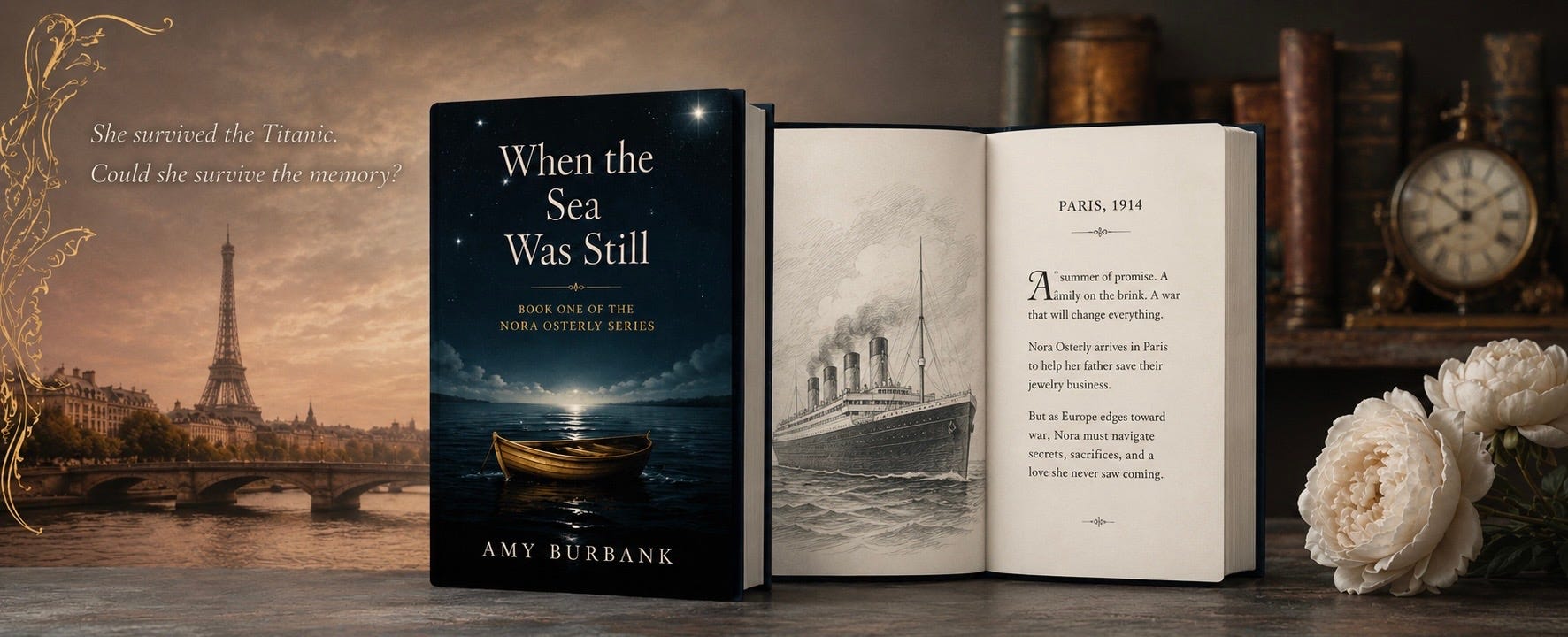

When the Sea Was Still is a historical novel inspired by Titanic survivor Helen Ostby. While the heroine of the story, Nora Osterly, is entirely fictional, her journey draws on the incredible life of Helen Ostby. After surviving the Titanic disaster and losing her father, Helen went on to help run the family jewelry business, Ostby & Barton, which required her to face the sea again for business in Europe. Remarkably, she found herself in Germany on the eve of the First World War.
The novel starts two years after the sinking of the Titanic, when Nora Osterly is forced to cross the Atlantic again—this time aboard Titanic’s nearly identical sister ship, the Olympic. To save her father’s legacy, Nora must do the one thing she swore she never would: return to the sea that nearly killed her.

←Previous Episode | Story Index
A Father’s Gift
Anders
1908
Providence and Paris
On Nora’s eighteenth birthday, Anders sat in his workshop waiting for his daughter to arrive for their usual after-school sketching time. As he waited, he sketched a wedding ring design for a young Providence couple. He had known the bride’s family for years and worked carefully to refine the delicate pattern of ivy that would wind its way along the band.
His pencil scratched against the parchment in quick, deliberate strokes, the same rhythmic sound that had fascinated Nora as a three-year-old. Back then, she would scramble onto his workbench, eager to help. She loved opening the black doctor’s bag he carried home from Europe, marveling at the velvet packets of gemstones tucked inside. She would soon lose interest and beg him for a spare sheet of paper, sketching colorful jewels surrounded by flowers and stars.
What started as play became the foundation of her education in the family business. As the years went on, her sketches grew more refined and she never tired of sitting beside him, pencil in hand, lost in her own creations.
The sound of footsteps in the hall drew him from his reverie. Nora appeared in the doorway, cheeks flushed from the cold, looking suddenly so much taller than she should be.
“Good afternoon, Father,” she said, as she stepped inside.
“Hello, little one.” The nickname slipped out before he could stop it.
She rolled her eyes, though her smile betrayed her. “I’m eighteen today, Father.”
He reached beneath a folded cloth on his bench and lifted a slender velvet case.
“Happy Birthday, my dear. I have something for you.”
Nora took the case from him at once and opened it. Her eyes lit up when she saw what was inside.
“A diamond bar pin,” she said, studying it. “The setting is exquisite.”
“It belonged to your mother,” Anders said. “I had the setting restored for you. She would have wanted you to have it today.”
“Oh, Papa.”
Nora touched the pin, tracing a small circle around the diamonds before lifting it for a closer look.
“Will you help me fasten it, Father?” she asked.
Anders pinned it to the collar of her blouse with careful, steady fingers. He stepped back and looked at her—his daughter, eighteen years old, wearing her mother’s pin—and said nothing for a moment.
“It suits you,” he said finally.
She smiled. “I was just thinking the same thing about your cravat, Father. Though I wouldn’t have chosen that particular shade of grey.”
Anders looked down at his cravat and laughed despite himself.
Now that Nora was eighteen, it was his duty—and his joy—to teach her the trade that had given him his place in the world. She was no longer merely sketching at his side, but was growing into a young woman with an eye for beauty and a mind eager to understand the craft. If she were to inherit his life’s work one day, she needed to see the world outside of Providence.
That was why he had planned her eighteenth-birthday trip so carefully. Their journey would begin with the Grand Tour of Europe, more pleasure than business, but Anders saw it as her first real education beyond his workshop. He wanted her to see the ateliers, the museums, the architecture—not only the art of design, but the world that inspired it.
Before Nora could settle at her place at the workbench, Anders held out an envelope.
“There’s something else,” he said.
She took it from him, turning it over once before opening it. Inside was a folded itinerary. She read it in silence—and then read it again.
“Paris,” she said. “Oslo. London.”
She looked up at him. “Father. Is this my Grand Tour?”
He nodded. “Yes, little one. We depart in June.”
She gave him a light hug, the itinerary still in her hands. “I don’t know what to say.”
“You don’t need to say anything,” Anders replied. “We’ll see the places that shaped the finest design houses in the world. Together, we will make something more of it than mere sightseeing.”
Their Grand Tour of Europe had begun in London, arriving after a calm week aboard the Adriatic—Nora’s first transatlantic crossing. She had been eager to set sail and took to the sea with remarkable ease. Each evening, they strolled the promenade deck before dinner, speaking of the day’s happenings and the latest shipboard gossip. It had been a week of unhurried ease, and there was nowhere he would rather have been, his daughter by his side.
Their time in London had been brisk and lively. Most mornings were spent visiting the jeweler’s shops along Bond Street, where Nora had lingered longest over the delicate enamel work in the windows of a small atelier near Piccadilly. Afternoons carried them through Kensington or into the galleries of the British Museum.
After London came Oslo, Anders’s birthplace, where Nora had been thrilled to meet distant cousins. They walked the narrow streets together, admiring the carved wooden eaves and painted doorways of his boyhood. One afternoon he took her to the small jewelry shop where he had first apprenticed—the house where Osterly & Co. had truly begun, though he hadn’t known it then.
It was there he told her how Astrid had come into their lives. She had been the shop’s secretary when Anders arrived as a young apprentice, known for her sharp wit and precise head for detail. When he later wrote to offer her a position at his new firm in Providence, she had crossed the Atlantic without hesitation.
“She was indispensable from the first day,” he told Nora. “I’d have not managed the accounts, nor half the orders, without her. She has given so much to this work, and to our family.”
But it was Paris that captured Nora’s heart. From the moment they entered the city, she marveled at its elegance. She loved the charm of its streets, the corner cafes, and the way every doorway seemed a masterpiece in carved limestone. They were staying at the Ritz on the Place Vendôme, among Paris’s finest jewelry houses, where Anders had planned to begin their first day.
The next morning, he stepped outside with Nora and into the gentle bustle of the square. Carriages moved at an unhurried pace across the wide stones. They crossed the square hand in hand, the symmetry of the facades rising around them, and slowed as they neared number 26, the Boucheron boutique.
“This,” Anders said, “is where you begin to understand what Paris does differently.”
“Then I hope Paris intends to impress me,” Nora said lightly.
Anders laughed at his daughter’s mettle and led her into the boutique.
Inside, light poured through the tall windows, glowing off glass and metal. An impeccably dressed attendant recognized Anders at once.
“Monsieur Osterly,” he said, “a pleasure to welcome you back. And this must be your daughter.”
“It is. I wanted her to see the finest jewelry house in Paris.”
“Then you have come to the right place, monsieur. If you would allow me.” He led them upstairs to the Hôtel de Nocé, to a comfortably furnished sitting room.
Nora hesitated at the threshold.
“Come,” Anders said gently.
He watched Nora take in the room. She had gone quiet in the way she did when something demanded her full attention. An assistant appeared with refreshments.
“It feels nothing like a shop,” she said, accepting a cup of tea.
“That is precisely the intention,” Anders said. “Boucheron understood that his clients were buying more than jewelry. Treat them as friends, and they never go elsewhere.”
Anders set his worn doctor’s bag on the table beside him—the same black bag he had carried on every European trip, its compartments holding the gems and stones he selected with such care.
The attendant appeared with several pieces arranged upright on a velvet board, each positioned as it would be worn. He set them before Nora without comment and stepped back.
She leaned forward to get a better look.
“You can hardly see the metalwork at all,” she said.” “The diamonds look as though they’re floating.”
The attendant smiled. “Platinum allows for work as fine as lace, Mademoiselle.”
Nora reached toward the brooch—a cluster of ivy leaves in platinum and enamel—and lifted it carefully, turning it toward the light.
“Boucheron draws from nature,” Anders said. “Ivy, ferns, fuchsia. He calls it untamed. Yet look at the precision.”
“The untamed parts are what make the precision matter,” she said, still studying the brooch. “Without one, you wouldn’t notice the other.”
Anders said nothing. He simply looked at her.
The attendant returned with a tray of additional pieces. He caught Anders’ eye. “She has a jeweler’s eye, Monsieur Osterly.”
Anders looked at his daughter, still bent over the velvet board, and knew it to be true. But it was not only Nora’s eye he found himself studying. He turned the ivy brooch over once more in his mind—the platinum work so fine it nearly vanished. Providence had no shortage of skilled hands, but this kind of vision, this willingness to let nature loose on a velvet board and still call it refined—that, he did not yet have. He filed the thought away, certain he would have use for it before long.
During their second week in Paris, Anders and Nora crossed to the 8th arrondissement to visit their friend Clara Wentworth at the Hôtel de Crillon. Anders had long admired the role Clara had come to play in Nora’s life, offering a kind of guidance and perspective that only a woman could provide. He knew her influence had helped shape Nora’s confidence in ways he could not have provided on his own.
For years, Clara had divided her time between America and Europe, returning each summer to Paris. She spoke often of the city’s devotion to art and had claimed it was her true home. When she chose to settle there permanently the year before, Anders had not been surprised.
Her decision to live abroad on her own had caused a stir among their conservative Providence social circle. Her divorce, discreetly granted two years earlier, might have unsettled another woman’s standing. Clara, however, remained respected, her reputation untouched by gossip.
Now, Clara devoted herself entirely to her work, spending her days writing travel and art essays. Paris, with its tolerance for unconventional lives, had embraced her at once.
Their carriage drew up next to the wide stone façade of the Hôtel de Crillon, and a uniformed doorman stepped forward to open the carriage door. Inside the grand hotel, the marble floors sparkled beneath the soaring ceilings. Anders gave Clara’s name to the desk clerk, who summoned an attendant to escort them to her rooms.
They were led through the wide corridors and up an ornate staircase, before reaching Clara’s suite. Clara’s maid answered the door and led them to the sitting room where Clara was waiting. She rose from her chair and greeted them warmly, giving both Anders and Nora a kiss on the cheek.
“Anders! Nora!” she said. “It is delightful to see you both.”
“You look well,” Anders said. “Paris suits you.”
“Thank you,” Clara replied. “I do feel at home here.”
Nora stepped back and looked at her with frank admiration. “Clara, you look wonderful. Is that a Worth gown?”
Clara laughed. “It is. One cannot live on the Place de la Concorde and resist the couturiers for long.”
Nora smiled. “You’re so very Parisian now.”
“I’ll take that as a compliment, my dear. And speaking of being very Parisian, you must let me take you out properly,” Clara said. “I’ve secured three excellent seats at the Opéra.”
“Boris Godunov,” Nora said. “Clara, you are extraordinary.”
“I’ve read it’s the season’s great performance,” Anders said.
“Yes,” Clara said. “And I confess—I wanted Nora to see it. The music, the stagecraft, the whole spectacle. It will be most impressive.”
“Father, we cannot possibly decline,” Nora said.
Anders chuckled. “If Clara insists, it would be ungracious to refuse.”
“Wonderful. I’ll have the details sent to the Ritz. You need only arrive on time and allow me to do the rest,”
The following Saturday, Anders waited in the sitting room of their suite at the Ritz while Nora dressed. He had grown used to waiting for her—at the workbench, at the foot of the stairs, on countless mornings when she’d fussed over her hair.
When she came out, he found himself, for a moment, without words. She wore deep blue silk, her mother’s pin fastened at her collar, her hair swept up in a new French style. She looked, all at once, very much eighteen, and not at all like the girl who used to color by his side.
“Well?” she asked, turning in a circle. “Will this do for the Opéra, Father?”
“Yes, it will do very well indeed,” he said, kissing her on the cheek. “Shall we go, my dear?”
“Yes, Father. I confess I have been humming the overture all afternoon, though I haven’t the faintest notion how it actually sounds.”
Anders chuckled as he followed her out the door.
Later that night, they sat together at a table at Café de la Paix, their senses still vibrating from a performance that had left them all enraptured. The audience had been a spectacle in its own right. Women were adorned in their finest diamond tiaras and velvet opera capes, holding pearl-handled opera glasses. The gentlemen looked equally elegant dressed in black tailcoats and stiff white collars. Murmurs of recognition rippled through the house each time a French countess or wealthy aristocrat was spotted arriving late. More than once, Anders had caught Nora’s gaze drifting from the stage to the opera boxes around them.
Now, at the café across the square, they celebrated the evening with champagne. Waiters in white jackets moved briskly between tables crowded with patrons in their evening dress, seemingly engaged in the same animated discussion of the performance. A waiter arrived at their table with a chilled bottle of champagne, pouring out three glasses for them.
Clara took a sip, then set her glass down with a satisfied sigh.
“Well,” she said, “that was worth every minute of anticipation. Diaghilev has outdone himself.”
Around them, the dining room hummed with energy, spirited conversations in both French and English mingling with laughter.
“I don’t think I’ve felt so alive in a theater before,” Nora said. “My heart was pounding through the whole coronation. I could hardly sit still.”
Anders smiled at his daughter. He could not remember the last time he had seen her so radiant.
“The scale of it is what struck me. When that chorus flooded the stage, it felt as though half of Russia had marched right into the theater,” he said. “Paris does not do these things halfway. It was unlike anything we see at home.”
Nora nodded and took a sip of her champagne.
“The costumes alone were remarkable,” she said.
“I’m told Diaghilev scoured half of Russia for those costumes—real peasant dress, genuine embroidery,” Clara said. “Paris has never seen anything so authentically Russian.”
“And the gold coronation robes were extraordinary,” Nora replied. “Though I confess, I spent half the second act watching the boxes instead of the stage.”
Clara laughed. “I noticed you weren’t alone in that.”
“How can one resist, when every countess in the house comes in determined to be seen?” Nora asked. “But my mind is still on those bells. I don’t think I shall ever forget the way they set the entire theater vibrating.”
“They added the bells especially for Paris. Diaghilev wanted a grander spectacle than the composer intended.” Clara turned to Anders. “And what did you think of Chaliapin as Boris?”
“He was magnificent,” Anders said. “I don’t know how a single man fills a house like that on the strength of his voice alone. I was moved nearly to tears.”
A waiter appeared at their table to refill their glasses, then withdrew as quietly as he’d come.
“The bells, the costumes, Chaliapin himself. There is such intention behind every detail,” Nora said.
Anders looked across the table at Nora. It pleased him that she was starting to see the world as a designer.
“Spoken like a true jeweler’s daughter,” he said.
“A jeweler’s daughter, yes,” Nora said, meeting her father’s gaze. “Though I think Paris is beginning to leave her mark on me.”
“You speak as though you are beginning to fall for Paris,” Clara said.
“This city is certainly easy to love,” Nora replied.
“That is why one comes to Paris, my dear. To fall in love in ways one never imagined,” Clara said, twirling the stem of her glass.
Anders lifted his glass. “To Paris,” he said.
“And to the grand performances she gives us,” Nora added.
“To both,” Clara said.
Their champagne coupes chimed together, echoing softly in the grand dining room.

Welcome to a special look behind the curtain. While these bonus deep dives are typically a perk for paid subscribers, this week’s edition is free for everyone. Enjoy the historical treasures of Nora’s world below.
Paris in 1908 was at the height of the Belle Époque period—a remarkable era of optimism, economic prosperity, and artistic innovation. As I researched Nora’s first visit to Paris, I found myself with a wealth of riches when it came to fascinating historical events and settings.
Ultimately, I chose the opera for a period set piece because it was the undisputed crown jewel of the spring and summer season—a glittering stage that fit naturally into Clara Wentworth’s affluent world. This was no ordinary night out; the 1908 Paris premiere of Boris Godunov was a towering cultural phenomenon. Featuring the legendary Russian bass Feodor Chaliapin in the title role, the production left audiences breathless with its lavish costumes, monumental sets, and a raw, thunderous vocal performance that redefined Parisian theater.
The summer of 1908 also witnessed Wilbur Wright’s historic flight demonstrations in France. At the time, aviation was a groundbreaking new technology advancing rapidly on both sides of the Atlantic. Wilbur flew his biplane near Le Mans in front of enormous crowds, while his brother Orville performed simultaneous flight demonstrations back in Washington, D.C. French aviators Henri Farman and Léon Delagrange had long been skeptical of the brothers' claims, but witnessing Wilbur effortlessly trace figure-eights in the sky silenced their doubts. His stunning performances became one of the most celebrated events in France that year.
Here are a few other interesting facts I uncovered while researching Paris in 1908 that nearly found their way into this episode:
Composer Claude Debussy was at the peak of his musical career. His dreamlike compositions changed the rules of traditional harmony, capturing the innovative spirit of Belle Époque Paris. Today, he is widely credited as a founder of modern classical music.
Construction on Line 4 of the Paris Métro was in full swing. This massive engineering feat embodied the era’s economic prosperity and technological advancement, marking the first subway line to dig entirely beneath the waters of the Seine.
Sculptor Auguste Rodin, creator of The Thinker, was dominating the Parisian art scene. In 1908, he moved his studio into the magnificent Hôtel Biron (now the Musée Rodin), cementing his status as a living legend amidst the city’s artistic renaissance.
Half the magic of crafting historical fiction lies in the curation—knowing which fascinating details will drive the story forward and which ones are best kept as hidden treasures. While I couldn't squeeze the underground Métro or Rodin's studio into this week's chapter without distracting from Nora's journey, sharing these unearthed gems with you is exactly why I love putting together this bonus material.
Which of these historical backdrops would you have loved to see Nora cross paths with—the ethereal music world, the flights of Wilbur Wright, the underground engineering marvels, or Rodin’s sculpture studio? Let me know in the comments below!