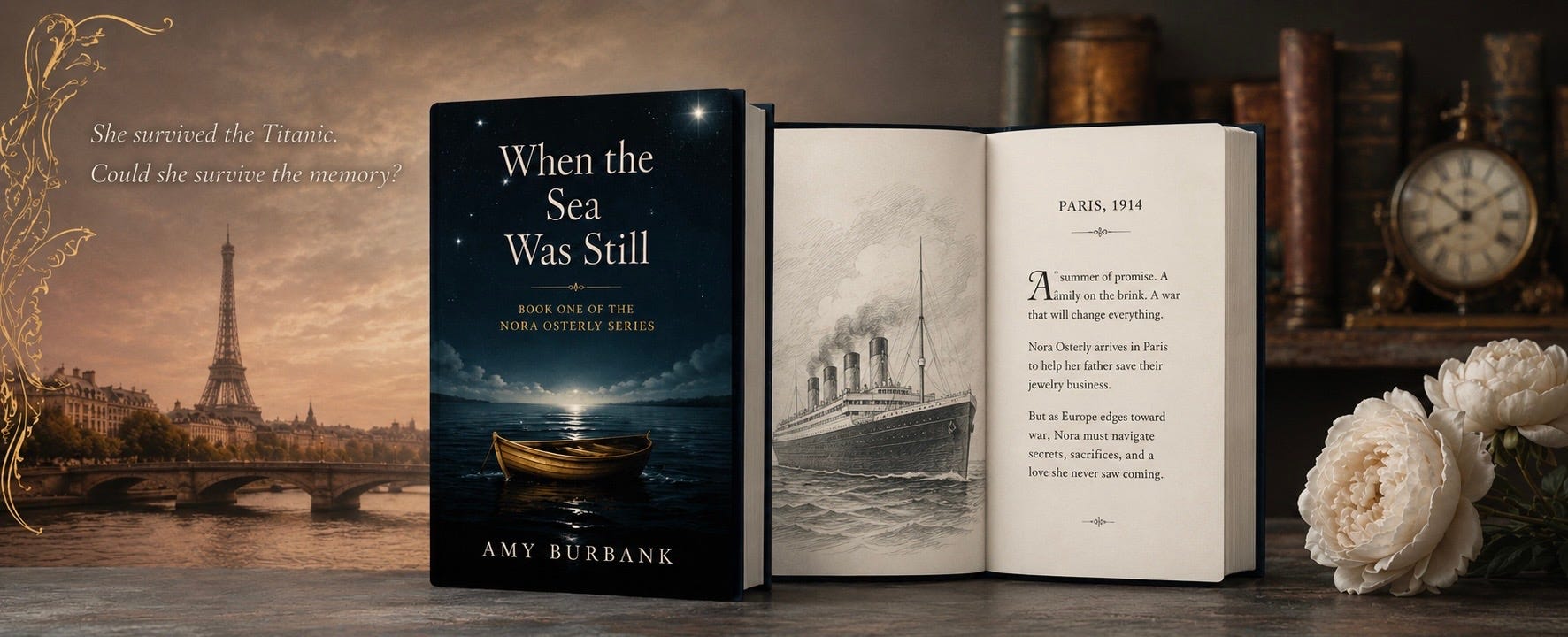


You are reading my weekly serial When the Sea Was Still.
When the Sea Was Still is a historical novel inspired by Titanic survivor Helen Ostby. While the heroine of the story, Nora Osterly, is entirely fictional, her journey draws on the incredible life of Helen Ostby. After surviving the Titanic disaster and losing her father, Helen went on to help run the family jewelry business, Ostby & Barton, which required her to face the sea again for business in Europe. Remarkably, she found herself in Germany on the eve of the First World War.
The novel starts two years after the sinking of the Titanic, when Nora Osterly is forced to cross the Atlantic again—this time aboard Titanic’s nearly identical sister ship, the Olympic. To save her father’s legacy, Nora must do the one thing she swore she never would: return to the sea that nearly killed her.

←Previous Episode | Story Index
An Unsettled Account
Nora
10 July 1914
Paris
When Nora and Astrid arrived at Maison Moreau, the dark-painted storefront looked just as it had the last time Nora had seen it. She paused for a moment before the display windows facing the river out of habit. The gold filigree combs she had once admired were gone now, replaced by a pair of diamond hair ornaments. Beside them rested a bracelet of tiny sapphires. The display had changed with the fashions, yet the craftsmanship of Maison Moreau remained as exquisite as ever.
Nora thought of her father and imagined him standing beside her as he used to, hands clasped behind his back, studying the elegant arrangement behind the glass. He had never hurried past these windows, but instead took his time admiring the work of his French counterpart before stepping inside.
The bell above the door chimed softly as Nora and Astrid entered. The familiar glass cases lined the showroom, filled now with new necklaces, brooches, and rings. Somewhere beyond the showroom came the steady tap of a jeweler’s hammer against metal. The sound carried her back to happy afternoons spent here with her father and Étienne, sketching new designs and discussing the coming season’s collections.
Étienne appeared in the doorway of his office and stopped when he saw Nora. Her breath caught as their eyes met, and she became intensely aware of every nerve in her body. He looked exactly as she remembered—the same navy suit and easy confidence. It struck her how strange it was that a place and a person could remain so unchanged, while everything in her own life had been upended.
Until receiving his letter in April, she had believed she would never see Étienne again, and yet here he was standing before her. He straightened his cravat, then came forward to greet them, his crooked smile slowly forming across his face.
“Bienvenue, Mademoiselle Osterly,” he said, kissing Nora on each cheek. As he drew back, their eyes met again. “It has been far too long.”
“Bonjour, Monsieur Moreau,” Nora said, unable to look away from him. “Yes, far too long.”
Nora smoothed her skirt in an effort to collect herself, then made the introductions between Étienne and Astrid. He greeted Astrid like a longtime acquaintance. A faint blush rose to her cheeks despite her composed smile.
Étienne turned toward the workshop.
“Come,” he said. “Geneviève is waiting for us.”
He led them down a narrow corridor and into a small office. Étienne’s sister, Geneviève, stood behind a wooden desk, reviewing an open ledger.
Nora had known from her earliest visits that Geneviève possessed a keen mind for business. When the flood damaged the atelier, she had kept the business operating while Étienne oversaw the repairs. In the years since, Nora had come to understand how important Geneviève was to Maison Moreau.
Geneviève came around the desk and kissed Nora on each cheek.
“Mademoiselle Osterly. I am very pleased to see you again.”
“And I you, Mademoiselle Moreau,” Nora replied.
Nora introduced Astrid, whom Geneviève greeted with the same gracious courtesy. She then returned to the desk and turned her attention back to the ledger.
“Geneviève has been helping me review the accounts,” Étienne said, motioning toward the chairs arranged near the desk. “Please sit.”
Once they were seated, he drew a breath before speaking again.
“Mademoiselle Osterly, Mademoiselle Lund, thank you for coming all this way. I regret that the circumstances are not more pleasant.”
“You were kind enough to write to me with honesty, Monsieur Moreau,” Nora said. “Though I confess, your letter concerned me greatly and I have thought of little else since receiving it.”
“I am sorry to have caused you such worry. Until recently, I have managed the payments without difficulty.”
“And what has changed, Monsieur Moreau?” Nora asked.
Étienne explained that orders had slowed over the past few months. Regular clients who had patronized the atelier each summer had not returned this year. The slowdown had been compounded by others who had gone home to Russia or Germany, feeling more secure in their home countries. Those who remained in Paris hesitated over pieces they would have previously commissioned without a thought. As he spoke, Geneviève turned the ledger toward Nora.
Nora looked at the ledger and then at Étienne. The strain he had described was easy to see in the figures before her.
“How serious is it?” she asked.
“The atelier will continue, but the pressure is real,” Etienne said. “I have not had the funds to pay the most recent interest payment. The arrears must be paid when the note itself is due on the first of August.”
Beside her, Astrid shifted in her chair, the concern on her face mirroring Nora’s own.
“You should have told me of the loan when my father died,” Nora said, holding his gaze. In his eyes, she saw kindness. She knew she should be angry—he had kept this from her for two years—but the anger would not come.
He inclined his head. “My apologies, Mademoiselle. I only wanted to spare you, as your father wished. It is with great reluctance that I come to you now.”
Nora thought of her father and his many lessons. He had taught her to read a ledger, to spot a flaw in a setting, to recognize a client’s hesitation before they understood it themselves. She had thought she knew the whole of his mind. And yet he had sat across from her at breakfast each morning, having undertaken an obligation of sixteen thousand five hundred francs, and said nothing.
“He never so much as hinted at it,” she said, more to herself than anyone else. “Not once.”
The loan itself did not frighten Nora. She had prepared for it and crossed an ocean with the bank draft waiting at the bottom of her trunk. What unsettled her was the picture Étienne had drawn of a partnership under strain, and the knowledge that he and her father had carried the debt alone. Although they meant to protect her, their silence had denied her the chance to help when she might have made a difference.
She folded her hands in her lap. “I have secured the means to pay it. Tell me to whom it must be presented, and I shall see it done.”
Geneviève explained that Herr Kessler’s bank in Paris held the note for collection, where Nora could settle the loan when it came due on the first of August. It was agreed that she and Astrid would meet Étienne and Geneviève at the bank that morning to see the debt finally resolved.
“There is one further matter,” Geneviève said.
Nora looked from Geneviève to Étienne. “What matter?”
“Herr Kessler required security against the loan,” Geneviève replied.
Nora glanced at Astrid. When they had searched through her father’s account books, neither of them had found any mention of collateral.
“What did Father leave with him?”
“Your mother’s engagement ring,” Étienne said.
“My mother’s ring…”
Nora saw again the velvet case open upon her father’s desk in Providence and her mother’s jewelry laid out between herself and Astrid: the pearl earrings, the gold bracelet, the sapphire brooch. She had wondered then why the engagement ring was not among them. Her father must have put it somewhere for safekeeping, she had told herself. Instead, he’d used it to secure the future of Osterly & Co.
“My mother treasured that ring.”
“As did your father,” Étienne said. “It remains in the bank’s custody and will be returned when the loan is paid.”
The knowledge brought an unexpected rush of relief. The sapphire ring her father had crafted for her mother all those years ago had not been lost. In three weeks, it would belong to her.
Nora swallowed against the sudden tightness in her throat. “Then I shall be glad to bring it home.”
“Before you go, there are several pieces for Osterly and Co. nearly ready for shipment,” Étienne said. “I hoped you might inspect them while you were here. Henri has been overseeing their completion.”
Geneviève remained in the office while Étienne led Nora and Astrid back to the main workroom. They found Henri Lefèvre beneath the tall window where Nora had so often watched him work with her father. He was bent over a piece with the same concentration she had seen back then. He did not look up until Étienne spoke his name.
“Henri. You remember Mademoiselle Osterly.”
Henri set down his tools at once, wiping his hands on the cloth at his hip before rising to greet them. “Mademoiselle Osterly. What a pleasure to see you again.”
He turned to Astrid. “And you must be Mademoiselle Lund. Étienne has spoken of little else all week.”
“I trust he has spoken favorably,” Astrid said.
“I did not say that,” Henri replied with a wink, and Étienne laughed.
Henri looked much the same as he had the last time Nora had seen him, his fair hair tousled and his shirtsleeves rolled up to his elbows. He had been Étienne’s closest friend since their student days at École Boulle and was one of the finest goldsmiths at Maison Moreau. He was known for his patience and determination, qualities that made him one of the few craftsmen capable of transforming Étienne’s most ambitious designs into finished pieces. When Étienne’s visions seemed to test the laws of physics, Henri used his humor to stave off frustration. During her earlier visits, Nora and her father had frequently paused beside his bench to see what magic he was working.
“I have kept the best pieces for last,” Henri said, gesturing toward the velvet at the end of his bench. “Étienne tells me you have your father’s eye. I confess I am curious whether you will find anything to fault.”
“I shall try not to be too severe,” Nora said.
“Please, be as severe as you like,” Henri replied. “It is the only way I improve.”
Several completed pieces had been arranged upon dark velvet at the end of his bench. Nora examined each one carefully, testing the clasps and studying the settings beneath the work lamp while Henri explained the final adjustments he had made. The workmanship was as precise as always. Every stone sat securely within its setting, and the delicate metalwork bore the unmistakable refinement of Maison Moreau.
Nora found nothing she would have changed before the pieces were sent on to Providence. Seeing their familiar craftsmanship reassured her after the troubling figures in Geneviève’s ledger. Whatever difficulties burdened the partnership, the jewelry itself was as beautiful as ever.
Before leaving the workroom, Nora thanked Henri for his exquisite work. He returned to his bench as Étienne escorted her and Astrid toward the showroom.
“It has been a pleasure to meet you, Mademoiselle Lund,” Étienne said with a slight bow.
“And you, Monsieur Moreau. Maison Moreau is every bit as impressive as Nora promised.”
Étienne smiled as he opened the door for her. “Then I hope we shall have the opportunity to welcome you again.”
He then turned to Nora and took her gloved hand in his. “I regret that your return to Maison Moreau should be under such unhappy circumstances.”
“As do I, Monsieur Moreau,” Nora said, letting her hand linger in his before withdrawing it.
“I hope I shall not have to wait until the first of August to see you again.”
She merely returned his smile, too disarmed to speak.
When Nora and Astrid stepped out of the atelier into the warmth of the Parisian summer, the Seine glittered beyond the quay across the road. Nora drew a breath of the river air before they climbed aboard their carriage for the ride back to the hotel.
Astrid spoke as soon as the carriage pulled away.
“Well,” she said, folding her hands in her lap. “That was a great deal to take in before luncheon.”
“It was,” Nora agreed.
“The loan, I mean.” Astrid glanced at her sideways. “Though I suspect that is not the only matter occupying your thoughts.”
Nora looked at Astrid, whose eyebrows were still in an unnatural position of height above her eyes. “I assume you are referring to Monsieur Moreau.”
“Of course,” Astrid said, in a tone that suggested she could mean nothing else.
“I assure you, my thoughts are entirely occupied with securing Osterly & Co.”
Even to her own ears, the declaration lacked conviction. But Astrid said nothing further, and Nora was grateful for it. The carriage continued west along the river, carrying them back toward the Crillon.