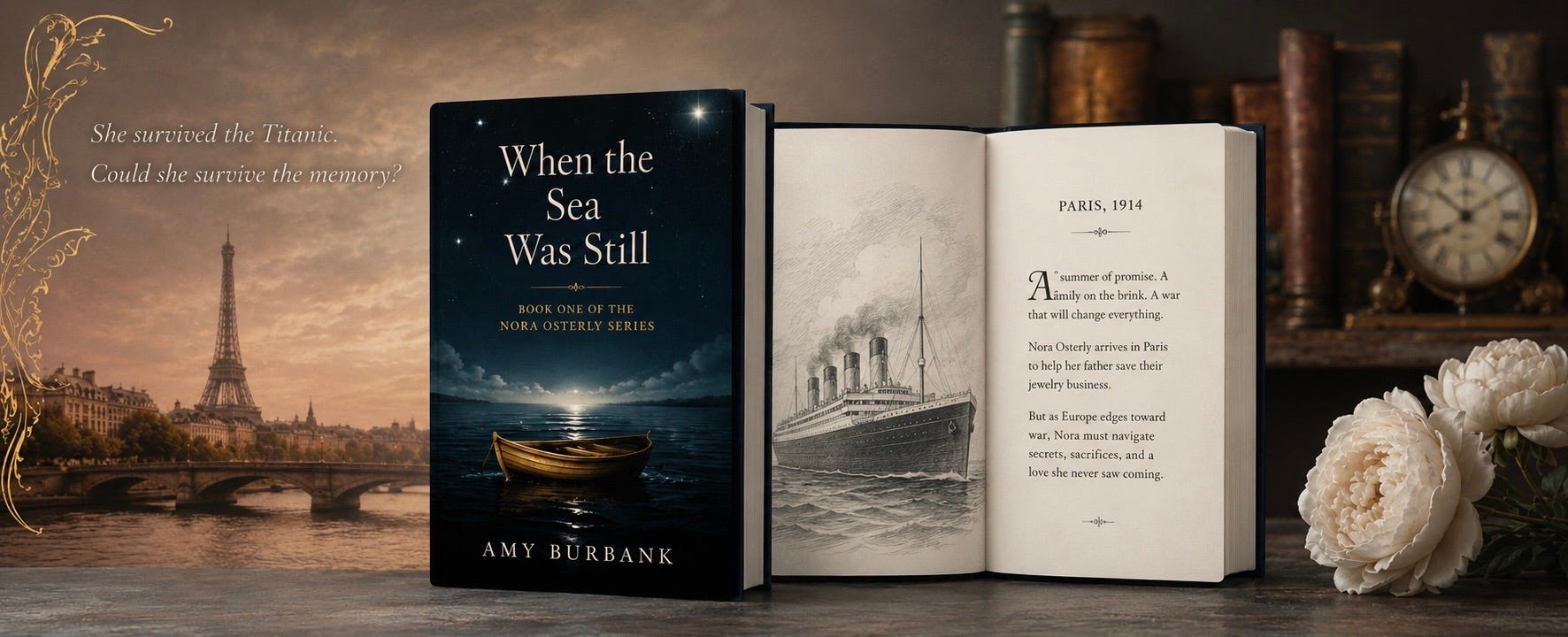


You are reading my weekly serial When the Sea Was Still.
When the Sea Was Still is a historical novel inspired by Titanic survivor Helen Ostby. While the heroine of the story, Nora Osterly, is entirely fictional, her journey draws on the incredible life of Helen Ostby. After surviving the Titanic disaster and losing her father, Helen went on to help run the family jewelry business, Ostby & Barton, which required her to face the sea again for business in Europe. Remarkably, she found herself in Germany on the eve of the First World War.
The novel starts two years after the sinking of the Titanic, when Nora Osterly is forced to cross the Atlantic again—this time aboard Titanic’s nearly identical sister ship, the Olympic. To save her father’s legacy, Nora must do the one thing she swore she never would: return to the sea that nearly killed her.

←Previous Episode | Story Index
A Surprise at the Bank
1 August 1914
Paris
As July drew to a close, August arrived with the increasing inevitability of war. Over breakfast, Nora read the headline reporting the assassination of Jean Jaurès, France’s greatest advocate for peace. His murder in a Paris café the evening before had sent a ripple of trepidation through the city. Further down the page ran a second discouraging article: Germany had demanded to know whether France would remain neutral, and expected an answer within hours. It seemed that with each passing day, Europe drifted farther from the peace so many still hoped could be preserved.
That afternoon, on the way to Banque Mallet, Nora ran her fingers along the diamond bar pin at her collar. She remembered her eighteenth birthday, when her father had given it to her. He had been so pleased to present it in its slender velvet case. She could still picture him fastening the pin before stepping back to admire it. Every day since, she had worn her mother’s pin. Even on the night Titanic went down, she had instinctively reached for it on her nightstand before leaving her room, never imagining that she wouldn’t return. The pin had survived with her, a precious link to all she had lost. It gave her courage now.
Nora considered what awaited her at the bank. A part of her felt she had let her father down. Yet how could she have known that she would meet the man who would threaten Osterly & Co. on the very ship she had boarded to save it? She wondered whether something she had said aboard the Olympic had given Mr. Cartwright motive to strike. Had he sensed her fear?
As the carriage carried her and Astrid north along the rue Royale, the imposing columns of the Madeleine came into view. Nora’s mind went to her mother’s ring sitting at the bank. She knew her father never would have used it as security if he had not been certain of his decision to partner with Maison Moreau. None of it had unfolded as he intended. And now, despite everything she had done to ensure his legacy, she would not be able to pay the loan. The thought stayed with her as they turned onto the rue d’Anjou.
Moments later, Nora and Astrid stepped through the tall bronze doors of the bank into a large vestibule that resembled a church. Dark paneled walls held oil paintings of generations of Mallets who had guided the family bank for two centuries. The atmosphere was more subdued than in the larger banks she’d visited, but the tension was still there. Some of the wealthiest men and women in Paris stood at the marble counters speaking in hushed but urgent tones. Nora watched a gentleman in a silk hat stuff a stack of banknotes into his wallet with irritation.
They were escorted to Monsieur Delacroix’s private office, where Étienne and Geneviève were already seated in deep leather chairs. Behind the closed double doors, the tension of the vestibule gave way to an eerie silence. A massive mahogany desk stood before a tall window covered in heavy drapes.
Monsieur Delacroix stood from behind his desk to greet them. In a chair to one side sat Lionel Cartwright, impeccably dressed as always. He discreetly slipped a gold watch back into his waistcoat pocket, on the same chain he’d worn aboard the Olympic, still a shade too bright.
“Miss Osterly. Miss Lund.” He rose and inclined his head. “I trust you are both well.”
Nora nodded but said nothing. Whatever fear he may have sensed in her, he would not see it today.
Sitting next to Mr. Cartwright was a man she recognized at once. It was the huissier who had served her with the notice, wearing the same severe black coat.
Once Nora and Astrid took their seats alongside Étienne and Geneviève, Monsieur Delacroix began to review the terms of the loan and the interest that had accrued since the missed payment. He continued with the clause requiring settlement in gold coin, which the holder of the note had chosen to invoke. He set down the paper and folded his hands.
“Mademoiselle Osterly, are you prepared to present payment in gold coin?”
Next to her, Étienne was as steady as always. He gave her a small nod. Her gaze shifted to Mr. Cartwright, waiting for her answer.
“At this time, I am not, Monsieur,” Nora replied. Whatever it cost her to say the words, she did not let her voice falter. “I am prepared to pay the full amount by bank draft, payable in francs.”
“In that case, Mademoiselle Osterly,” Monsieur Delacroix said, “I am afraid that will place the loan in default.”
The huissier opened his portfolio and pulled out a printed form. Nora stared at the piece of paper, its blank lines waiting for her father’s name. Her heart sank lower with each stroke of the huissier’s pen. Once the protest was signed, her mother’s ring would pass to Mr. Cartwright, and with it, a claim against Osterly & Co. Refusing his interest in a share of her father’s company would no longer be so simple.
Mr. Cartwright sat back in his chair and crossed one leg over the other. He did not look at Nora but kept his eyes fixed on the huissier’s pen. Astrid laid her hand over Nora’s and gave it a firm squeeze. Beside them, Étienne and Geneviève sat motionless.
Just then, a knock sounded at the door.
“Pardon, Monsieur le Directeur.” A clerk stepped inside, an envelope in his hand. “An urgent notice from the Banque de France.”
Monsieur Delacroix frowned at the interruption but held out his hand. He begged their pardon and read the document quickly, his brows lifting slightly.
He cleared his throat and turned the notice toward them. “A decree has been issued that will affect this proceeding.”
Mr. Cartwright uncrossed his legs and leaned forward. “What is it?”
“All notes falling due from today onward have been extended thirty days by government decree. The intent is to spare debtors from ruin while the crisis lasts,” Monsieur Delacroix said, scanning the page. “This loan is no longer in default. Its maturity is now the thirty-first of August.”
Nora wondered if she’d understood correctly. If so, she now had thirty extra days to find gold. Had the very crisis that brought her to this point given her a reprieve?
She looked to Étienne, who seemed to sense her question. He nodded, and Geneviève smiled. Nora knew she’d understood Monsieur Delacroix’s words. Relief flooded through her.
Mr. Cartwright’s expression hardened briefly. “Very well, I shall see you back here in thirty days, Miss Osterly,” he said with his usual polished smile.
Nora’s mind raced through this turn of events. With the extension came the answer she had been searching for all week. Paris might not have gold to give her, but Providence still did. Her father’s bank had served Osterly & Co. for twenty years, and a single cable would set the matter in motion. In thirty days, gold could cross the Atlantic twice over.
“Then there is nothing more to be done today,” Nora said, rising from her chair. “Good day, Mr. Cartwright. I shall see you on the thirty-first of August, with your gold coin.”
She started toward the door, Astrid by her side and Étienne and Geneviève close behind.
“Miss Osterly.”
She turned to face Mr. Cartwright, who had risen from his chair. He studied her for a moment as if weighing what he was about to say.
“A draft in hand is worth a great deal in times like these,” he said. “I will accept it.”
Beside her, Astrid gave her hand a light squeeze.
Nora thought she might float away for the burden that had just lifted. She walked slowly back to her chair.
“I believe you will find everything in order,” she said, placing the bank draft on the desk.
Monsieur Delacroix studied it for what felt like a very long time. At last satisfied, he handed the draft to Mr. Cartwright, who examined it for himself. Then the director dipped his pen and wrote Acquitté across her father’s promissory note in large letters.
“The obligation has been discharged,” Monsieur Delacroix said.
Mr. Cartwright and the huissier both stood to leave. On the way to the door, Mr. Cartwright paused at Nora’s chair, just a hair closer than common courtesy required. She felt Étienne tense beside her.
“Your father built a remarkable company, Miss Osterly,” he said. “I shall continue to follow its fortunes with great interest.” He pulled on his gloves, placed his hat over his slick hair, and strode out the office door.
“There remains the matter of the security,” Monsieur Delacroix said. “One diamond engagement ring set with two sapphires.”
He handed Nora a small leather case. Inside was her mother’s ring. The diamond was more brilliant than she remembered, a pale sapphire on each side perfectly nestled next to it. While she turned it in her hand, she caught sight of an inscription on the inside of the band she had never known was there: Forever Love.
Nora took off her right glove and slipped the ring onto her finger, where it fit as though it had been made for her.
“It looks beautiful on you,” Geneviève said.
“Merci,” Nora said, rising and smoothing her skirt. “Now that it is finished, shall we go?”
Outside the bank, Nora was so thankful for the unexpected reversal of fortune that she gave each of her companions a long embrace, beginning with Astrid. Astrid remained stiff but patted her back graciously before pulling away. Geneviève returned the embrace affectionately and said, “Congratulations, mon amie.”
Her embrace with Étienne lasted the longest, neither one of them eager to let go. Finally, he stood back, holding both her hands in his. “I cannot tell you how happy I am for you, Nora.”
Astrid opened her parasol with a decisive snap. “Clara will be waiting for us at the Crillon.”
“Yes, of course,” Nora said. “I shall call on Maison Moreau soon so that we may celebrate.”
Nora and Astrid decided to take the short walk back to the Crillon on the warm summer afternoon. They strolled along the boulevard Malesherbes past tall Haussmannian buildings. The broad thoroughfare bustled with hurried pedestrians as carriages rattled among the motorcars. Nora found herself looking up at the wrought-iron balconies and carved stonework, noticing every detail as if she had become her father.
“I shall miss this when we return home,” Nora said.
“Does this mean you have made your decision?” Astrid asked.
“I was waiting until things were more settled with Osterly & Co. I confess that with the loan paid, I am more inclined to go home with the Harroways.”
Astrid was visibly relieved, then asked, “Is it Paris you will miss?”
“Yes, Paris. Clara…Étienne.” His name slipped out before she could stop it.
Astrid raised an eyebrow. “So you will finally admit it.”
“I suppose there is no more denying that I have grown fond of him,” Nora said. “If we return home next week, it would hardly matter now.”
“It would still matter a great deal,” Astrid said. “You have had losses enough for one lifetime. I should not like to see you add another by choice.”
Nora looked at Astrid, astonished by the turn their conversation had taken. Paris had revealed unexpected sides of her companion, but even Astrid’s fascination with the Madame Caillaux trial had not surprised Nora as much as this apparent willingness to place love above practicality.
“You do surprise me, Astrid.”
Astrid gave her a small smile. “Do not grow accustomed to it.”
Nora laughed as they continued along the boulevard.
A few minutes later, they approached the Crillon, where Nora noticed a cluster of people congregated at the corner up ahead. Behind the crowd, the afternoon shadow of the Luxor Obelisk stretched long across the Place de la Concorde. More people were crossing the square to join the gathering.
Astrid was about to speak when the bells of the Madeleine began to ring behind them. No sooner had they begun than bells from the east started to ring. Then across the Seine more bells chimed until the whole city seemed to be ringing.
“The tocsin,” Astrid said, her face ashen. “The bells are sounding an alarm.”
Nora froze as they continued to clang. She was back for an instant on Titanic’s boat deck, steam screaming from the funnels above people gathered in bewilderment. She forced the memory away as quickly as it had come.
“We should see what has happened,” she said at last.
Together they walked quickly toward the gathering. All around them, people were moving in the same direction. There on the rue Royale, just steps from the Crillon, was a poster with two crossed French flags above heavy black letters:
Ordre de Mobilisation Générale.
Beneath the heading, the notice declared Sunday, the second of August, the first day of mobilization. It called for every Frenchman subject to military obligations to follow the instructions in his livret militaire, or face punishment under the law. Nora read the words slowly, struggling to translate their meaning.
She was filled with dread for Étienne. He was to report on the third day. Only moments ago, she had been close to a decision to return home, and now it was he who would leave.
Astrid was staring at the poster, her expression grave. She looked at Nora then, and in that shared glance lay the full weight of the news.
Men pressed forward to read the notice, some with stoic expressions, others pale and unsteady. A young woman clutched her husband’s arm as though she might never let go. Another pressed a kerchief to her mouth, her eyes fixed on the poster as her companion pulled her gently away. The usual hum of the street was replaced by an uneasy murmur that rolled outward like ripples on water. Nora watched as the city’s brilliance seemed to dim.
Then, as abruptly as they had begun, the bells fell silent.
Next Episode→ | Story Index

Welcome to this week’s bonus deep dive. Since we’ve reached a pivotal chapter in the story, I’m making this one a free preview of what paid subscribers get. Enjoy!
The Week Gold Disappeared
If Nora’s race to find gold coin felt almost too cruel to be believed, you may be surprised to learn how closely it follows what actually happened in Paris during the last week of July 1914. The gold clause, the empty bank vaults, and the last-minute reprieve were all real.
The Gold Clause
A gold clause was a provision in a loan requiring repayment in gold coin rather than paper money. Lenders used it as protection against a currency losing its value, and it was common in international lending before the First World War. A German lender like Herr Kessler had good reason to insist on one. In ordinary times, the clause was little more than a formality. Anyone holding French banknotes could exchange them for gold at the Banque de France, so paper and gold were treated as one and the same.
The Empty Bank Vaults
That changed almost overnight. As war began to seem likely, people across Europe rushed to turn their paper money into gold, the one form of payment they trusted to hold its value. Banks soon found they could not keep up. By July 30, French savings banks had invoked a rule limiting depositors to fifty francs every two weeks. Foreign travelers, unable to pay for their passage home with checks or letters of credit, lined up at banks across Paris.
This was the crisis Nora encountered at the banks she visited. Having enough money on paper did not guarantee that she could collect the same amount in gold. Banks under pressure from anxious customers were increasingly reluctant to release their available coins, particularly in large amounts. France still possessed gold, but obtaining it had become another matter entirely. Lionel’s demand exploited that distinction: Nora had the money to settle her father’s debt, but he insisted on the form of payment the crisis had made hardest to secure.
The Last-Minute Reprieve
As the financial crisis deepened, the French government intervened in the normal business of collecting debts. A decree dated July 31 allowed thirty additional days for formally recording nonpayment on certain written promises to pay, including those falling due in early August. With money increasingly difficult to obtain, the measure gave the financial system time to cope with the disruption.
This emergency measure inspired Nora’s unexpected reprieve at Banque Mallet. In the chapter, I have simplified its workings into a thirty-day extension of her loan. The same crisis that had helped Lionel corner her also provided the basis for her escape.