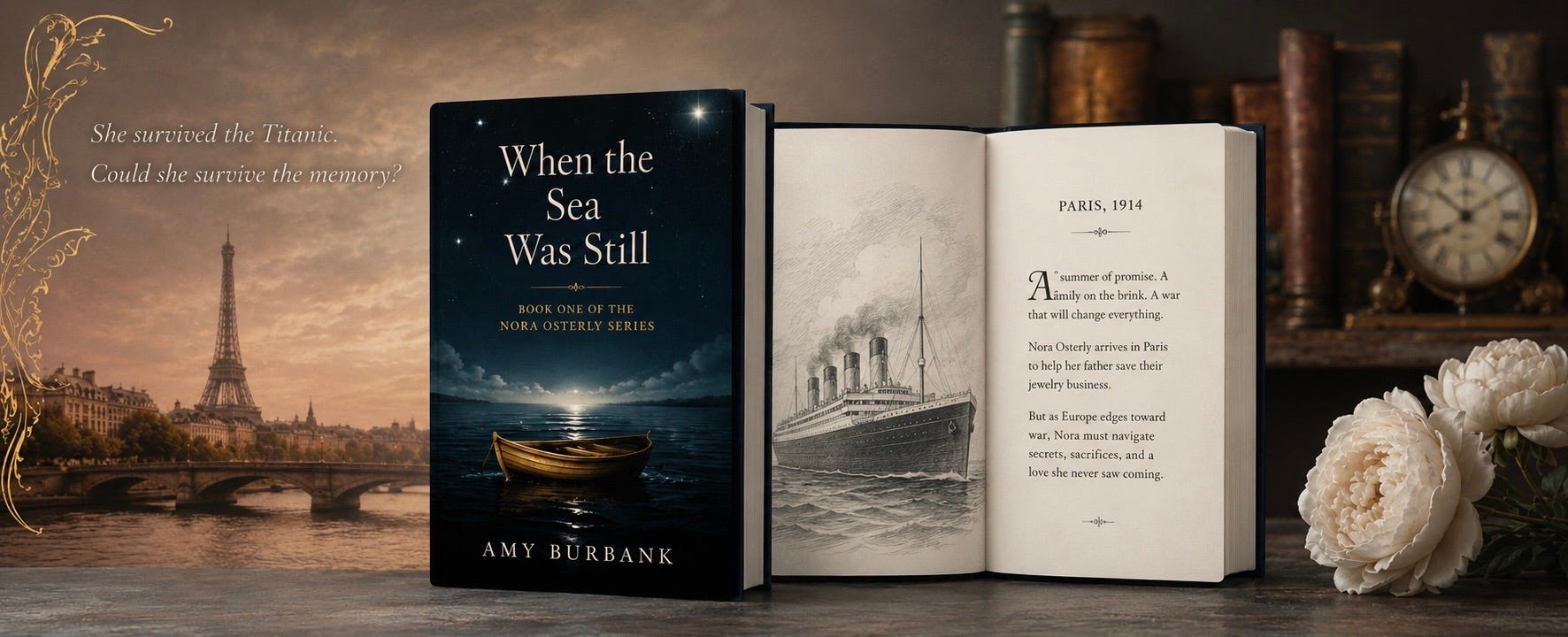


You are reading my weekly serial When the Sea Was Still.
When the Sea Was Still is a historical novel inspired by Titanic survivor Helen Ostby. While the heroine of the story, Nora Osterly, is entirely fictional, her journey draws on the incredible life of Helen Ostby. After surviving the Titanic disaster and losing her father, Helen went on to help run the family jewelry business, Ostby & Barton, which required her to face the sea again for business in Europe. Remarkably, she found herself in Germany on the eve of the First World War.
The novel starts two years after the sinking of the Titanic, when Nora Osterly is forced to cross the Atlantic again—this time aboard Titanic’s nearly identical sister ship, the Olympic. To save her father’s legacy, Nora must do the one thing she swore she never would: return to the sea that nearly killed her.

←Previous Episode | Story Index
Stranded at the Crillon
2 August 1914
Paris
Nora hadn’t dreamed of Titanic since her last night aboard Olympic. But on the morning after the mobilization announcement, the nightmare returned. This one was different. She wasn’t on the sinking ship. She was back in Lifeboat No. 5, drifting on the impossibly calm water as the cries rang out. This time, her words came. “We must row back,” she whispered.
Pitman didn’t hear her.
“We must row back,” she said again, her voice louder now.
Pitman turned in her direction.
“We must row back!” she said one more time, shouting now.
Incredibly, he gave the order to turn back. The men at the oars started rowing toward the voices. Nora woke with a start.
She sat upright in bed, her heart pounding as she struggled to recall where she was. Morning light seeped through the heavy curtains, revealing the familiar furnishings of her room at the Crillon. No water surrounded her. No desperate voices cried out.
Nora pressed a hand against her chest and waited for her heartbeat to slow. She drew back the covers and crossed the room to the window overlooking the gardens. Outside, the day was just beginning, awash in golden sunlight. She heard the distant sound of Sunday bells ringing.
The tocsin of the previous afternoon returned to her thoughts. She could still see the crowd gathered near the rue Royale and the mobilization poster on the wall. Men were called to leave their homes, their businesses, and their families. They were called to report to their regiments in service of their country. Étienne and Henri would be among them soon, along with many of the craftsmen who worked at Maison Moreau.
Astrid had been adamant over dinner last night that the mobilization order required them to leave Paris at once. She had all but ordered Nora to accept the Harroways’ invitation to sail with them aboard the Philadelphia. Nora knew she expected an answer today, and only a yes would satisfy her.
But with so many of the men called away, Geneviève would have to manage Maison Moreau with the few craftsmen who remained. Nora thought of mornings working next to Étienne, how easily they had fallen into a rhythm together, designing, revising, sketching. There was work she could do at Maison Moreau to help keep it afloat while Étienne was away.
Nora pondered last night’s dream. She had been twenty-two when Titanic sank, frightened and grieving as Lifeboat No. 5 carried her away from people who were dying in the freezing water. She had possessed neither the authority nor the strength to make Pitman turn the boat around. For more than two years, a part of her had remained in that lifeboat, still hearing the cries while knowing she had survived.
This time, she had a choice, and the decision belonged to her.
Later that morning, Nora and Astrid made their way downstairs for breakfast. Nora could see the change at the Crillon immediately. The white-gloved footmen, always readily available for any guest who had a need, were nowhere to be seen. At the bottom of the stairs, only a single attendant stood near the hotel entrance, where there had been several the day before.
The lobby was filled with guests trying to get answers. French and English mingled with languages Nora did not recognize as questions were fired at the few members of staff remaining behind the desk.
“When will the trains resume?” Nora heard a gentleman ask as they walked by.
Yesterday afternoon, the Crillon had seemed untouched by the turmoil that lay beyond its doors. This morning, the orderly world of the hotel had finally given way to the upheaval that the escalating conflict between nations had brought to Paris.
When Nora and Astrid entered the dining room, the change there was unmistakable too. Several tables remained uncleared. A waiter hurried between guests carrying more dishes than seemed wise. The usual peaceful atmosphere at breakfast had been replaced by an anxious current of conversation.
Once they were finally seated, Astrid let out a small huff, then said, “Did you manage to sleep after yesterday’s announcement?”
“Not particularly well,” Nora replied.
She said nothing about her dream. Instead, she looked around the dining room as they waited for someone to take their order. Under ordinary circumstances, their coffee and tea would already have arrived. This morning, no one appeared to have noticed that they were waiting.
At last, a waiter appeared. “Mesdemoiselles, forgive me. We are short of staff this morning.”
“It’s quite all right,” Nora said. “Where is Monsieur Leblanc?”
“He left this morning to join his regiment, mademoiselle,” the waiter said as he served their coffee and tea. “I scarcely had a chance to wish him well.” He then took their orders before quickly moving to the next table.
Astrid sipped her tea. “The Crillon will have a hard time attending to its guests if the waiters are called away. At least we shall be home before long.” Her eyes pierced Nora’s. “Isn’t that right, Nora?”
Nora hesitated. She couldn’t avoid the unpleasant task of telling Astrid any longer. “It goes far beyond the Crillon, I’m afraid. Businesses throughout France will lose the men they depend upon. Businesses such as Maison Moreau.”
Astrid’s brow furrowed. “What are you saying?”
“I am saying that I have decided I shall remain in Paris to help Geneviève with the atelier.”
Astrid’s jaw dropped. “You cannot be serious.”
“I’m afraid I am quite serious. I won’t leave Maison Moreau to sink while the men are away. You shall sail home with the Harroways next week. I shall follow as soon as Étienne and Henri are back home.”
“But Nora, France may very well be at war within days,” Astrid said.
“Nobody expects this to last longer than a couple of months. Surely, I will be home before the year is out.”
Astrid shook her head but said nothing.
“I have not made this decision lightly,” Nora continued. “It is what I must do.”
Astrid offered no further argument so Nora dropped the subject. They finished their breakfast in silence while the dining room around them continued in chaos.
After breakfast, they planned to attend their usual Sunday service at Holy Trinity. But when they stopped to request a carriage, the concierge told them none was available. Astrid asked how this could be at a hotel such as the Crillon. The army was requisitioning horses, he explained, and the Crillon’s had already been taken. Nora was ready to give up on church and go upstairs to catch up on her correspondence, but Astrid wouldn’t abandon her Sunday service so easily. She urged the concierge to find them a cab instead. After several failed attempts, he apologized. The few cabs still circulating were carrying men to the stations, while the rest had been taken into service for the army. Astrid finally relented, and they returned to their rooms.
That afternoon, Nora and Astrid joined Clara for tea out on the terrace of her suite. Clara had planned to go to England that morning, where she had rented a country house for the rest of the season. She instead found herself blocked from leaving Paris, like so many others. The railways were being used only to transport soldiers, and no one knew when travelers would be allowed to depart by train.
“And so, I am here until goodness knows when,” Clara said as they took their seats. “My servants and nearly all my clothes are already in England. I have only what I took on the motor trip.”
“Then what shall you do?” Nora asked.
“Prepare the house on the rue de Varenne, if I can find anyone to help me. If I must remain in Paris, I should at least like to do so in my own home.”
“Surely you are not entirely stranded,” Astrid said. “You still have your motorcar.”
“For the moment. I am told it may be requisitioned at any time.”
“Requisition a lady’s private motorcar?” Astrid asked. “There must be limits!”
Clara merely shrugged her shoulders.
Below the terrace, Nora watched the lives of young men and their loved ones being rearranged. Now and then a taxicab or a private motorcar crossed the Place de la Concorde, carrying soldiers to the stations. Men in groups tramped through the square with bags over their shoulders and patriotic banners in their hands.
“So many of the men are leaving,” Nora said, pointing toward the square.
“The rue Royale was full of them last night too. William took me to dinner, and we sat watching as their wives and children walked with them. There must have been hundreds of families. It was a sad sight to behold.”
“It’s hard to imagine having an appetite for dinner,” Nora said.
Clara nodded. “The restaurant’s band kept playing national anthems. The Marseillaise, God Save the King, the Russian anthem, then the Marseillaise again. We stood up for every one of them, and with so few waiters left, we did a great deal more standing than eating.” She had a way of finding something amusing even in circumstances that would have tried anyone else’s patience.
“Did every nationality in the dining room require its own anthem?” Astrid asked.
Clara laughed, and Nora smiled with her. Astrid did not share in their amusement.
Clara’s face grew serious. “All along the street, the bands of the other restaurants were playing too. It was a night of singing as the men kept coming. Their faces were solemn, determined. Some of them looked so very young.”
“They will have to grow up quickly now.” Nora stood and went to the edge of the terrace.
For a moment, none of them spoke. Another group of soldiers crossed the square. Nora watched as they passed out of sight, then turned back to Clara.
“If you need help with the house, you must tell me.” Nora did not look at Astrid but sensed her displeasure at the offer.
“Thank you, my dear. I may take you at your word. Though I hope by our next tea I shall be able to receive you there.”
This time Astrid made her disapproval known with a small grunt.
“I should like that,” Nora said, ignoring her. She reached for her tea as Clara began describing what would have to be done before she could move home.
Next Episode→ | Story Index