


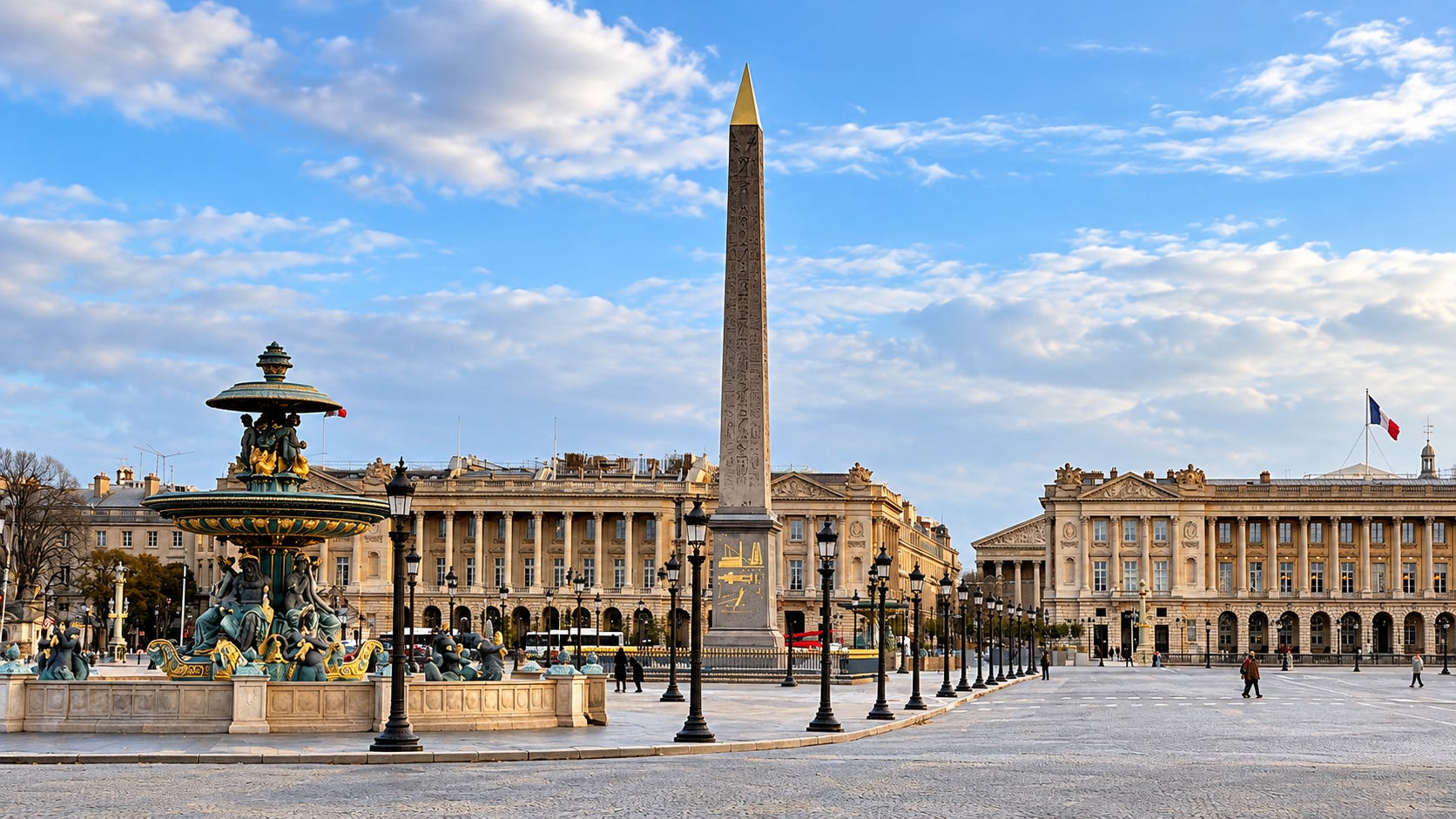
Welcome back to Tuesday’s newsletter! A few weeks ago I told you that going forward we would be exploring the real places and fascinating history behind the travels that inspire my writing. Although it’s taken a little longer than I intended, today I’m taking you straight to the heart of Paris. But we aren’t just traveling across the globe; we are traveling back in time, as far back as 1778, through the glittering Belle Époque of the early twentieth century, and back to present day.
The Hotel de Crillon
It’s easy to walk into one of the most luxurious hotels in Paris when you act like you belong there. At least, that’s what I told myself as I walked through the doors of the Hôtel de Crillon on a cold January day. I had looked into staying there for just one night, but since it would cost more than my flight from Phoenix, I opted to walk in like I owned the place instead.
The hotel was at the top of my list of sights to see during my research trip to Paris. So I walked in, tried not to look too much like someone who had no business being there, and started exploring.
From the moment I stepped inside, I felt as though I’d entered a palace of Parisian luxury: glittering chandeliers, marble floors, soaring ceilings, golden accents, and a series of rooms that kept getting more beautiful as I walked through them. This is the kind of place where you find yourself saying wow around every corner.


Marie Antoinette at the Crillon
Long before the Crillon was a hotel, it was a grand private residence of the family of the Count of Crillon. The building was designed in the exquisite Neoclassical style by Ange-Jacques Gabriel, one of the leading architects of his time. It is said that Marie Antoinette came here regularly for private piano lessons between October 1789 and August 1792. The royal family had been forced out of Versailles and moved into the nearby, comparatively run-down Tuileries Palace. The grand private mansion, located just a stone’s throw from Antoinette’s new residence, offered an elegant escape for her music lessons.
As the legend goes, the second-floor salon associated with those lessons was decorated with exquisite bronze-gilt details and was lit by massive, lead-crystal tier chandeliers holding dozens of beeswax candles. Marie Antoinette sat at a fortepiano looking through magnificent glass doors onto a columned terrace that gave her a direct view of the Place Louis XV, now Place de la Concorde—the very square where she would lose her life little more than a year later.
Today, the hotel has a Marie-Antoinette Suite adjoining the historic salon associated with those piano lessons. I stood in the suite named for the fallen queen looking out over the Place de la Concorde, having no idea about any of this. All I knew was that I was in an incredibly beautiful room whose door had been left open, and I wasn’t sure if I was supposed to be there or not. I snapped a few quick photos, took in the view, and got out.


From Palace to Hotel
When the Hôtel de Crillon opened its doors as a luxury hotel on March 12, 1909, it represented the absolute zenith of Belle Époque glamour. Its soaring reception salons preserved the grandeur of the eighteenth-century building while introducing the opulence expected of one of Paris’s newest luxury hotels. Crystal chandeliers glittered overhead, tapestries covered the walls, and enormous windows looked out over the Place de la Concorde.
Over the years it attracted famous guests like Isadora Duncan, Igor Stravinsky, Charlie Chaplin, Arthur Conan Doyle, and Peggy Guggenheim. But for a cultured intellectual like Edith Wharton, it was the ultimate sanctuary. She booked a room the very spring the hotel opened to draft her novel The Custom of the Country, which was published in 1913. She deliberately chose the Crillon over the Ritz—which she detested for attracting the ostentatious, newly rich American crowd.
Wharton famously described her favorite top-floor suite as a “very nice apartment up in the sky, overlooking the whole of Paris.” From these lofty windows, a guest at that time could look out at the transition of a century: horse-drawn carriages sharing the asphalt with sleek early motorcars on the Place de la Concorde.
Edith Wharton continued to stay at the Hôtel de Crillon even after establishing a home of her own in Paris. At the end of July 1914, she took rooms there after a motorcar trip through Spain. She was due to depart on August 2, but became stranded at the hotel when France ordered general mobilization just days before entering WWI. In Fighting France, Wharton describes looking out from the terrace of the Crillon as taxis and private motorcars carried soldiers across the Place de la Concorde toward the railway stations. Groups of soldiers marched through the square carrying their bags.
Diplomacy at the Crillon
Before Marie Antoinette, Edith Wharton, and the other famous guests, the Crillon played a key role in America’s first alliance. In 1778, Benjamin Franklin and his fellow American commissioners met with French representatives in the hotel’s magnificent Salon des Aigles (Eagles Room) for the signing of two historic agreements. The Treaty of Alliance made France America’s first formal ally, while the Treaty of Amity and Commerce recognized the United States as an independent nation.
More than 140 years later, just 10 years after becoming a hotel, the Crillon was once again the setting for an important moment in international diplomacy. In 1919, after the devastation of the First World War, the covenant establishing the League of Nations was signed in the same Salon des Aigles. The League of Nations was an ambitious attempt to bring countries together to prevent another catastrophic war. Although it ultimately failed and was dissolved after WWII, its legacy helped shape the United Nations.


The Crillon Today
Over a century after the League of Nations covenant was signed in the Salon des Aigles, the Crillon still exists in the same kind of unapologetic luxury. Echoing the transformation that preceded its opening as a hotel in 1909, a four-year restoration completed in 2017 preserved the Crillon’s historic salons and eighteenth-century details while bringing it firmly into the twenty-first century. Some of the numbers are staggering: 250 artisans worked on the restoration, and 53 different types of marble were used throughout the hotel. I didn’t even know there were 53 kinds of marble I needed to covet, but after walking through the Crillon, I believe it.
The restored chandeliers and iconic views over the Place de la Concorde remain, along with the protected historic spaces of the Marie-Antoinette and Aigles salons, with ceilings dating back to 1775-76. The fashions and famous faces have changed since Wharton checked in during the Belle Époque. More recently, the hotel has welcomed guests like Madonna, Jennifer Lopez, Roger Federer, Andy Warhol, and Taylor Swift. Today’s Crillon mixes all its fantastic history with modern Parisian luxury.
My Takeaway
My visit to the Hôtel de Crillon was part of a research trip I took to Paris to learn firsthand about the setting for the second half of my historical novel When the Sea Was Still. I walked into the hotel hoping to get a glimpse of the 1914 world I was writing. What I found was a hotel that was not only quintessentially Parisian but a place that had seen far more than I could ever imagine.
Marie Antoinette had walked through these rooms before the French Revolution changed France forever. Edith Wharton looked out over the Place de la Concorde as Europe was on the brink of WWI. During the glittering years of the Belle Époque, some of the most famous artists, writers, and travelers in the world passed through the Crillon’s doors. I was humbled to think I had walked through them too.
Of course, the hotel looks much different today than it did in 1914. But the bones are the same. I believe the elegance is the same. And for a few hours, I felt as though I had stepped into the Paris I had spent so much time writing about.
After walking through the grand lobby, up the ornate staircase, and into the Marie Antoinette suite, I made my way back downstairs and outside the hotel. Standing at the door I had freely walked through were three large guards. I said a confident “Bonjour” and left quickly.
If you’d like to go back to 1914 with me and follow Nora into the glittering final summer in Paris before the First World War, you can start reading here:

You should have coffee or champagne in the Lobby Bar!