


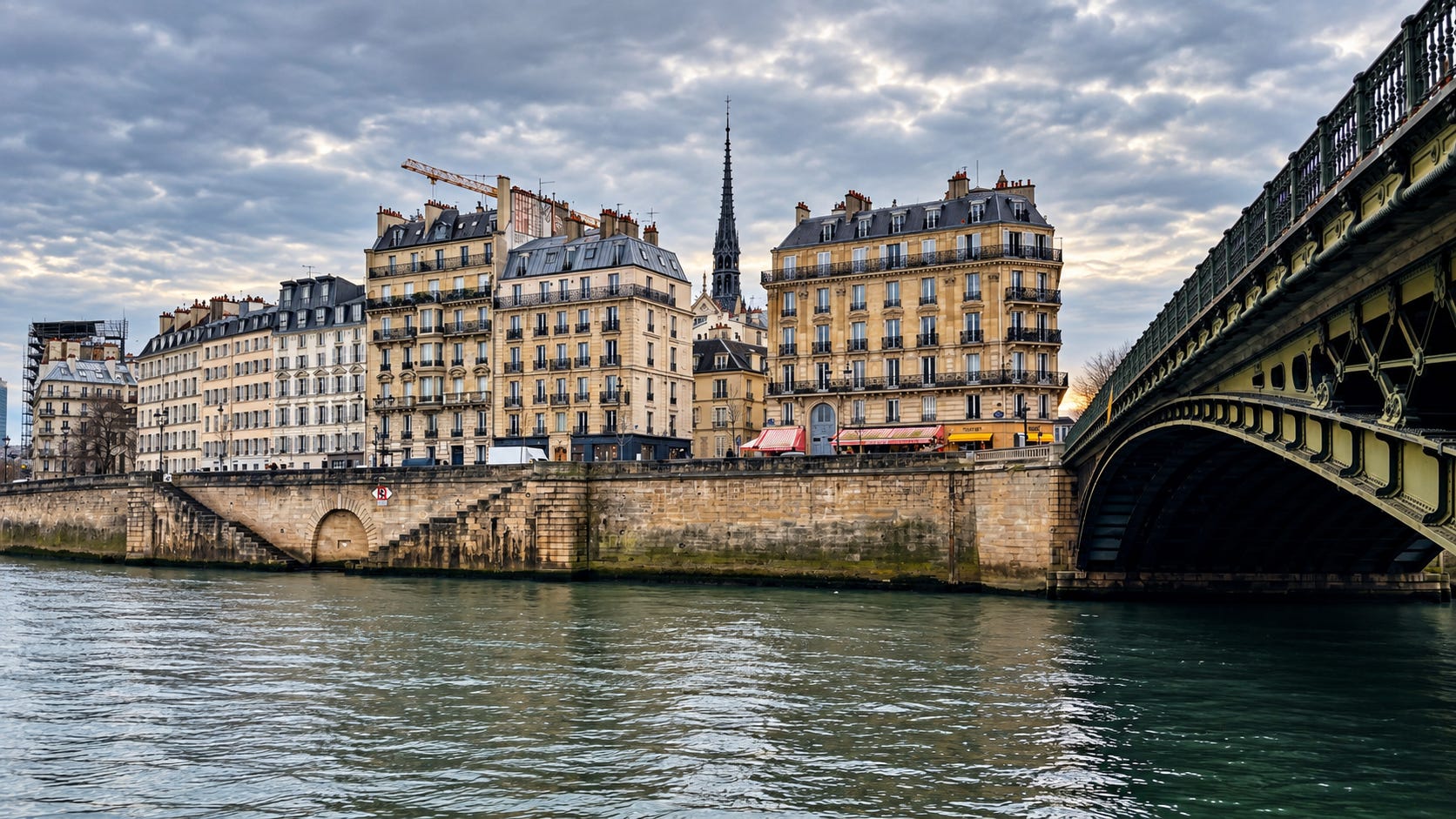
This week, we are going back in time to 1910 to an island in Paris. The Île de la Cité (Island of the City in English) is perhaps most well known as the home of the stunning religious landmarks like Sainte-Chapelle and Notre-Dame, monuments of soaring stone and brilliant stained glass that have inhabited this small piece of land for more than 800 years.
By 1910, the Île de la Cité was a remarkable mix of old and new. Notre-Dame had dominated the central plaza since the 14th century with medieval streets surrounding it. Along its northern bank sat the famous flower market, Marché aux Fleurs, which had been a staple since 1808. Yet much of the island had been transformed during the nineteenth century with massive government complexes like the Palais de Justice and the Préfecture de Police. Now a new underground Métro station was under construction, bringing another wave of modernization to the ancient island.


In the early twentieth century, the island was alive with traditional family businesses and the prosperity of the Belle Époque was in full swing. Goldsmiths and jewelers had practiced their trades on the island for centuries, while newer businesses included legal robe-makers who crafted custom formal wear for the nearby high courts. It was a bustling place with a mix of merchants, craftsmen, government workers, and a growing number of tourists, all contributing to an economic boom that filled the Île de la Cité with an excess of goods and overflowing wealth.
But January of 1910 would see a different kind of excess. It began with weeks of incessant rain that saturated the ground and filled the tributaries feeding into the Seine. By mid-January, the river was creeping up the stone embankments until it finally spilled over into the streets of Paris. The rising river slowly transformed the Île de la Cité into a maze of wooden boardwalks and rescue boats as residents scrambled to combat the relentless water. The flood forced the closure of the newly opened stretch of Métro Line 4, which only days earlier had finally connected the northern and southern halves of Paris. And much of the island was plunged into weeks of darkness when electricity and gas lines were disrupted by the floodwaters.


The devastation was particularly severe along the Quai aux Fleurs and the narrow streets that branched from it, including Rue des Chantres and Rue des Ursins. This corner of the Île de la Cité sat at one of the island’s lowest elevations, directly beside the Seine. It had also escaped much of Baron Haussmann’s redevelopment of Paris in the nineteenth century, leaving its old, tightly packed streets and buildings largely intact. During the flood, that combination of geography and ancient architecture proved disastrous.
Even before the Seine spilled over the stone quays, the flood had begun beneath the streets. As the river rose, mounting pressure forced water and raw sewage backward through the island’s old network of drains, inundating cellars from below. For the merchants who worked on the Île de la Cité, these underground spaces were not simply used for storage. Jewelers, watchmakers, and bookbinders kept workshops there, along with tools, materials, furnaces, and valuable stock. Some cellars filled nearly to the ceiling with murky water. As the flood continued to rise, it crept through floorboards and into the ground-floor shops and showrooms, coating floors and furnishings in a thick layer of foul gray silt. Velvet display trays, glass cases, papers, and design records could all be ruined without the river ever having to crash through the front door.
This was the reality Étienne Moreau and his family had to contend with in my historical serial When the Sea Was Still. Their fictional jewelry atelier sits along the Quai aux Fleurs, placing Maison Moreau directly in the path of the rising water and the destruction that followed. (If you’d like to read the story, start with Episode 1 here.)


When the waters finally subsided after weeks of flooding, the ordeal was far from over. Cellars, workshops, and shops were left coated in layers of river mud and sewage, while walls, floors, and foundations remained saturated with contaminated water. The narrow streets filled with recovery efforts as residents hauled away destroyed belongings and attempted to disinfect buildings. The damp masonry took months to dry, and the smell of stagnant water and rot lingered long after the Seine had receded.
Restoring the flooded shops was painstaking too. Tools, furnaces, and other equipment had spent days submerged, while valuable goods were ruined and months of work lost. Workshops first had to be emptied of damaged materials, then scrubbed clean of the mud and sewage the river had left behind, and finally repaired before craftsmen could return to work. Then came the difficult process of sorting through what remained. Attempts were made to salvage stock, account books, correspondence, designs, and other records, separating anything that could be saved from what had been destroyed by water and silt.
Although the Seine began to recede at the end of January, additional rises followed in February and early March, and the river did not fully return to normal until mid-March. For the businesses along the Quai aux Fleurs, reopening was a slow process. Damp walls, damaged equipment, lost inventory, and interrupted orders would continue to be felt long after the floodwaters were gone. When their doors finally opened once again, returning to business was not business as usual.


Today, it is difficult to imagine the Île de la Cité as it appeared during those weeks in 1910. The Seine once again flows quietly past the stone quays, and the narrow streets around the Quai aux Fleurs give little indication of the destruction they endured. But traces of the flood remain if you know where to look. High-water markers hang from buildings throughout the island, recording just how far the Seine rose and preserving the memory of the winter when the historic heart of Paris nearly disappeared beneath the water.
The next time you walk these streets, look for those small reminders. They are easy to pass without noticing, but once you understand what they represent, it becomes much harder to look at the Seine, or the Île de la Cité, quite the same way again.
If you’d like to go back to 1914 with me and follow Nora into the glittering final summer in Paris before the First World War, you can start reading When the Sea Was Still here:
