


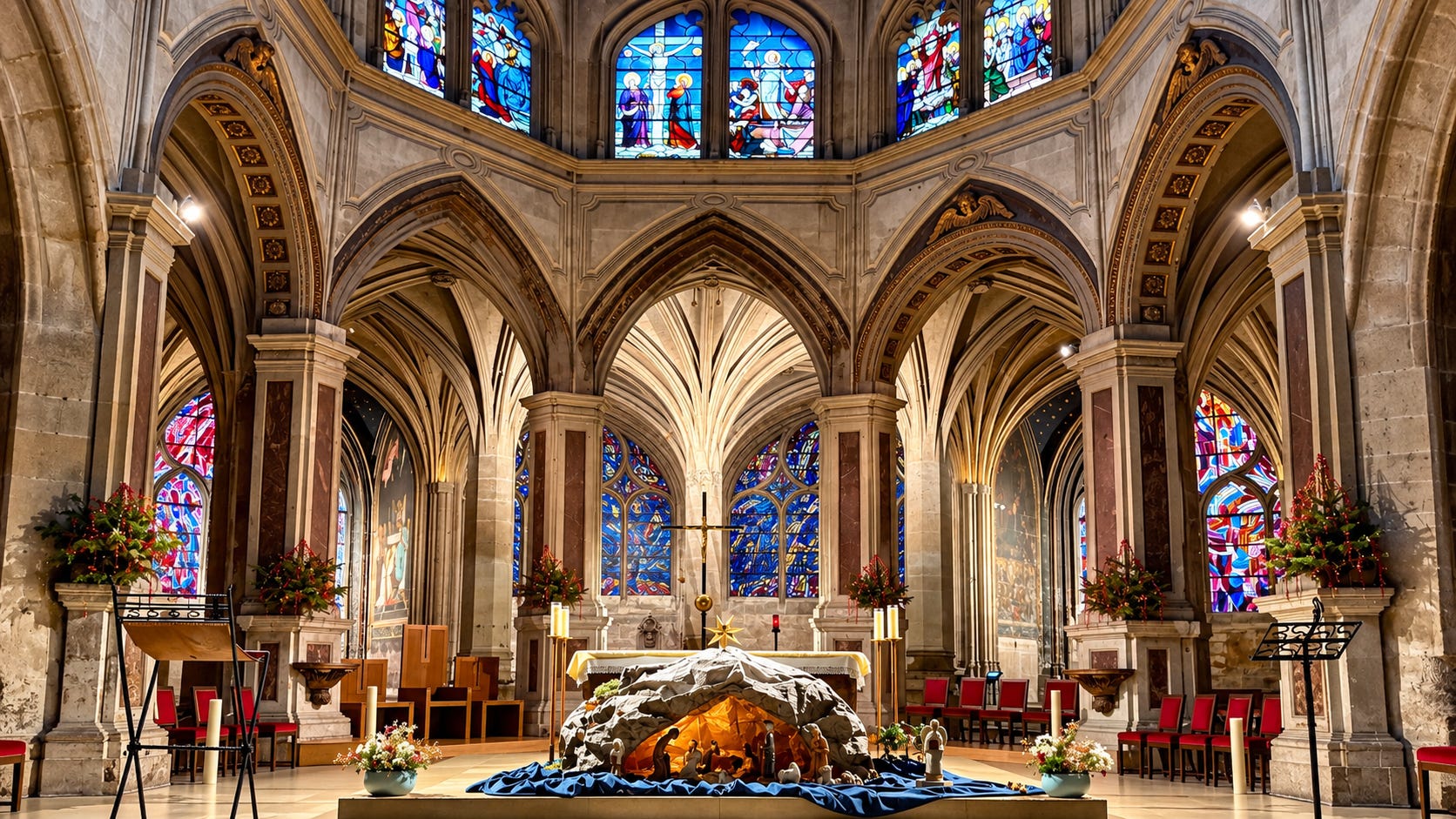
Tucked away in the Latin Quarter of Paris is a medieval church that has stood watch over its neighborhood for hundreds of years. I visited Saint-Séverin during a research trip to Paris to explore the settings for my historical fiction series, When the Sea Was Still. I had already tentatively chosen it as one of the settings in my novel, but I wanted to see the church for myself before committing it to the page. After all, there are so very many beautiful and interesting churches in Paris to choose from.
From the outside, the Church of Saint-Séverin looks every bit its age, its weathered façade darkened by centuries of soot, pollution, and exposure to the elements. Nothing about its somber exterior prepares you for what waits beyond its heavy wooden doors.


Stepping inside, I found a stunning atmosphere of artistry and wonder. Colorful stained-glass windows rose above dramatic arches, while carved columns twisted upward like ribbons of stone. I had entered a peaceful sanctuary that felt in complete contrast to the hustle and bustle of the Latin Quarter outside.
Saint-Séverin is one of the oldest churches on Paris’s Left Bank. Construction on the Gothic church began in the thirteenth century, around 1230, when the area was becoming the center of university life in Paris. Much of the building was later destroyed during the Hundred Years’ War, leaving only the bell tower and the first three sections of the original nave intact.
Reconstruction began around 1450, just two years later, transforming Saint-Séverin into the Flamboyant Gothic church we see today. The church was widened from three aisles to five. Later, between 1489 and 1495, the distinctive cluster of columns was added, including the famous central pillar that fans out like a palm tree.


Saint-Séverin survived another perilous chapter during the French Revolution, when it was closed as a place of worship and used to store gunpowder, then animal feed and church bells. Countless bells across France were broken apart and melted down for metal, but Saint-Séverin’s bell, named Macée, was one that survived. Today it is the oldest bell in Paris, having been cast in 1412.
When I began searching from home for a church to use in my story, I had specific requirements in mind. It needed to be in the 5th arrondissement, near where my characters lived and it had to be old enough to have served generations of the same family. The church was important to me because it would become the setting for a powerful scene after the First World War changed their lives.
Saint-Séverin seemed to offer everything I needed. Its location in the heart of the Latin Quarter placed it very close to my character’s apartment, and the photographs I found online confirmed its beauty. Once stepping inside, the deal was sealed. None of the photos I’d seen had captured its true magnificence or the feelings it inspired, for only being there in person could.


Some places feel as though the story itself chose them rather than the author, and Saint-Séverin is one of them. In the novel, it has been part of my characters’ lives since childhood. They have gathered there for Sunday Mass, celebrated baptisms, confirmations, holidays, and weddings, and shared moments that bound their families together across generations.
When the First World War broke out, so much in Paris changed. So much was lost. Shops closed. Men left for the front. Daily life was suddenly transformed from joie de vivre to uncertainty and fear. Through it all, Saint-Séverin remained, one of the few constants. A beacon of hope. A place to pray. For my characters, the comfort and continuity it offered felt like a lifeline as they waited to hear news of their loved ones.


All of this settled over me as I sat quietly in the church. The centuries of history were present in its walls—the many lives that have passed through, the prayers whispered, the love celebrated, and the tears shed. Places like Saint-Séverin inspire me to tell stories about the people who walked these streets and sat beneath these arches long before us.
And maybe that is why I love Paris so much. To stand inside one of its centuries-old buildings is to stand inside a page in history. Across the city, the past remains woven into places that are still visited, loved, and used every day. When I walk through Paris, I see layers of history so captivating that I am compelled to write about them.
If you’d like to go back to 1914 with me and follow Nora into the glittering final summer in Paris before the First World War, you can start reading When the Sea Was Still here:
