
The Two Faces of Patmos
Uncovering an Aegean paradise where sacred history and modern luxury collide

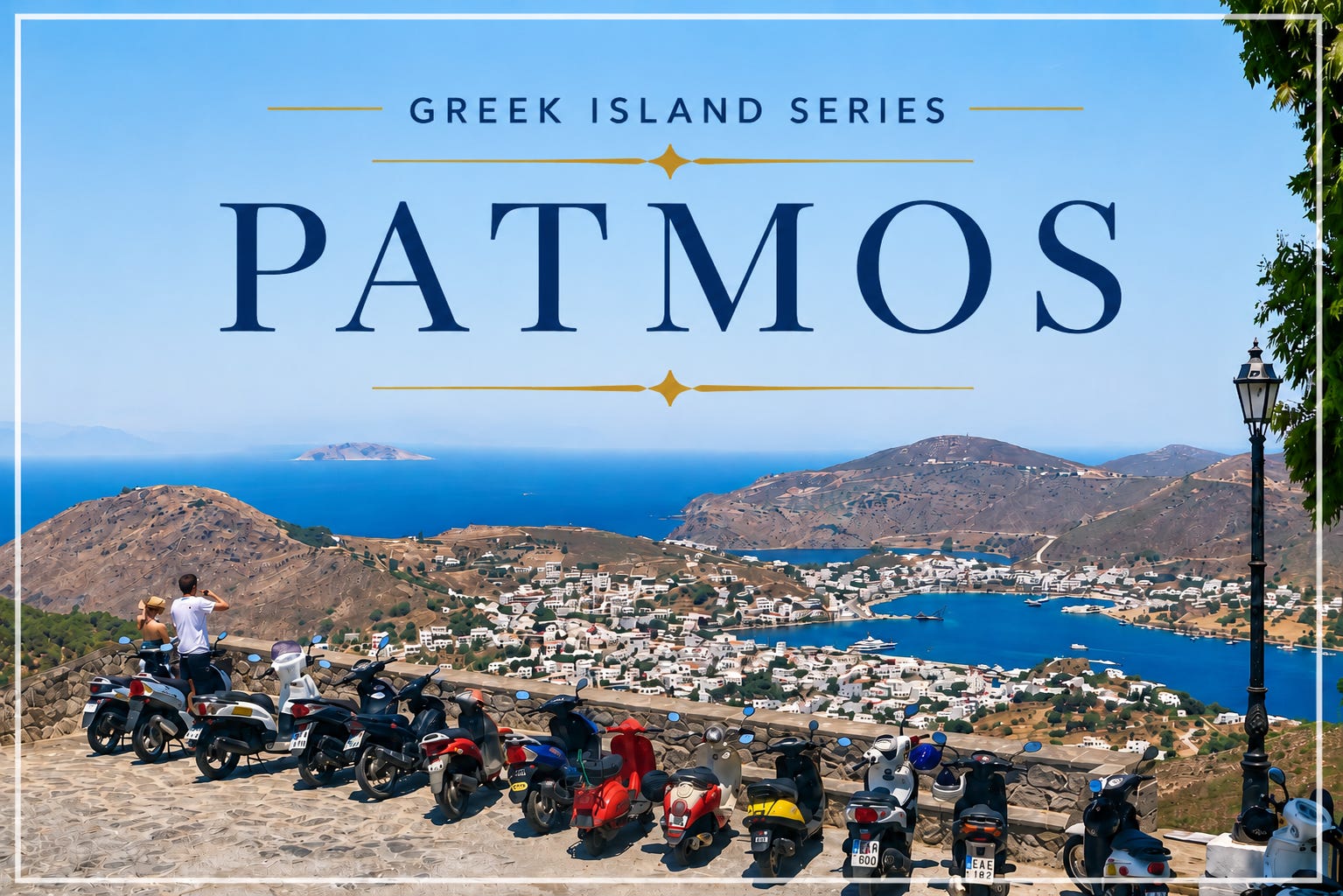
The Story of Patmos
Patmos is best known as the island where the Book of Revelation was written around A.D. 95, but its story begins much earlier. According to ancient Greek mythology, Patmos was an island born from the sea, raised up from the waters by Zeus for his daughter Artemis. And the island’s first known inhabitants date all the way back to 3,000 B.C. Travelers today can still see the 4th-century B.C. acropolis walls on Kastelli Hill, evidence of the island’s early prosperity. The Apostle John, who wrote the Book of Revelation, ended up on Patmos after the Romans turned the remote island into a colony for political prisoners and banished him there for preaching Chrisitanity.
Centuries later, pirates became a constant threat, raiding the island for provisions, Christian relics, and slaves. By the 7th century, Saracen pirates had ravaged Patmos so severely that the island remained largely abandoned for the next 200-300 years. Then a monk named Christodoulos needed a place to build a new monastery. Likely because of the island’s Book of Revelation ties, plus the fact that Patmos was empty and available, he asked for permission to found a monastery. It was granted by the Byzantine Emperor Alexios I Komnenos, and the Monastery of Saint John the Theologian was born in 1088. To protect itself from pirates, it was built up like a fortress high on the island, and with walls over 15 meters high. The town of Chora sprung up around it, with narrow streets that acted like a maze. The idea was that any pirates who made it ashore would get lost before reaching the monastery gates.
Today, Patmos is a place where two worlds coexist. It’s a collision of sacred history versus modern luxury, where black-hulled yachts anchor in the same harbor that pilgrims have arrived at for centuries, and where the dark stone fortress of the monastery looms silently above the sunbathers on beaches below. It is this beautiful contradiction that draws travelers to Patmos, inviting them to wander a landscape filled with religious history, ancient village streets, waterfront cafes, boutique shops, and the crystal clear waters of the Aegean Sea.
What Not to Miss
Explore the Monastery of Saint John


Perched high on the island, the imposing Monastery of Saint John has watched over Patmos for more than 900 years. Inside, visitors can wander (with no charge) through a maze of stone arches, beautiful courtyards, and Byzantine chapels adorned with centuries-old frescoes. The monastery’s museum displays centuries-old religious treasures (for a small entry fee).
Even if you’re not visiting for religious reasons, it’s one of the island’s most impressive landmarks. It was named a UNESCO World Heritage Site in 1999. Come for the history, but stay for the view—the terrace outside offers one of the best panoramas of the beautiful sea below on the entire island.
Visit the Cave of the Apocalypse


Just below the monastery lies the Cave of the Apocalypse, one of Christianity’s most significant pilgrimage sites. Tradition holds that this is where the Apostle John received the visions recorded in the Book of Revelation. Visitors can go inside the cave for a small fee (3 Euro at the time of writing this) where they can see the stone pillow John is said to have rested his head, along with the cleft in the stone ceiling through which he reportedly heard the voice of God. The cave has since been built into a working chapel, and it remains an active place of worship today.
Along with the monastery, the cave was named a UNESCO World Heritage Site in 1999. Outside the cave are beautiful gardens with the scent of lavender in the summer and gorgeous views of the harbor below.
➡️ Recommended Experience: Combine the Monastery and the Cave with a tour such as Monastery & Cave of the Apocalypse Tour with Viator.
Wander the Streets of Chora


Chora is the capital of Patmos. It means “town,” which is the name shared by virtually every island capital in Greece (similar to Main Street in the U.S.). Allow yourself at least two or three hours to explore this charming place on foot. Chora is best experienced without a plan or a map because every turn seems to reveal another surprise, whether a hidden courtyard, tiny chapel, or breathtaking view of the Aegean Sea.
Browse the boutiques. Chora is home to a number of beautiful shops selling handmade Greek jewelry, leather sandals, artwork, textiles, and honey. Be sure to look for locally produced thyme honey and extra virgin olive oil, two of Patmos’ best-known specialties.
Stop for a Greek coffee. Find a café tucked into one of Chora’s quiet squares and take time to slow down. Watching everyday life unfold is part of the experience.
Get lost on purpose. Some of Chora’s prettiest streets aren’t marked on any map. Wander the narrow alleyways and you’ll discover hidden courtyards, blooming bougainvillea, tiny chapels, and spectacular views over the harbor.
Stay until evening if you can. As the sun sets, the village takes on a magical atmosphere as lanterns illuminate the whitewashed streets and the monastery glows above the town.
Relax at Agriolivadi Beach


An easy taxi ride from Skala, Agriolivadi is one of Patmos’s most easygoing beaches. The beach is long and wide, with a mix of soft sand and fine pebbles. Its shallow, warm water makes it especially well suited to families. Sunbeds and umbrellas line the organized section and cost a small fee to rent. A line of lovely tamarisk trees at the other end of the beach, offering natural shade for visitors who don’t wish to pay for a sunbed. A beach bar serving food and drinks, along with water sports is also available. The beach’s calm, crystal-clear waters make it one of the best places on the island for a refreshing swim, with excellent visibility that lets you see straight to the bottom.
Dine and Shop in Skala


Skala is the island’s main port and the place where most visitors first arrive. During the day it’s bustling with ferries, fishing boats, cafés, and local shops. In the evening, the waterfront becomes a wonderful place for dinner as the sun begins to set over the harbor.
Enjoy a leisurely meal. Skala’s waterfront is lined with cafés and tavernas serving everything from fresh seafood and traditional Greek dishes to homemade desserts. While you’re there, be sure to try the island’s traditional Patmos cheese pie made with local cheeses and a hint of cinnamon.
Browse the harbor shops. From locally made jewelry and artwork to olive oil, honey, and handmade soaps, Skala offers plenty of opportunities to pick up a souvenir before heading home.
Take a walk along the marina. Before leaving, wander the waterfront promenade and admire the colorful fishing boats, visiting sailboats, and the beautiful views across the bay.
What I loved about Patmos


There are plenty of reasons to love Patmos, and since it was my first visit to a Greek Island, I did love just about everything about it, from the white-washed buildings to the gorgeous harbor views from the top of the island. It was all stunning. But three things stood out to me above all the rest, three things that were a surprise to me.
The swimming. I’d heard that the waters of the Aegean have a restorative quality, but I didn’t truly understand what that meant until I experienced them for myself. Floating in the calm, crystal-clear sea, I felt an overwhelming sense of peace unlike anywhere I’d ever swum before. Whether it was the warmth of the water, the incredible clarity, or simply the beauty of my surroundings, I came away feeling completely refreshed.
The food. I knew the food would be good but I didn’t know just how good it would be until I tried it for myself! Every meal tasted fresh and full of flavor. The stuffed tomatoes I had for lunch were so simple yet so delicious.
The cats. If you’ve followed me for any length of time, you know I can’t resist a friendly cat. It was on the island of Patmos where I saw my first cat of Greece, having no idea that this meant something. After seeing cats seemingly everywhere on the islands to follow, I learned about the “cats of Greece” and fell in love with the way Greeks take care of their cats, leaving food and water for them on the streets.
When you combine all of that with Patmos’ peaceful atmosphere, beautiful architecture, fascinating history, and welcoming people, it’s easy to understand why this Greek island has stayed with me long after I returned home.
Traveling Author Reads
As a writer, I rarely travel anywhere without a stack of books that tie me to the landscape. If you want to journey deeper into the unique atmosphere of Patmos from your own armchair, here are three books to add to your reading list:
For the Mystery Fan: Prey on Patmos by Jeffrey Siger. If you like your travel with a side of suspense, this is part of a critically acclaimed Greek police procedural series. It is a fast-paced thriller that plays out against the backdrop of the island’s historic monasteries, hidden monk politics, and local culture.
For the Psychological Thriller Fan: The Destroyers by Christopher Bollen. A psychological thriller that strips away the sleepy island myth to reveal Patmos as a glittering, tense playground for the ultra-wealthy. It plunges readers into a dark web of conspiracy, super-yacht politics, and elite secrets hidden behind the whitewashed walls of Chora.
For the Historical Fiction Lover: The Prophet of Patmos by Adelbert Scholtz. A vividly researched historical novel that steps back into 95 AD. It reconstructs the harsh realities of the Roman penal colony and reinterprets the dramatic, cosmic visions of the Apostle John as he experienced them on the island.