


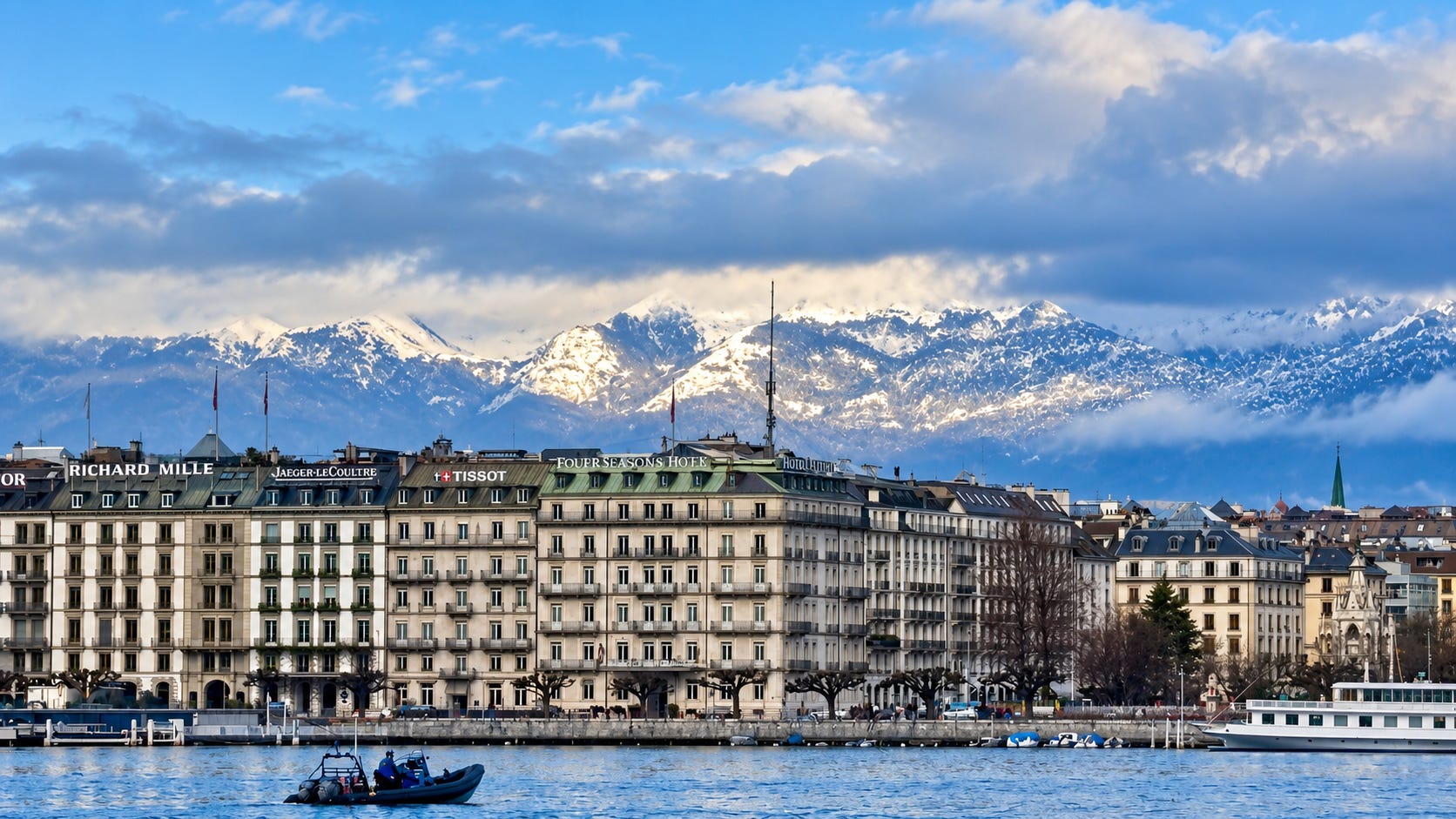
I caught my first glimpse of Lake Geneva from a high-speed train as I traveled from Milan last year, a beautiful finale to an already spectacular journey through the Alps. But it wasn’t until I walked down to the waterfront that I truly appreciated the magic of this giant lake. Its calm waters stretch beneath the Swiss Alps and beyond the French border, giving it a vastness I hadn’t expected. Being there in the quiet of winter made it feel even more enchanting. The lake was devoid of tourist boats and summer crowds. All that was left to enjoy the peaceful atmosphere was me and the swans swimming serenely across the water.
Playground for the Wealthy
More than a century before my visit, Lake Geneva was already one of Europe’s great vacation destinations. During the Belle Époque, from 1871 to 1914, wealthy American travelers came for the spectacular views as we do today, but they also chose Lake Geneva for its grand hotels, elegant steamers and the Swiss hospitality that dominated luxury travel at the time.
The grand hotels along the shores of Lake Geneva were much more than just places to sleep. They were at the heart of the social scene, and the social scene was everything. Wealthy travelers dined in extravagance and gathered in elegant salons, taking note of who else was there. Even the visitors’ book became part of the social experience. Guests could browse the names of the prominent guests who had stayed before them, while leaving their own name and social affiliations behind to impress travelers who followed. Being able to say you had stayed at one of Europe’s fashionable grand hotels carried a status all its own.
A Belle Époque vacation on Lake Geneva moved at a very different pace from European travel today. Wealthy visitors didn’t arrive at a grand hotel for two or three nights before hurrying on to the next city. Stays of several weeks, or even months, were common. With trunks of clothing unpacked into their rooms and their household staff accompanying them, a grand hotel became a temporary home for the season.
Affluent families arrived with an entourage, typically bringing two to four personal servants, including a lady’s maid and a nanny or tutor for the children, while some also traveled with a secretary, butler or chauffeur. Their servants stayed at the hotels too, although in decidedly less glamorous accommodations. At the Caux Palace above Montreux, guests occupied luxurious rooms overlooking Lake Geneva, while their servants slept in smaller rooms on the mountain-facing side of the same floors and used separate staircases.
Fresh Air and a Good Night’s Sleep
There was another reason Switzerland appealed to travelers of the period: people believed it was good for them. Throughout the nineteenth and early twentieth centuries, European physicians increasingly prescribed changes of climate, fresh air, rest and outdoor activity for a variety of ailments. Switzerland became particularly associated with this culture of restorative travel, with its mountain air, beautiful scenery and tranquil surroundings, all believed to help restore an overtaxed nervous system.
Switzerland provided Americans a sanctuary from the smog of rapidly industrializing cities like New York and Chicago. Doctors even prescribed climatic cures for people suffering from neurasthenia, a term used for burnout, anxiety and insomnia. Edwardian doctors genuinely believed that the unique microclimate where the Swiss Alps met Lake Geneva created a tranquil atmosphere that acted as an antidote.
As a result, the ritual of rest was taken seriously. At Swiss resorts, guests spent hours reclining outdoors on deep set hotel balconies, wrapped in expensive wool blankets while breathing the mountain air and starring at the glassy water to soothe their nerves. Around Lake Geneva, they could also visit spa towns for hydrotherapy and mineral-water treatments. Just across the lake in Évian-les-Bains, visitors came specifically to drink and bathe in the mineral water for which the town was already famous.
Then and Now
One of the things I love about Lake Geneva is how much of its Belle Époque world can still exists today. From preserved boats that transport visitors back in time to grand hotels that have been serving guests for well over a century, Lake Geneva is a time capsule of that elegant era.
Paddle Steamers
During the Belle Époque, paddle steamers were one of the most elegant ways to travel around the lake. The Compagnie Générale de Navigation (CGN), Lake Geneva’s passenger-boat company, carried visitors between Geneva and fashionable lakeside destinations such as Lausanne, Vevey, Montreux and Évian. By the early twentieth century, its finest vessels offered first-class salons designed to rival the grand hotels waiting on shore. Passengers walked across teak decks into richly decorated interiors filled with intricate wood marquetry, gilded details, plush carpets and comfortable upholstered seating. Outside, they could stroll the open decks and watch the Alps, vineyards, and grand hotels drift past as coal-fired engines powered the great paddle wheels beneath them. Crossing the lake wasn’t simply transportation. The journey itself was part of the luxury vacation.
You can still experience these historic vessels today. Six vessels from the CGN fleet continue to carry passengers on Lake Geneva, including La Suisse, commissioned in 1910, and Savoie, commissioned in 1914. They offer scenic cruises, service between lakeside towns, and dinner cruises serving Swiss and regional dishes. Extensive restorations have preserved their elegant period appearance while also incorporating modern safety systems and technology beneath the surface. Despite the use of 21st-century technology, the Belle Époque aesthetic remains alive and you can still see the beautiful surroundings of Lake Geneva from the water much as travelers did more than one hundred years ago.
The Jet d’Eau
Geneva’s signature landmark has also existed since the opulent days of the Belle Époque. This unique spray of water that jets high up into the sky straight out of the lake is known as the Jet d’Eau (“jet of water”).
It originally appeared almost accidentally in 1886, when a hydraulic plant needed a way to release excess water pressure after the city’s workshops shut down for the evening. People loved the resulting plume of water so much that in 1891 Geneva created a new Jet d’Eau in the harbor, where it became a popular attraction.
Visitors today see a more dramatic version of what was seen then. As a result of a new pumping station installed in 1951, the height of the water increased from about 295 feet (90 meters) to a dramatic 460 feet (140 meters). The accidental burst of water that delighted Belle Époque visitors still delights travelers today and has become the iconic symbol of Geneva.


When the Sea Was Still Connection
Lake Geneva is the vacation destination for a wealthy couple in my serial novel When the Sea Was Still, which inspired me to dig deeper into what they would have experienced there in July 1914. I hope you’ve enjoyed traveling back with me to Lake Geneva during the elegant days of the Belle Époque!
If you’d like to learn more about When the Sea Was Still, you can read about it here.
To celebrate the fall season, I am running a flash sale on my first book, You Don’t Have to Stay. From now until Thursday (9/17), the Kindle eBook is just $0.99. Grab your copy here!