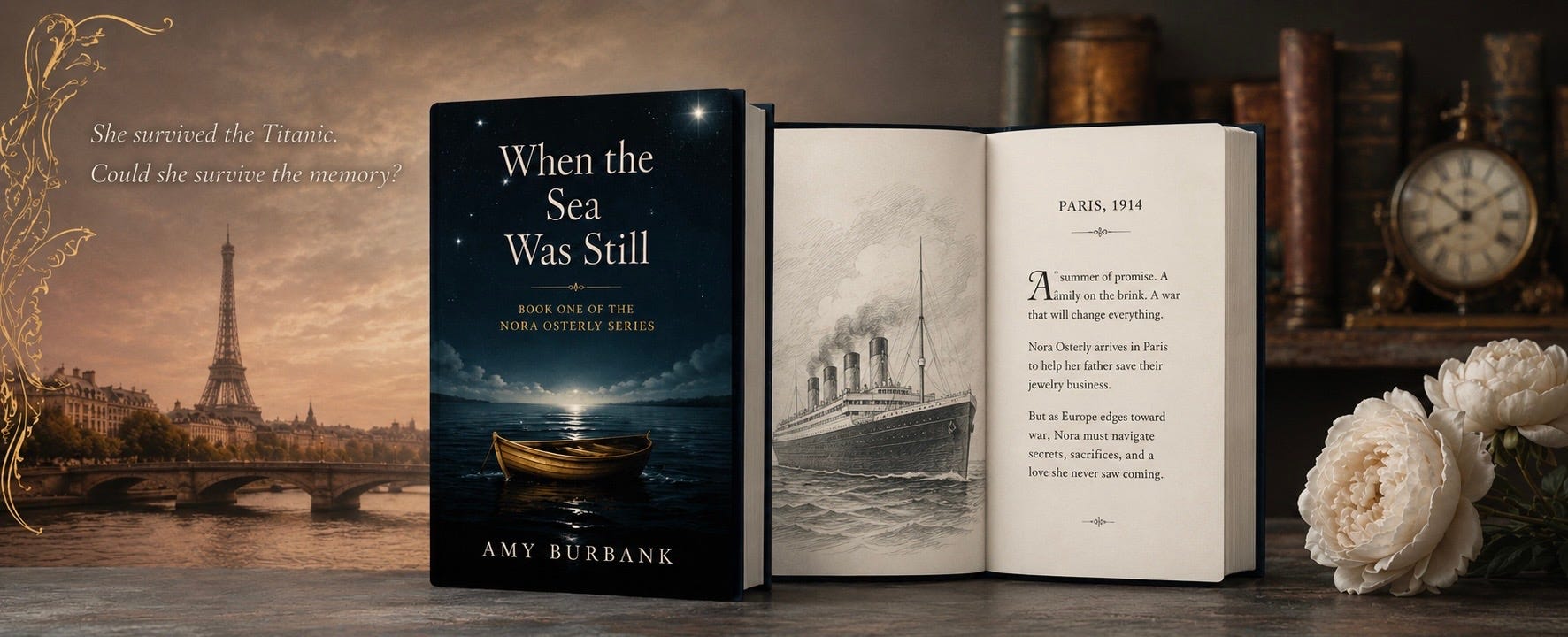

When the Sea Was Still is a historical novel inspired by Titanic survivor Helen Ostby. While the heroine of the story, Nora Osterly, is entirely fictional, her journey draws on the incredible life of Helen Ostby. After surviving the Titanic disaster and losing her father, Helen went on to help run the family jewelry business, Ostby & Barton, which required her to face the sea again for business in Europe. Remarkably, she found herself in Germany on the eve of the First World War.
The novel starts two years after the sinking of the Titanic, when Nora Osterly is forced to cross the Atlantic again—this time aboard Titanic’s nearly identical sister ship, the Olympic. To save her father’s legacy, Nora must do the one thing she swore she never would: return to the sea that nearly killed her.

←Previous Episode | Story Index
Nice
Anders
April 1912
Nice, France
The morning light in Nice had a gentle beauty Anders hadn’t found anywhere else. Standing on the balcony of the Hôtel Royal, he watched hues of gold shimmer off the blue waters of the Mediterranean as scents of orange blossoms wafted up from the gardens below. He had always been fond of Nice in April. But Ingrid had simply adored it.
What began as their honeymoon destination became a place they returned to year after year. Ingrid had loved Nice the way some people love a person—completely and without reservation. Each morning she would rise early and sit on the balcony to watch the sunrise, the sun catching the pale sapphires of the ring he’d made her. He would watch her from the doorway, a cup of coffee in hand, struck each time by the love he felt for her.
They had always planned to bring Nora to Nice once she was old enough. But before that day came, Ingrid fell ill, and the holiday they had imagined never came to be.
Ingrid had developed a lingering cough in the fall of 1899. At first it was easily dismissed—a soft sound at the breakfast table, or in the evenings when the air turned cool. Yet as winter deepened, so did her cough. The sound of it began to haunt the house.
Anders had watched helplessly as her strength ebbed. Once so full of energy, Ingrid had grown pale and tired, spending more time in bed with each passing day. By spring, she could no longer climb the stairs without stopping to catch her breath.
The end came on a warm summer morning. Anders had sat beside the bed, holding her hand, trying to imagine a life without her. He had thought about how much he would miss her laughter and the warmth of her hand on his. All the years they had believed still lay before them had suddenly vanished, stolen by her illness.
Then, as he looked upon her peaceful face, another thought came, more painful than the first. She would never see their daughter grow up. He bent closer to her. “Nora will never want for anything,” he said. “You have my word.”
She tried to smile, and for a moment, he thought she might speak. He gave her hand a gentle squeeze as she drew one last breath, and her eyes closed forever.
The tuberculosis had taken Ingrid in a long, drawn-out battle when Nora was only ten years old. She was too young to fully understand. For months after the funeral, she spoke little, drifting through the house as though she was lost, until one day she wandered into his workshop and stood beside him with a pencil in hand. From then on, she sketched silently as he worked, their shared grief slowly healing in each other’s company.
A soft rustle drew him back to the present.
“Father?”
He turned. Nora stood in the doorway, her hair loosely pinned. For an instant, he caught a glimpse of Ingrid in his daughter’s expression.
“Good morning, Nora,” he said. “Did you sleep well?”
“Quite well,” she replied, stepping onto the balcony. She rested her hands on the railing and looked out at the glittering Mediterranean. “Nice is beautiful. It is easy to see why Mother adored it so.”
“Yes,” he said. “There was nowhere she loved more.”
“The hotel is lovely too,” Nora replied. “It is every bit as elegant as the Ritz.”
“It is,” Anders agreed. “I only wish your mother could have seen it. She would have approved.”
“I wish I could remember more of her,” Nora said. “Every year she fades a little more.”
“I feel it too, little one,” Anders said, putting an arm around his daughter’s shoulders.
They stood together a moment longer, gazing at the shoreline, lost in memories of Ingrid. Finally, Anders straightened, letting the past settle gently back into place.
“Shall we dress for breakfast?” he asked.
Nora’s smile returned. “Yes, let’s.”
That afternoon, Anders sat at the writing desk in the sitting room of their elegantly appointed suite while Nora rested in her bedchamber. The tall windows draped in ivory silk stood open to the balcony, allowing the sea air to drift inside. From beyond the promenade came the rhythmic sound of waves against the shore and the occasional distant clatter of carriage wheels along the Promenade.
Anders leaned back in his chair for a moment, letting the calm settle around him. The Paris trip had gone better than he had dared hope. It had been nearly a year since the partnership was signed—August of 1911, in Etienne’s father’s old office—and this trip had let him see for himself that the arrangement was working as they had planned.
He thought of Étienne. He was a gentleman of precision with an ambition that mirrored his own. Anders had met many talented men in his years in the trade, but few who combined artistry with sound judgment in equal measure. The collaboration would benefit both houses. For Anders, the partnership meant Paris-made pieces for his American clients and a European presence he could not have built from Providence. For Etienne, it meant American capital and access to the Osterly & Co.’s clientele. Together, they could create work neither house could have produced on its own.
And Nora had taken to him. That mattered more than he had admitted to himself at the start. She would be the one to carry this forward one day, and he needed to know she trusted the man he had chosen to build it with.
There was, of course, the matter of the loan, sixteen thousand five hundred francs, borrowed at the signing to fund the expansion of the workshop. The new luxury line required new equipment, more space, and master artisans capable of bringing their designs to life. Though the sum was considerable, it was hardly alarming.
He had paused when it came time to pledge Ingrid’s engagement ring as collateral. He had designed it himself more than twenty years earlier. At its center sat a brilliant diamond, embraced by two sapphires, Ingrid’s favorite stone. He could still picture her face when he placed it onto her finger. Now it rested in Herr Kessler’s Paris office, held in trust until the debt was retired.
The luxury line was already performing well, and the first of the interest payments had been made without difficulty. By the time the principal came due in August of 1914, Anders was confident the collaboration would have generated more than enough to retire the debt entirely and return the ring to his safe. He had run the calculations many times. The numbers held each time.
He had not mentioned it to Nora. There was no need to. She had enough to carry without the weight of financial details that would resolve themselves long before they became her concern.
He reached for a sheet of the hotel’s cream-colored stationery and began to write.
Cher Monsieur Moreau,
I hope this letter finds you well and that Paris has returned to its usual rhythm since our departure. I write from Nice, where Nora and I have paused to rest before our voyage home. The Hôtel Royal is as comfortable as its reputation promises, and the Mediterranean light is unlike anything one finds further north.
I wished to express once more my gratitude for your hospitality during our visit. The signing of the partnership agreement marks the beginning of something I believe will serve both our houses well for many years to come.
The calm here has given me time to reflect on the opportunities our collaboration presents. The pieces we discussed, particularly the Art Nouveau inspired line, have great promise. When I return to Providence, I shall begin selecting the stones suited to the designs we reviewed together.
If you are able, I would be glad to receive the updated sketches once your artisans have refined the enamel work. Nora was especially taken with the prototype you showed her, and I believe such pieces will resonate strongly with our clients on both sides of the Atlantic.
I look forward to the road ahead. Please extend my regards to your staff.
Avec mes sentiments dévoués,
Anders Osterly
As he let the ink dry on the letter, he thought of the promise he had made years ago at Ingrid’s bedside. Every decision since had been shaped by it—every investment, every carefully chosen stone, every client relationship built and maintained.
That evening, Anders and Nora dressed for dinner and made their way to the Hôtel Royal dining room, where they were to join Frank and Anna Morris, a Providence couple they had met earlier in Paris. The Morrises had proven to be pleasant company, Mr. Morris a successful manufacturer, while his wife was warm and gracious.
As they stepped inside the hotel’s dining room, the hostess led them beneath crystal chandeliers to a table dressed in crisp linen, where Mr. and Mrs. Morris rose to greet them.
“Mr. Osterly! Miss Nora!” Mrs. Morris said, extending her hand. “How lovely to see you again.”
Mr. Morris gave a firm nod. “We’re delighted you could join us this evening.”
“The pleasure is ours,” Anders replied, taking his seat beside Nora.
The waiter filled their glasses with chilled water before presenting the menu—an elegant assortment of Provençal dishes and seafood from the bay.
Mrs. Morris leaned in with a smile. “Have you been enjoying Nice, dear?”
“Very much,” Nora answered. “We walked the promenade this morning. There’s a lovely balance here between activity and ease.”
“You have a keen eye. I’ve been embracing the quieter side myself,” Mrs. Morris said. “I told Frank this is the first place in Europe where I feel I could simply sit and do nothing at all for days.”
Mr. Morris smiled. “And she has, I assure you.”
Their first courses arrived as the conversation shifted to the Morrises’ travels through Italy, from Florence’s art galleries to the charm of Lake Como. Anders listened intently, while Nora peppered the older couple with questions about the Italian lakes.
Anders smiled at the stories of mishaps with luggage and unpredictable spring weather. “When do you return home?” he asked.
“We’re traveling to Cherbourg on Wednesday, where we’ll board our ship for home.” Mrs. Morris replied.
The mention of the French port piqued Anders’s curiosity. “Will you be crossing with the French Line?”
Frank shook his head. “White Star Line. The Titanic.”
“The Titanic,” Nora said, her eyes widening. “We’ve been reading about her all season. The newspapers describe her as a floating palace.”
“The very one,” Mrs. Morris confirmed. “It’s her maiden voyage to New York. Frank surprised me with our passage for our fortieth wedding anniversary.”
“How lovely,” Nora said. “We sailed on her sister ship, Olympic, last year. She was so steady I barely knew I was at sea.”
“Then Titanic will suit you even better,” Mr. Morris said. “They say she’s everything Olympic is and more.” He turned to Anders. “Have you seen the passenger list? Astor, Guggenheim, Straus. The cream of New York society. It promises to be quite a crossing.”
“And I understand Lady Duff-Gordon is sailing,” Mrs. Morris added. “I have two of her gowns and I confess I am quite beside myself at the prospect of meeting her.”
Anders felt a stir of intrigue. “Titanic has been the talk of every city we’ve visited this season. With a passenger list like that, I imagine White Star intends her maiden voyage to be as much a social event as a crossing itself. You’ve secured first-class passage, then?”
“We have.” Mrs. Morris smiled at her husband. “Frank wanted something memorable to end our forty years together.”
Frank smiled. “If you are heading home soon Mr. Osterly, you might consider joining us. I understand there are still berths available.”
The prospect sent a quiet ripple through Anders. A maiden voyage on the most celebrated ship afloat, with new friends and the finest passenger list of the season, had a certain appeal.
Conversation flowed easily between them throughout dinner as the pianist continued to play waltzes from the corner. A gentle breeze off the Mediterranean drifted through the open windows. It was one of those evenings that felt suspended in time.
As the dessert plates were cleared, Mr. Morris set down his wine glass. “Thank you for joining us,” he said. “The offer stands should you wish to join us aboard Titanic.”
“Do think it over, Mr. Osterly,” Mrs. Morris added. “It would be delightful to have company on the crossing.”
Anders hesitated, weighing the invitation. “It is certainly a remarkable ship if she’s anything like her sister.”
“Then let’s sail on her, Father!” Nora said, unable to hide her excitement.
Anders felt his own excitement rising to meet hers. He chuckled softly, imagining the story they would one day tell of sailing on the greatest ship ever built.
“Why not, Nora?” he said. “They are calling her the Queen of the Ocean. And we shall be on her maiden voyage!”
“Then it’s settled,” Mr. Morris said with a satisfied nod.
“Splendid!” Mrs. Morris said, raising her glass.
The other three raised their glasses and clinked them with hers.
“To the Titanic,” they said in unison.

Before Titanic: The Story of Nomadic
When Nora and her father decide to cross the Atlantic on Titanic’s maiden voyage at dinner in Nice, it seems like such a simple choice at the time. It turns out to be a decision that will affect the rest of their lives. It’s also a part of their story that is rooted in history.
The real woman who inspired Nora, Helen Ostby, also crossed the Atlantic on the Titanic with her father Engelhart, who was a Providence jeweler. They’d spent the winter touring southern Europe and Egypt together, and it was in Nice, over dinner with their friends, the Warrens, that they first heard the Titanic still had room for passengers on her maiden voyage. They decided, that night, to change their plans and sail home on Titanic instead.
Officially, the White Star passenger list has the Ostbys boarding Titanic at Southampton. But Helen herself, in her letters and later accounts, insisted they’d boarded at Cherbourg—alongside the Warrens. I’ve chosen to believe her, so Nora and Anders board in France as well.
The inner harbor of Cherbourg wasn’t built to accommodate ships as large as Titanic, so instead of docking, it anchored offshore in the deeper water. And a small, unassuming vessel called the SS Nomadic ferried the first-class passengers out to the great ship.
Helen and Engelhart were sitting among some of the richest, most prominent people of the day on the small tender boat. Each of them had their own reason for being in Europe that spring, and their own reason for choosing this particular crossing home.
Famous Titanic Passengers Aboard Nomadic
Colonel John Jacob Astor, one of the richest men in the world, had spent the winter abroad with his new wife, eighteen-year-old Madeleine. The couple had gone on an extended honeymoon to Egypt and Paris, in part, to escape the scandal their marriage had caused back home in New York. They traveled with quite a crew, including a manservant, a maid, a private nurse, and even their dog, an Airedale terrier named Kitty. When Madeleine became pregnant during their travels, they cut their honeymoon short and booked passage home on Titanic.
Margaret “Molly” Brown, who had joined the Astors for part of their Egyptian travels, was aboard Nomadic too, though her reason for sailing home was more urgent. She’d been touring Europe with her daughter Helen when she received word that her infant grandson, back home in America, had fallen ill. She booked her ticket the day before Titanic sailed and was one of the very last passengers to do so.
Sir Cosmo and fashion designer Lady Duff-Gordon (Lucile) also boarded Titanic in Cherbourg. Nora, who wears one of Lucile’s gowns in the story, would have sailed on Nomadic with the woman who dressed famous clients from dancer Isadora Duncan to the British royal family. Lady Duff-Gordon hadn’t planned to sail on Titanic but urgent business at her New York fashion house meant she needed the first available ship home, and Titanic’s maiden voyage happened to be it.
Like Nora and Anders, none of these elite passengers could have known, stepping from the decks of Nomadic onto those of Titanic, that they were walking toward the last few days of the world they knew before it changed forever.
SS Nomadic
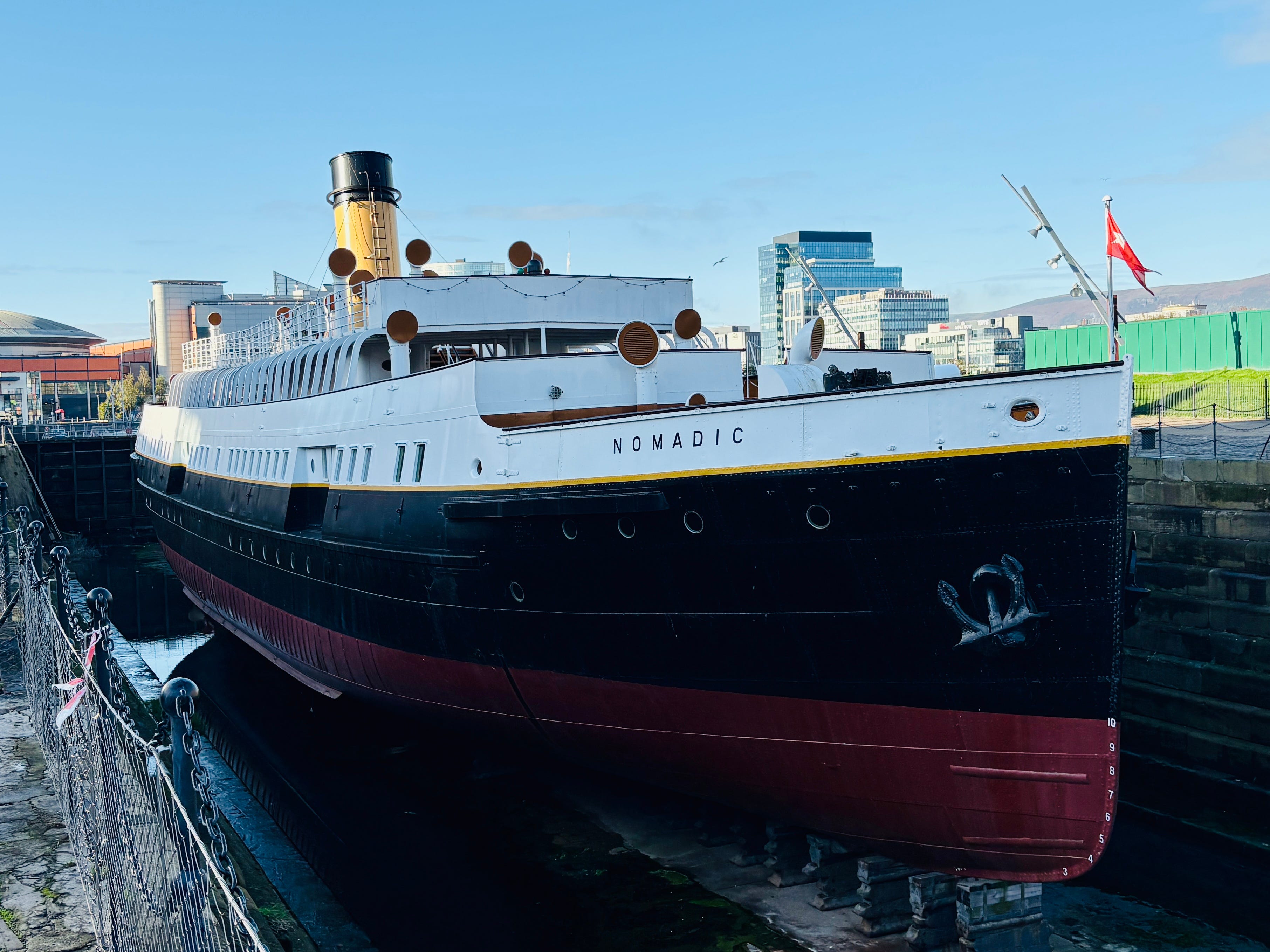
Unlike Titanic’s short life, Nomadic went on to live a long and remarkable one. After completing her duties at Cherbourg for Titanic, she continued for years to serve as the tender for Titanic’s surviving sister, the Olympic. When WWI began, she was requisitioned by the French Navy and refitted as a military transport and minesweeper.
After the First World War, Nomadic returned to civilian service, once again ferrying passengers to White Star Line ships. In 1934, the merger of White Star and Cunard, combined with an expansion of Cherbourg’s harbor made her tender services unnecessary. She was sold to a French salvage company and renamed Ingénieur Minard. During the Second World War, she was once again used as a minesweeper and troop transport.
After retiring in 1968, she narrowly escaped the scrapyard more than once before being restored to her original name and returned to her birthplace through the efforts of Titanic preservation groups.
Today, after a massive overhaul, she sits back where she began—in Belfast as a part of the Titanic experience. It’s fitting that she now rests near the same shipyard that built her alongside Titanic over a century ago. The SS Nomadic is the sole survivor of the White Star Line and a living piece of Titanic history.


Stepping Back in Time
Visiting Nomadic while researching When the Sea Was Still gave me the opportunity to walk through the very first-class spaces where Helen and Engelhart spent their last moments leading up to the Titanic voyage. Stepping aboard this richly detailed relic, restored to her 1911 appearance, offered me a glimpse into a past era of elegance—its cream-painted paneling, slatted wooden benches, and patterned flooring, all recreated from the ship’s original design.
As I rested my hand against the cold iron wall, a hundred years of stories were alive within it. And gazing at the first-class seating section, I could almost hear the conversations of the famous passengers she once carried.
It was, for a historical-fiction novelist, a dream come true.