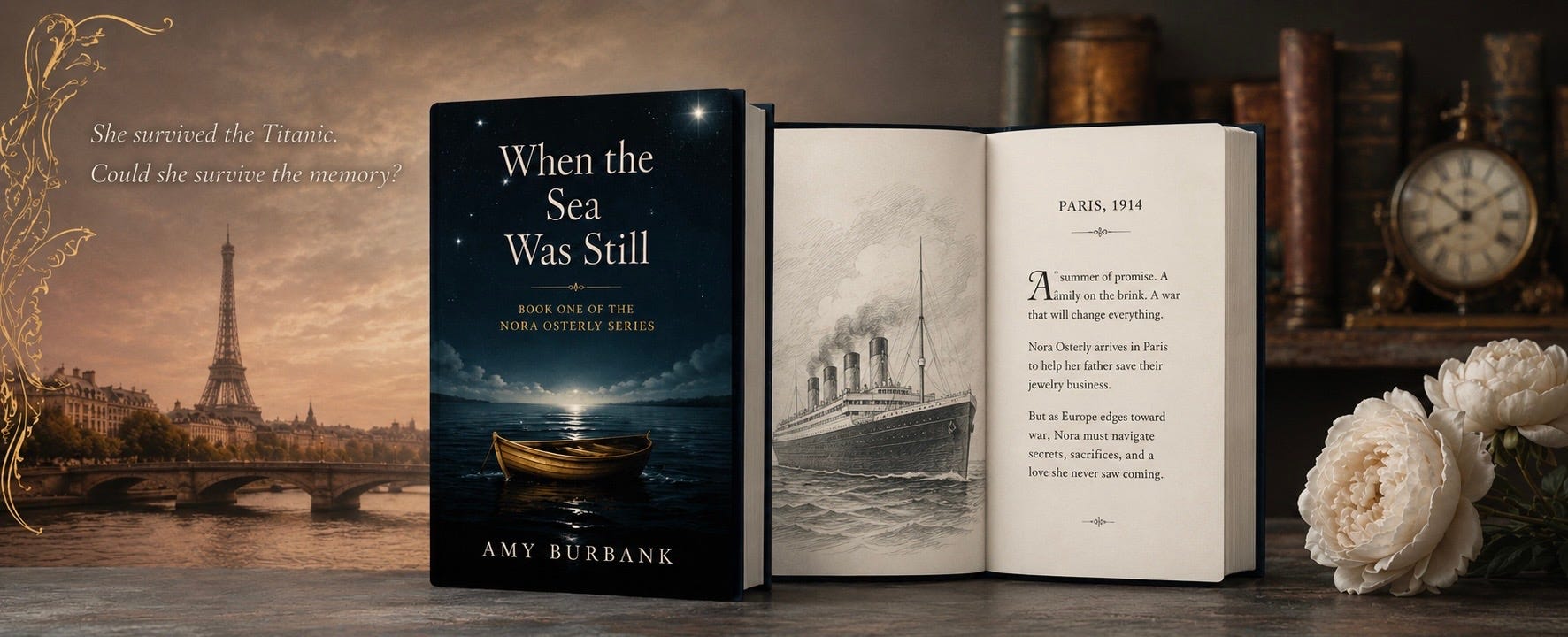


When the Sea Was Still is a historical novel inspired by Titanic survivor Helen Ostby. While the heroine of the story, Nora Osterly, is entirely fictional, her journey draws on the incredible life of Helen Ostby. After surviving the Titanic disaster and losing her father, Helen went on to help run the family jewelry business, Ostby & Barton, which required her to face the sea again for business in Europe. Remarkably, she found herself in Germany on the eve of the First World War.
The novel starts two years after the sinking of the Titanic, when Nora Osterly is forced to cross the Atlantic again—this time aboard Titanic’s nearly identical sister ship, the Olympic. To save her father’s legacy, Nora must do the one thing she swore she never would: return to the sea that nearly killed her.

←Previous Episode | Story Index
Arrival in Southampton
Nora
June 1914
Onboard the Olympic
Nora stepped onto the promenade deck as the Olympic made her slow approach to the port of Southampton. Under a sky streaked with the soft hues of dawn, she watched the distant shoreline come into focus. After six days with nothing but open water surrounding her, land was a reassuring sight.
As Southampton drew nearer, her mind went back to the last time she’d watched land appear after days at sea. That had been the hardest part of it all. The sinking itself had been horrific. The night spent freezing in an open lifeboat was terrifying. But returning to New York aboard Carpathia without her father had nearly broken her. How could two people board a ship together in New York and only one return she’d wondered.
For weeks afterward, she had replayed their final moments, unable to accept that his decision to return below for warmer clothes had been the last time she would ever see him. She had been haunted by an endless stream of what ifs. What if she had gone with him to retrieve warmer clothes? What if she had insisted that he stay with her on deck? What if she had stayed on the ship and waited for him before she climbed into the lifeboat? The unrelenting questions were her mind’s way of grappling with a loss too great to comprehend.
His funeral had brought her a measure of comfort, offering her the chance to say the goodbye she had been robbed of. She knew she was fortunate that her father’s body had been recovered. Of the 1,500 who perished, only about 300 had been found, numbered and catalogued like inventory. Her father was number 234. It was a cruel kind of blessing, but a blessing all the same. She could visit his grave and know exactly where he lay.
After his body was recovered by the cable ship Mackay-Bennett, it had been transported to Halifax, and identified by David Sather, a trusted employee of Osterly & Company. The only belongings found with him were a pocket watch, a chain, and two pocket books. His black doctor’s bag, the one she had loved so much as a girl, was not among them. It was somewhere at the bottom of the Atlantic now, along with everything else the sea had claimed that night.
He was laid to rest at the family cemetery beside her mother on a rainy Saturday in May. Nora had asked Astrid to circulate a note to guests requesting no flowers. It had always been her father’s wish to keep his funeral simple. But no one had listened, and the church had been filled with funeral wreaths made of roses and white lilies. It was as if a fortress of grief had been raised from the city’s collective sorrow.
She hadn’t cried until the casket was lowered into the ground at Swan Point Cemetery. And then the tears came, deep and endless. She had stood there long after the others had gone, her teardrops competing with the rain falling on the mahogany lid. Astrid had eventually come quietly to her side and taken her arm without a word.
Astrid had been her anchor then, just as she had been again this past spring when Etienne’s letter arrived. She remembered that day in Providence—a Tuesday in April, the lilacs just beginning to show outside her window. After her initial shock, she sought out Astrid at once. Astrid had sat across the writing desk from her, reading the letter in silence before setting it down between them.
“Well,” Astrid had said. “Then we had better see what we have.”
They spent the next weeks going through ledgers, account books, and the papers her father had left behind. Nora remembered the steady scratching of Astrid’s pencil as she made careful notes. Together they calculated what could be withdrawn safely from the estate without jeopardizing the business further.
But it still wouldn’t be enough.
Only then had Nora gone to her father’s dressing table and opened the bottom drawer.
Her mother’s jewelry rested inside a velvet case Nora had not seen since childhood. She remembered Ingrid sitting at her dressing table before evenings out, the case open before her as she chose which piece to wear. Now Nora lifted each one carefully onto the desk between them. The pearl earrings Ingrid had loved. The gold bracelet she wore so often Nora could still hear its gentle clink against the dressing table. A sapphire brooch Nora had never seen before. It struck her as strange that her mother’s engagement ring was not among them. She remembered how dearly her mother had treasured the ring her father had made for her. He must have placed it somewhere for safekeeping.
For a long while, Nora simply looked at the pieces before her. Then, with quiet resolve, she selected a handful to part with. The following week, she sold them through a trusted jeweler in Boston. Together with what could be drawn from Anders’s estate, the proceeds were enough to satisfy the loan. Before leaving Providence, she had the funds converted into a bank draft payable in French francs. It now rested safely in the bottom of her trunk, waiting for Paris.
Her father had not meant to leave her with this burden. She understood that now in a way she hadn’t in those first stunned weeks. He’d believed the debt would be resolved long before it became her concern. He thought he had longer.
She closed her eyes for a moment and drew a deep breath. She had crossed the ocean. She had faced what needed facing. And now there was work to do. When she opened her eyes, she saw the promenade had begun to fill with passengers eager for their first glimpse of England. Nora heard a distant gong sound from within the ship, the breakfast bell. She rose from the deck chair and smoothed her skirt.
The first-class dining saloon, usually a hum of lively conversation, held a more subdued air this morning as the Olympic made her final approach into Southampton. Sunlight spilled through the tall windows, brightening the white linen tablecloths. Most passengers were already dressed in their traveling clothes, ready for the journey ahead.
The company at Nora’s table had grown familiar over the past week. Through shared meals, afternoon teas, and long conversations at sea, they had formed the peculiar intimacy of ocean travel. A crossing made fast friends of strangers and parted them just as swiftly. Now their final breakfast carried a note of sadness.
Nora was the last to arrive and took her seat beside Astrid. Across the table, Mr. Harroway and Mr. Cartwright were deep in conversation over The Times, their expressions grave.
“Has something happened?” Nora asked.
Mr. Harroway was the first to speak. “There is news out of Sarajevo, I’m afraid,” he said, handing her his paper.
She read the headline Archduke Francis Ferdinand Assassinated in Sarajevo. Then she continued reading, The Austrian Royal house has had enough tragedies in its history, and fate might well have spared it another. It was not to be. The Archduke Francis Ferdinand, nephew of the Emperor Francis Joseph, and heir to the throne, has been most cruelly murdered at Sarajevo, and his wife, the Duchess Hohenberg, has shared his fate...
“How terrible,” Nora said, handing the paper back to Mr. Harroway.
“It’s such a tragedy,” Mrs. Harroway agreed.
“Franz Ferdinand was the one voice of moderation in Vienna,” Mr. Cartwright said. “Without him, Austria has no reason to hold back.”
“The powers in Europe have been on edge for years,” Mr. Harroway added. “This may be exactly the provocation they’ve been waiting for.”
“My brother’s last letter said that everyone in Berlin believes Germany is only waiting for a reason,” Mrs. Cartwright said. “He said the banking houses have become very—”
“Marion.” Mr. Cartwright’s voice was pleasant but strained. “Can you please pass me a roll?”
Mrs. Cartwright looked at him. “Yes…of course, dear.”
An uncomfortable silence settled briefly over the table. Mr. Harroway folded The Times and set it beside his plate. Astrid reached for the toast rack as though nothing had happened.
“Thank you, my love,” Lionel said as he buttered the roll. Then he turned to Mrs. Harroway. “Now, do tell us your plans for Switzerland.”
Mrs. Harroway took a sip of coffee. “I intend to spend the next two months doing very little beyond breathing mountain air,” she replied. “I always sleep so well during our summers in Switzerland.”
A steward arrived with a fresh rack of toast, briefly interrupting the conversation while coffee cups were refilled.
“And Mrs. Cartwright,” Mrs. Harroway said. “What will you do in Paris while Mr. Cartwright works?”
Mrs. Cartwright dabbed her lips with her napkin. “While Lionel meets his clients, I intend to shop for my new dresses.”
“How lovely,” Mrs. Harroway said. “Do you favor any particular houses?”
“Worth, usually,” Mrs. Cartwright replied. “Though my mother insists I must try Paquin this season.”
“A wise choice,” Nora said. “You can hardly go wrong with either.”
“I’ve never understood how women distinguish one Paris gown from another,” Mr. Harroway admitted with a smile.
“That is because gentlemen rarely notice the details,” Mrs. Harroway replied.
That earned a ripple of laughter around the table.
“My wife,” Mr. Cartwright said, “has an excellent eye. She’ll return from Paris with gowns that will turn every head in New York.”
Mrs. Cartwright reached for her teacup. “Lionel always exaggerates,” she said.
As breakfast wound down, the ship had gone still beneath them. Mrs. Harroway set down her cup and reached for her gloves. Mr. Harroway slid his folded newspaper into his satchel. Astrid was already gathering her reticule. Mrs. Cartwright watched her husband and rose when he did.
The voyage was over.
The Southampton docks were alive with movement. Porters navigated luggage trolleys through the crowd while station attendants guided disembarking passengers. Steam drifted from locomotives farther down the platform. Overhead, gulls soared above the busy channel.
A sea of trunks and hatboxes surrounded Nora and Astrid. The Harroways stood beside them speaking with a station guide. Towering above them all was the immense dark hull of the Olympic, her funnels still smoking against the gray English sky.
Nora approached Bridie, who stood just behind the Harroways with their luggage, tightening a strap on one of the trunks.
“Bridie,” Nora said, drawing closer. “I wanted to thank you.”
Bridie straightened at once. “There’s no need for that, Miss Osterly.”
“There is,” Nora said. “You helped me more than you know on this voyage. There were moments aboard the ship I wasn’t certain I could manage, and your kindness made them easier to bear.”
Bridie smiled. “I only did what anyone would do.”
“Not everyone would have understood,” Nora said.
A porter rattled past them with a loaded trolley and they stepped aside together.
Bridie glanced toward the Olympic. “I’m glad you crossed again, Miss Osterly,” she said. “And glad you’ve come through it.”
Nora felt the truth of it settle within her. Only a week earlier, boarding the Olympic had felt impossible.
“So am I,” she replied.
Nora reached into her bag and withdrew a book wrapped in brown paper. “I finished this two nights ago,” she said. “I thought you might like it for the journey ahead.”
Bridie unwrapped the paper. “The House of Mirth,” she read. “By Edith Wharton.”
“She has a remarkable understanding of people,” Nora said. “And a sharp eye for the world.”
Bridie held the book in both hands, as though it were something precious. “Thank you, Miss Osterly. Truly.”
“You’re very welcome.”
Josie Harroway joined them just then. “There is nothing quite like English air after a week at sea,” she declared.
As they made their way to the boat train, Nora took one last glance at the Olympic docked at her berth. She offered the great ship a silent farewell and said a quiet prayer for those who had not returned from her sister ship just over two years ago.
Moments later, they were aboard the train, Nora and Astrid settled into their seats across from the Harroways. Mr. Harroway unfolded his paper once again while his wife gazed out the window beside him. Astrid drew out her needlework as the train pulled away from the docks and gathered speed toward Waterloo Station. Nora watched Southampton recede into the distance. Somewhere beyond the waterfront lay the neighborhoods that had lost so many of Titanic’s crew, their grief woven into the city as deeply as the sea itself.
When at last Southampton disappeared from view, Nora turned from the window. Beside her, Astrid’s needles moved with the steady rhythm of the train. Nora reached for her writing case and withdrew a fresh sheet of paper, unsure how to put what she wished to say into words. Outside, the English countryside rolled past in shades of green. She uncapped her pen and began.
Mon cher Monsieur Moreau,
I am pleased to tell you that I have arrived safely in England. By the end of the week, I shall be in Paris.
As you know, I have read your letter with the greatest care and given it much thought. I am grateful for your candor and look forward to discussing the details in person. I believe I have found a way forward. My father held your judgment in the highest esteem, and I have always trusted his instincts.
I will write again upon my arrival so that we may arrange a meeting. Please extend my warmest regards to Genevieve.
With kind regards,
Nora Osterly
There was more she wished to say, something warm she couldn’t quite name, but she kept it tucked safely inside her for now. Soon, she would see him again, on business, yes, but in Paris. She was surprised to find how much she was looking forward to it.
She folded her hands in her lap and looked out at the passing countryside. It was foolish, perhaps, to think about him this way. There was business to attend to, a debt to settle, a company to preserve. But the train moved steadily toward Paris and she found, despite everything, that she was glad of it.
Beside her, Astrid’s needles continued their quiet rhythm. Across from them, Mr. Harroway had fallen asleep behind his paper while Mrs. Harroway read her copy of Harpers Bazar. Nora folded Etienne’s letter carefully inside her writing case and rested her hand against it for a moment. Outside the carriage window, the English countryside continued to unfurl in green fields and distant villages.

Number 234
In Chapter 8, Nora learns that her father’s body was one of the few recovered after the sinking of the Titanic. It is a small comfort she finds in the wake of an unimaginable loss. Like so many moments in Nora’s story, this one is based on the life of the real woman who inspired her.
The recovery effort that followed the Titanic disaster was one of the largest maritime operations of its time. For Helen Østby—the real woman who inspired Nora—it meant the difference between having a grave to visit and never knowing where her father had come to rest.
Halifax, Nova Scotia became the center of the recovery effort. It was the closest port to the wreck site and was well-equipped. Already a major North Atlantic port, White Star Line turned to Halifax for the grim task ahead.
CS Mackay Bennett
The first ship dispatched was the cable vessel CS Mackay-Bennett. Hastily refitted for recovery, she sailed from Halifax on April 17, 1912, carrying undertakers, embalming supplies, coffins, and ice. Over the course of several days, Mackay-Bennett recovered 306 bodies, carefully numbering each one and cataloging personal effects for identification. When embalming supplies ran low or bodies were too badly deteriorated, burials at sea were conducted with solemn care. Of those recovered, 190 were brought back to Halifax, while 116 were buried at sea.
One of those 190 was Engelhart Østby, the real Providence jeweler who inspired Anders. He was body number 234. The recovery record lists his effects plainly: a gold watch and chain, a diary, two pocket books. He was identified in Halifax not by family, but by an employee of his own jewelry firm, sent to do the terrible work of confirming what everyone already feared. His body was carried home to Providence and buried there in May 1912.
When I wrote Anders’s own recovery in Episode 8—the pocket watch, the chain, the two pocket books, the loyal employee who makes the identification—I wasn’t inventing the details. I was simply following the record.
Additional Recovery Ships
As the scale of the tragedy became clear, additional ships were sent to assist. The cable ship CS Minia recovered seventeen more victims. The Canadian government vessel CS Montmagny recovered four, and the lighthouse supply ship SS Algerine assisted with transport and logistical support. Though these ships recovered far fewer victims than Mackay-Bennett, their contributions were essential to completing the recovery effort.
In total, only 328 bodies were recovered from the Atlantic, out of approximately 1,514 people who perished in the sinking. Just over 21 percent of the victims were given a burial, whether on land or at sea. The remaining majority, however, never received last rites, leaving their families and loved ones without the chance to say goodbye.
For Helen Østby, knowing that her father’s body had been recovered could never erase the loss, but it gave her something many Titanic families never received: a place to grieve. In Episode 8, I imagined Nora finding that same small measure of comfort.