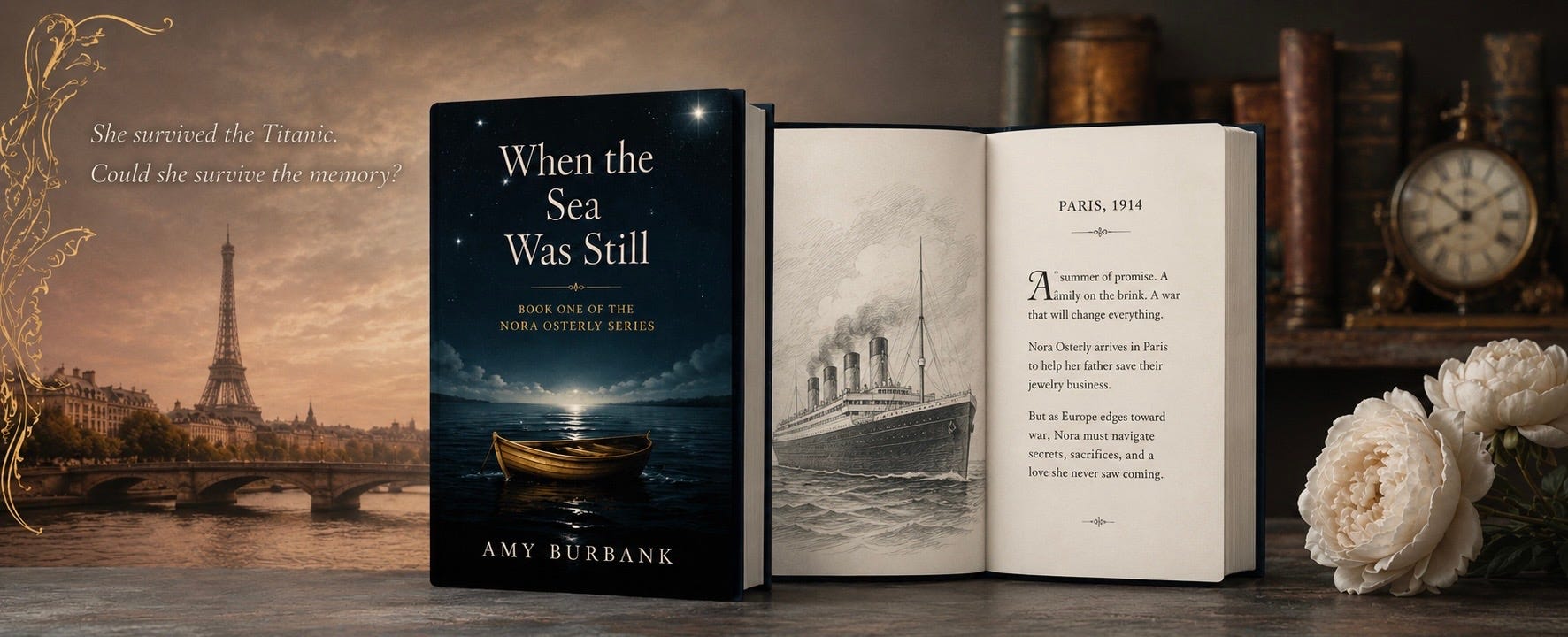

When the Sea Was Still is a historical novel inspired by Titanic survivor Helen Ostby. While the heroine of the story, Nora Osterly, is entirely fictional, her journey draws on the incredible life of Helen Ostby. After surviving the Titanic disaster and losing her father, Helen went on to help run the family jewelry business, Ostby & Barton, which required her to face the sea again for business in Europe. Remarkably, she found herself in Germany on the eve of the First World War.
The novel starts two years after the sinking of the Titanic, when Nora Osterly is forced to cross the Atlantic again—this time aboard Titanic’s nearly identical sister ship, the Olympic. To save her father’s legacy, Nora must do the one thing she swore she never would: return to the sea that nearly killed her.

←Previous Episode | Story Index
Return to Paris
Nora
July 1914
Paris
The Gare du Nord had not changed since Nora had last seen it. Women in wide-brimmed hats and flowing skirts hurried to meet arriving family, while businessmen in dark suits and bowler hats navigated the crowd currents with purpose. Above all of the commotion, coal smoke drifted beneath the great iron-and-glass roof, filtering the July sunlight into hazy beams. The hiss of steam engines and shrill whistles of trains departing, along with the chatter of travelers from near and far, created a cacophony.
Nora had never before arrived in Paris without her father by her side. Standing on the platform now, it was impossible not to think of him. The memory of their last arrival rose so intensely she could almost hear his voice beneath the noise of the station.
“Look up, Nora,” he had said as they stepped down from the train just over two years ago.
She followed his eyes upward, toward the impressive roof that spanned the platforms.
“A railway station ought to be practical,” he had continued, “but the French cannot resist making even an ordinary arrival beautiful.”
“I suspect that is why you like them,” Nora had said.
“It is one of many reasons,” he had said, still admiring the soaring framework above.
He had smiled then and offered her his arm before leading her through the crowd, already talking about gemstones he wanted to purchase. Even after countless visits, Paris had possessed an extraordinary ability to both delight and inspire him. There was always something he wanted Nora to see, some detail of Parisian design that might spark an idea for Osterly & Co.
Nora looked up at the same roof now. The station was just as crowded, just as noisy, just as alive as it had been that day. Only her father was missing by her side.
Nora drew a slow breath and smoothed her skirt. Beside her, Astrid surveyed the surroundings with interest. After years of hearing Nora’s stories of Paris, she was seeing the city for the first time.
“You were right about Paris,” Astrid said. “One feels the energy of it the moment one arrives.”
Nora smiled as she adjusted her gloves. “We have yet to see the best of it.”
Together they followed a porter in a dark uniform through the station’s grand doors into the bright summer afternoon. The city opened before them in a grand display of elegant Parisian architecture, accompanied by the clatter of horses’ hooves over the cobblestones.
Nora looked up at the neoclassical station façade. Lining the roofline were large statues, each one representing a city the station served. Her father had pointed them out on their first arrival, naming each one. Berlin, he had said, his eyes moving along the row. Amsterdam. Vienna. London. He had named them like old friends.
Nora and Astrid continued to follow the porter through the bustle outside the station. Around them, other porters called out in rapid French as they heaved trunks into waiting carriages. Ahead, a motorcar waited at the curb—Clara’s motorcar, gleaming black and incongruous among the line of horse-drawn carriages.
“Surely that is not for us,” Astrid said, eyebrows raised.
“I believe it is,” Nora replied.
Clara had written of her new car in a recent letter, in that breezy way she had of announcing momentous things. But seeing it was different. The machine was long and sleek, its brass fittings catching the light. The driver sat upright behind the wheel with his gloved hands resting on it. Nora and Astrid exchanged a glance, momentarily struck by the novelty of their first motorcar ride.
Nora gathered her skirts and stepped up into the vehicle, sinking into leather seats that still held the faint scent of newness. As Astrid settled beside her, the driver turned in his seat and extended a folded note.
“From Madame Wentworth, Mademoiselle.”
“Merci.” Nora accepted the envelope and recognized Clara’s handwriting across the front. The familiar slant brought a smile to her lips before she had even broken the seal.
My dear Nora,
I cannot tell you how pleased I am to know you are in Paris again. Will you and Astrid do me the honor of joining me for tea tomorrow afternoon at four? It has been far too long since I have had the pleasure of your company.
Affectionately,
Clara
Nora smiled again and tucked the note into her reticule. More than two years had passed since she had last seen Clara. Tomorrow, at last, she would be sitting across from her friend again, listening to stories of the exotic places Clara had traveled, the fascinating people she had encountered, and the latest essays she had written along the way. Clara seemed to be continually returning from somewhere new with another story to tell.
The motorcar pulled away with a low rumble, and Nora felt the difference immediately. In place of the jolting clop of hooves over cobblestones, there was the steady drone of the engine. Their seats vibrated beneath them as they moved forward in an even rhythm. Astrid held fast to the edge of her seat with a bewildered look on her face.
They made their way toward the heart of the city along Rue La Fayette. Outside the car window, Nora watched as the grand Haussmann boulevard passed by in a whirlwind of activity. Despite the July heat, well-dressed Parisians moved briskly along the crowded sidewalks while bicycle riders darted in and out of the traffic.
As they approached the Opéra district, Nora caught sight of Café de la Paix, its broad awning extending over a terrace crowded as always with its loyal patrons, while a steady stream of pedestrians passed by. It was a corner where half of Paris seemed content to sit and watch the other half go by.
The café always reminded Nora of her first opera in Paris, Boris Godunov. She had been eighteen at the time. The way the bells had rattled the theater during the opening scene had stayed with her long after the production ended. Later that evening, at this very café, she’d celebrated the night with Clara and her father. Looking at the café now, she could almost see the three of them inside laughing as they relived the performance and raised their glasses to Paris.
Nora gestured toward the café. “That was one of father’s favorite cafés. He said there was no better place to sit outside and watch the world go by.”
Astrid looked out at the terrace. “Your father did always have impeccable taste.”
“He certainly did,” Nora said, then turned her attention to Astrid. “What do you think of Paris so far?”
“It’s even more beautiful than I thought it would be,” Astrid said. “The wide boulevards, the uniform buildings. I quite see why your father loved it so.”
The motorcar turned onto Rue Royale and moments later the Place de la Concorde opened before them. Nora sat forward slightly as the vast square came into view. At its center, the Luxor Obelisk rose against blue sky. It was a piece of Paris history that had always fascinated her more than any other.
Her father had told her the story of how it had been brought all the way from Egypt, first sailing down the Nile, then across the Mediterranean, and finally up the Seine before being raised here in Paris. After more than three thousand years in Egypt, it had come to rest in a Parisian square where revolutionaries had once screamed for blood and kings had lost their heads.
Along the edge of the square, they rolled to a gentle stop in front of the Hôtel de Crillon. Nora looked up at the grand façade through the motorcar window. She had heard Clara speak fondly of the hotel many times, but arriving here as a guest herself felt odd.
Nora had always stayed at the Ritz with her father when they traveled to Paris. She could still picture the exact route through its lobby, the turn toward their usual suite, and his hand gesturing as he explained an architectural detail that fascinated him. The thought of walking those corridors without him was more than she could bear.
Knowing that Clara had always taken rooms at the Hôtel de Crillon, and trusting her friend’s discerning taste, Nora had felt the Crillon was a natural choice. Leaving the familiarity of the Ritz for the freshness of the Crillon felt like a necessary step forward. There seemed something fitting about exchanging the established prestige of Place Vendôme for a square that had endured a revolution and emerged transformed. One square belonged to her father’s Paris. The other would be hers.
A uniformed doorman stepped forward to open Nora’s door. She accepted his gloved hand and stepped onto the cobblestones, pausing to gaze at the hotel before her. The centuries-old façade still commanded attention, its stately row of columns rising above uniform archways.
“Clara was right,” she said to Astrid. “It’s splendid.”
“Indeed it is,” Astrid agreed.
Inside, Nora paused just beyond the entrance, allowing her eyes to adjust from the brightness of the square. The hotel lobby unfolded before them with understated grandeur. Pale stone columns rose from a smooth marble floor while delicate crystal chandeliers hung overhead. Nora and Astrid moved through a succession of arched salons until they arrived at the reception desk. A clerk in morning dress greeted them with a courteous bow.
“Mesdames, welcome to the Hôtel de Crillon. I trust your journey was pleasant?” His voice was polite, marked by a refined Parisian accent.
“Very pleasant, thank you.” Nora presented their reservation card.
He studied it briefly, then inclined his head. “Your suite is prepared, Mademoiselle.” A white-gloved footman appeared at his gesture. “Jean will escort you.”
They followed him through hushed corridors with thick carpets. Nora felt as though she were moving through a private palace that had temporarily opened a few select doors to guests.
Their suite occupied a corner of the third floor. Two bedrooms flanked a central sitting room filled with elegant furnishings, its tall windows overlooking the gardens below. Near one of the windows stood a handsome writing desk with a small brass lamp. Astrid set her reticule on the desk and turned in a slow circle, as if appraising the salon. Above her, painted medallions decorated the ceiling, bordered by intricate gilt moldings.
“Yes, I think this will do very nicely,” she said.
Nora nodded in agreement. It felt strange to be in Paris and not know the room around her. At the Ritz, everything had been familiar, almost like a second home. Here, there were no memories waiting for her around every corner. The unfamiliarity left her feeling a strange mix of uneasiness and comfort at the same time.
Astrid seemed to sense her unease. “How are you finding it, being back in Paris without your father?” she asked.
“It’s not been easy,” Nora admitted. “Though not as difficult as the crossing.”
“I do believe the hardest part of returning is behind you now,” Astrid said.
“You are quite right, I’m sure,” Nora said. “I wasn’t prepared for all the memories. The station, the cafés, the boulevards, he’s everywhere. But he’s nowhere…”
“I know, dear,” Astrid said, resting a hand on Nora’s shoulder.
“But at the same time, it is such a comfort to be in the place that we loved together,” Nora continued.
“The city where he taught you the business of Osterly & Co.,” Astrid said.
“Yes,” Nora said. “And there is quite a lot of it to do now that we are here.”
Astrid nodded. “Are you prepared for what comes next?”
“As prepared as I can be. I have the means we secured to pay the debt, and tomorrow I’ll arrange a meeting with Étienne. Once the payment is made, that should settle the matter.”
“Provided there are no surprises.”
Nora looked at her. “Precisely.”
Astrid studied her for a moment, then gave a single nod.
“Good. I believe I shall unpack before tea,” Astrid said, disappearing into the far bedroom.
Nora sat on the settee by the window, grateful for a quiet moment to herself. Soon, she would see Étienne again. So much had happened since that final afternoon at Maison Moreau that it seemed to belong to another lifetime. And yet, beneath the grief of all that had changed, anticipation still lingered. She wondered how much the intervening years had changed him. She wondered, too, what it would feel like to stand before him again.

Why the Hotel de Crillon?
Please enjoy this free preview of this weeks behind the scenes bonus material.
Like so many choices in When the Sea Was Still, the reason I chose the Hôtel de Crillon for Nora is rooted in actual history, although this time not from Nora’s inspiration, Helen Østby, but from an unlikely candidate: Edith Wharton. When I began imagining Nora’s return to Paris in the summer of 1914, I knew I wanted her to stay somewhere different from the Ritz, the hotel she had always visited with her father. The Crillon seemed the perfect choice because Edith Wharton, whose life and humanitarian work during the First World War helped inspire the character of Clara Wentworth, had stayed there herself.


Wharton was among the Crillon’s earliest guests. In April 1909, only weeks after the hotel first opened its doors, she took rooms there and described them in a letter to her friend John Hugh Smith as “a very nice apartment up in the sky, overlooking the whole of Paris.” While staying at the new hotel, she worked on the novel that would eventually become The Custom of the Country, published in 1913.
She would return to the Crillon, becoming a regular and making it an easy choice for Clara to favor as well. For Nora, who trusted Clara’s impeccable taste, it seemed a natural progression for her to follow her friend’s lead.


What I didn’t realize when I chose the Crillon for Nora was just how fascinating the building itself would turn out to be. When Nora arrives at the Hôtel de Crillon in Chapter 9, she steps into one of the grandest hotels in Paris. But in July 1914, the Crillon was still a remarkably new hotel. For most of its existence, the magnificent building overlooking the Place de la Concorde had been a private aristocratic residence.
Behind its neoclassical façade were rooms that had already witnessed more than a century of French history. The building had survived revolution, passed through generations of the Crillon family, and even counted Marie Antoinette among the famous figures connected to its rooms.


Before It Was a Hotel
The story of the Crillon begins in the eighteenth century with the creation of what is now the Place de la Concorde. King Louis XV commissioned architect Ange-Jacques Gabriel to design the magnificent new square, then known as the Place Louis XV. Behind one of Gabriel’s grand neoclassical façades, the Duc d’Aumont created an opulent private residence filled with carved woodwork, mirrors, gilding, and elaborate reception rooms.
In April 1788, the Comte de Crillon purchased the residence. His timing could hardly have been more extraordinary. Barely a year later, the French Revolution began, and the elegant Place Louis XV would become the setting for some of the most dramatic events in French history. The square was eventually renamed Place de la Révolution, and the guillotine erected there claimed, among many others, Louis XVI and Marie Antoinette.
Marie Antoinette at the Crillon
Marie Antoinette also had a more personal connection to the residence.
After the royal family was forced from Versailles in October 1789, Marie Antoinette lived at the nearby Tuileries Palace until 1792. During those years, she is believed to have taken private piano lessons in one of the historic salons at the Crillon residence.
Today, the hotel has a Marie-Antoinette Suite honoring that connection, adjoining the historic salon associated with her lessons.


In 1904, the property was purchased for conversion into a grand luxury hotel. Many elements of the eighteenth-century residence were preserved as the building was transformed, and on March 12, 1909, the Hôtel de Crillon welcomed its first guests. When Nora arrives in July 1914, it has been a hotel for only five years.
To Nora, the Crillon would have offered everything expected of one of Europe’s finest new hotels: elegant rooms, attentive service, and an extraordinary location overlooking the Place de la Concorde. But beneath that modern luxury remained the bones of an eighteenth-century aristocratic home.
I hope that you’ve enjoyed this free preview of behind the scenes bonus material. Upgrade today to go behind the scenes of Nora’s world every week!