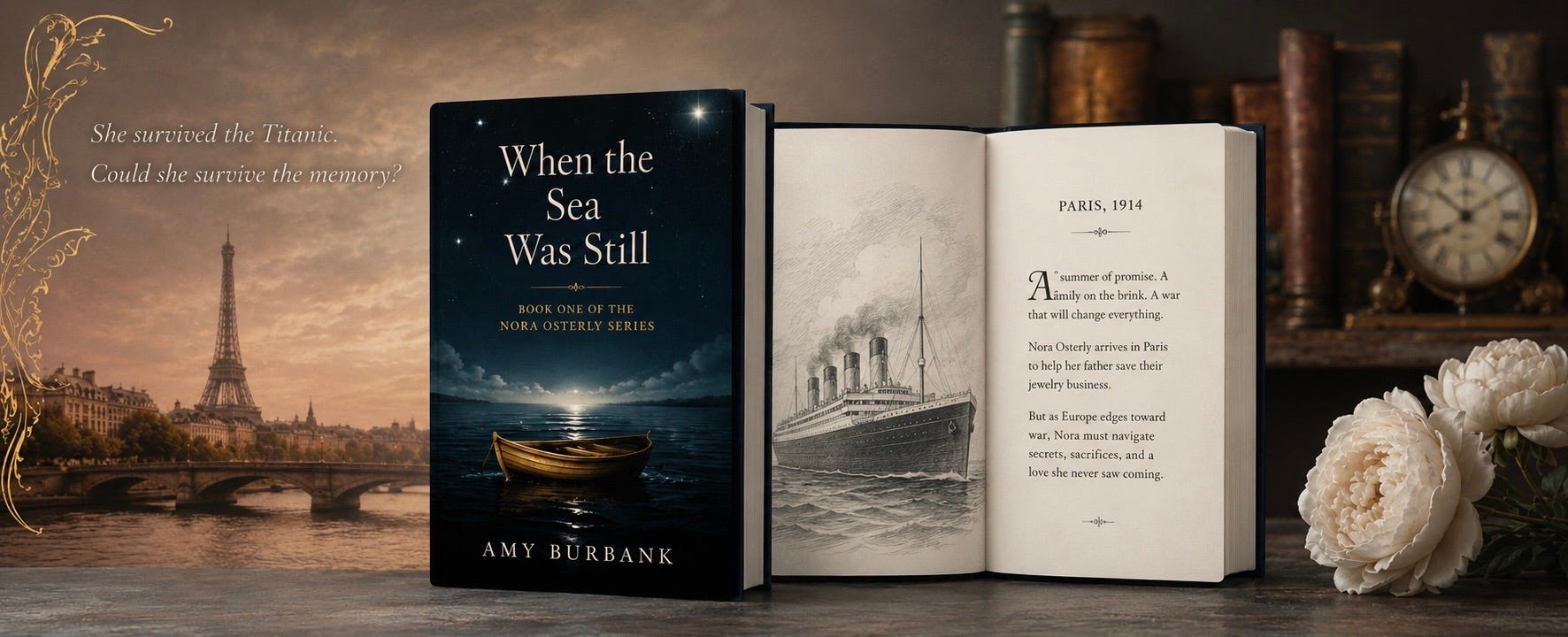

You are reading my weekly serial When the Sea Was Still.
When the Sea Was Still is a historical novel inspired by Titanic survivor Helen Ostby. While the heroine of the story, Nora Osterly, is entirely fictional, her journey draws on the incredible life of Helen Ostby. After surviving the Titanic disaster and losing her father, Helen went on to help run the family jewelry business, Ostby & Barton, which required her to face the sea again for business in Europe. Remarkably, she found herself in Germany on the eve of the First World War.
The novel starts two years after the sinking of the Titanic, when Nora Osterly is forced to cross the Atlantic again—this time aboard Titanic’s nearly identical sister ship, the Olympic. To save her father’s legacy, Nora must do the one thing she swore she never would: return to the sea that nearly killed her.

←Previous Episode | Story Index
A Change of Hands
Nora
27 July 1914
Paris
The following day, Nora stood beside Étienne at the workbench in his office at Maison Moreau. Between them, a velvet-lined tray held an antique brooch, its ornate gold setting framing a six-carat sapphire of deep blue. Discarded sketches surrounded the piece, each one a little closer than the last, though none was quite right. They had been working all morning on a design for a new commission.
When Nora arrived at the atelier, she had felt a new shyness at seeing Étienne again. Neither had spoken of yesterday’s walk. Instead, they turned at once to the task at hand. As they sketched together, she couldn’t quite shake the memory of walking arm in arm with him through the gardens. She was not accustomed to being so affected by another’s presence. While reaching for a pencil, Nora bumped Étienne’s drawing hand, sending his line astray. They both laughed, and the awkwardness between them began to ease. Before long, they had fallen back into their familiar rhythm.
The brooch that had brought her to his side that morning had belonged to their client’s family for three generations. The client wished to have the sapphire reset in a pendant to present to their eldest daughter upon her marriage in the spring. With commissions becoming rarer, Étienne was determined to create a piece worthy of both the heirloom and the occasion.
He slid the newest drawing toward her. “What do you think of this one?”
Nora considered it for a moment before shaking her head. “It’s closer. There is a trace of the old scrollwork at the base. I wonder if it should go entirely.”
“It has framed the stone for decades.”
“Yes,” Nora said. “But the sapphire is what the family wishes to carry forward. Let’s try it and let the piece tell us what it wants.”
Étienne looked at Nora and smiled. “I like the way you think, mademoiselle.”
She returned his smile, then picked up his pencil and redrew the base herself, removing the final curve of scrollwork. “There. No hint of the old-fashioned brooch left. Let her wear it as though it were designed just for her.”
As Étienne bent closer to examine the correction, Nora caught the familiar scent of his cologne. She concentrated on the drawing, although it no longer required such careful study.
“Yes,” he said, still looking at the sketch. “That is the piece.”
Nora nodded and handed the pencil back to Étienne.
When their eyes met, he paused. “I was very glad you came yesterday.”
“As was I,” she said. “I was sorry when the afternoon came to an end.”
For a moment, neither of them looked away. Then Étienne cleared his throat. “I shall ask Henri whether we have created something that he can produce.”
A few minutes later, Étienne returned with Henri beside him. After a brief comparison of the revised drawing and the brooch, Henri pronounced the design elegant, balanced, and unlikely to keep him awake at night. Étienne objected to the suggestion that any of his designs had ever disturbed Henri’s sleep, and Henri replied that he had long ago learned not to examine them before bedtime. Nora laughed at Étienne’s look of wounded dignity. Satisfied that he was no longer needed, Henri returned to the main workroom.
He had scarcely gone when Geneviève appeared in the doorway carrying a letter.
“Forgive me for interrupting, but our metal supplier has asked that we settle our account with him before it falls due.”
Étienne frowned. “Has he given a reason?”
Geneviève handed him the letter. “His bank has called in an advance. He finds himself in need of ready funds.”
Étienne read the letter in silence.
Nora thought of the commissions that had already been postponed or canceled. “Then the uncertainty is affecting credit as well as sales.”
“It appears so,” Geneviève replied. “Two of our other suppliers have declined to extend their usual credit. This is the first to request payment early.”
Étienne handed the letter back to Geneviève, his earlier amusement gone. “That is troubling. I had hoped the canceled commissions would be the extent of our difficulties.”
“One account may be managed,” Nora said. “Several would be another matter, particularly with sales already diminished.”
“Quite so.” Étienne turned to Geneviève. “We have the funds to meet this one. Please settle it and tell me at once if another such request arrives.”
Geneviève nodded and left the room as quickly as she’d come in.
After Geneviève withdrew, Nora noticed the sounds from the workroom begin to quiet as the tapping of hammers ceased. Only then did she realize how completely the commission had claimed the morning.
Étienne gathered the discarded sketches while Nora drew on her gloves. He placed the finished design beside the brooch, then carried the velvet tray to a cabinet and locked it away.
He escorted her toward the door as the craftsmen passed through the front room, offering brief farewells on their way to luncheon. Once the last of them had gone, Nora found herself alone with Étienne in the showroom.
“Thank you for your help, Nora.” He took her hand in his. “I hope I have not kept you too long.”
“No, you have not,” she said, blushing. “I am always happy to help with a design. We must do everything we can to keep the business strong.”
He smiled, still holding her hand. “Your dedication is admirable. I hope we shall not require another vexing pendant before I see you again.”
Nora smiled back. “Surely we can find a less troublesome excuse.”
“Then I shall have to find one.” He kissed her on each cheek before opening the door for her.
That evening, Nora and Astrid dined at their usual table in the Crillon’s dining room. Over the first course of consommé julienne, Nora recounted the day’s events. Astrid followed the account closely, interrupting more than once to question exactly what Geneviève had said about the supplier’s request for early payment. Nora assured her that it was not as dire as she seemed to think. Yet her assurances did little to alleviate Astrid’s worry about the unrest that continued to grow around them.
When Astrid asked if this was another reason for them to sail home with the Harroways, Nora answered as she had every day since receiving Mrs. Harroway’s invitation. A waiter arrived with their second course, fillets of sole in white-wine sauce, just as Nora finished explaining again why she wasn’t ready to make a decision. Astrid waited until he had withdrawn before responding.
“Yet it appears there is more trouble,” she said. “The evening paper reports some trading at the Bourse was suspended today. Vienna and Brussels have closed their exchanges.”
“That may explain why the supplier’s bank called in its advance,” Nora said.
“And if conditions continue to worsen?” Astrid seemed to be issuing her a challenge.
Nora finished a bite of her fish before answering. “Then Maison Moreau may need our partnership more than ever.”
Astrid let out a small huff. “You possess a remarkable talent for turning every reason to leave into an argument for remaining.”
Nora reached for her wineglass. “Let us talk of something else. I have fretted enough for one day. Please update me on the progress of Madame Caillaux’s trial.”
Astrid abandoned her argument for the moment and turned readily to the trial. “The testimony has finally concluded. The lawyers are to make their closing arguments tomorrow.”
“Then Paris may soon have its verdict. Have you an opinion on which it will be?”
“I should think my opinion has been perfectly clear.” Astrid paused while the waiter cleared their dishes. After he finished serving their main course of roast chicken with tarragon, green beans, and new potatoes, she continued, “She went to a man’s office carrying a pistol and shot him. She ought to be found guilty.”
“That is what you believe should happen. I asked what you think will happen.”
“After reading the reports of this trial, I would not wager on justice prevailing. It has played out more like the theatre than a murder trial.”
Astrid shook her head disapprovingly as she described how the court had been cleared that day after the spectators began applauding and jeering while Monsieur Caillaux traded insults with a witness.
“My goodness. I daresay the theatre crowd is generally better behaved.”
Astrid raised an eyebrow as she lifted her fork. “Indeed they are.”
She was still recounting the courtroom spectacle when the waiter arrived with something other than the dessert Nora was expecting. Instead, he carried a folded blue telegram.
“Pardon, Mademoiselle Osterly. This has just arrived for you,” he said.
Nora thanked him and accepted it. Banque Mallet was printed beneath the delivery mark. After opening it, she read the message. She should not have felt as surprised as she did.
HERR KESSLER HAS TRANSFERRED NOTE TO MONSIEUR LIONEL CARTWRIGHT STOP BANQUE MALLET WILL CONTINUE TO HOLD NOTE FOR COLLECTION STOP TERMS AND MATURITY OF 1 AUGUST UNCHANGED STOP DELACROIX
“What is it?” Astrid asked.
Nora passed the telegram across the table. “Herr Kessler has sold the note.”
Astrid’s eyes moved over the message, her expression hardening. “To Mr. Lionel Cartwright.”
Nora nodded. “With the markets in such distress, it would seem Herr Kessler has done well. But what could Mr. Cartwright want with a note due in five days?”
Across Europe, men were scrambling to turn debts into cash. Lionel had chosen to do the reverse.
“He does not strike me as a man who purchases what another is anxious to sell without expecting some advantage.” Astrid handed the telegram back to Nora.
“That is what will keep me up tonight.” Nora could not see what benefit the note offered Mr. Cartwright. Still, she feared he had recognized something she had not.