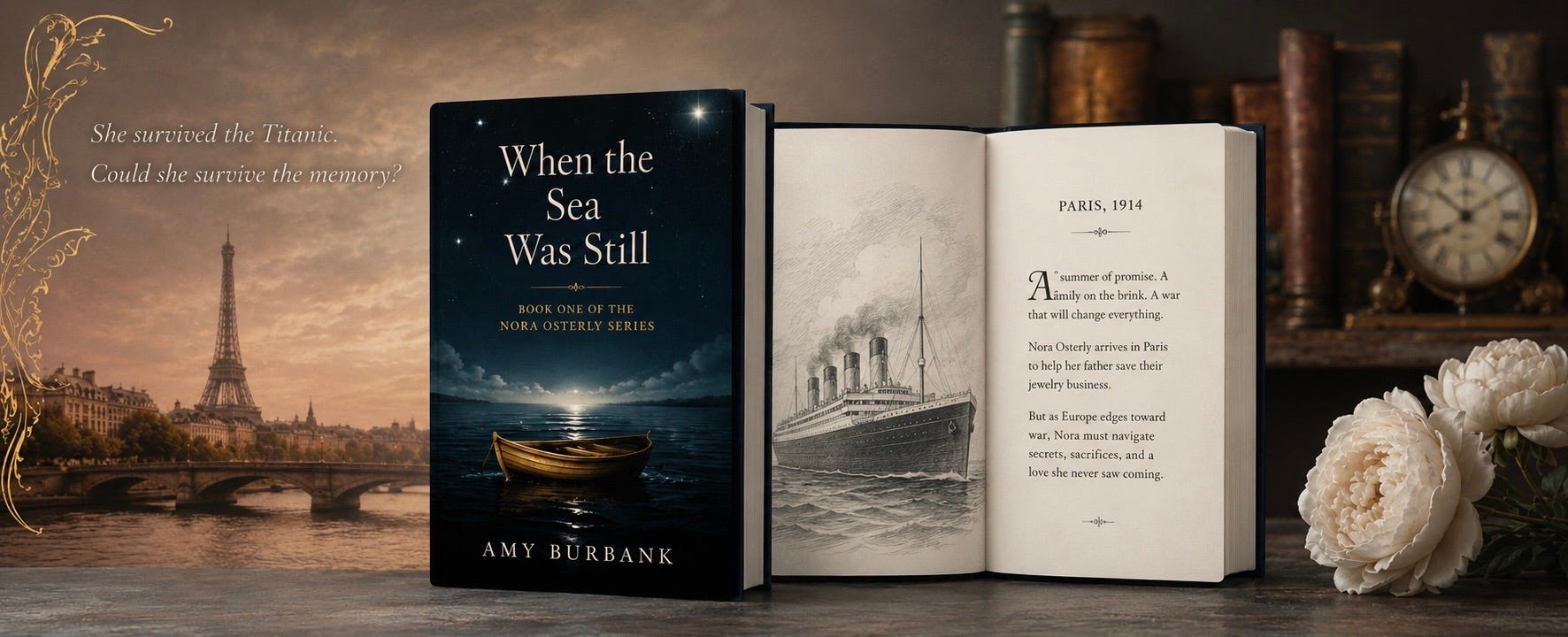


You are reading my weekly serial When the Sea Was Still.
When the Sea Was Still is a historical novel inspired by Titanic survivor Helen Ostby. While the heroine of the story, Nora Osterly, is entirely fictional, her journey draws on the incredible life of Helen Ostby. After surviving the Titanic disaster and losing her father, Helen went on to help run the family jewelry business, Ostby & Barton, which required her to face the sea again for business in Europe. Remarkably, she found herself in Germany on the eve of the First World War.
The novel starts two years after the sinking of the Titanic, when Nora Osterly is forced to cross the Atlantic again—this time aboard Titanic’s nearly identical sister ship, the Olympic. To save her father’s legacy, Nora must do the one thing she swore she never would: return to the sea that nearly killed her.

←Previous Episode | Story Index
A Knock at the Door
29 July 1914
Paris
The morning after Nora received the troubling telegram announcing the transfer of the loan to Mr. Cartwright, she and Astrid had called on Étienne and Geneviève at Maison Moreau. Étienne had blamed himself, believing he was at fault for giving Mr. Cartwright information that had led him to Herr Kessler. Both Nora and Geneviève had refused to let him feel responsible for what Mr. Cartwright had chosen to do with it. They all agreed that the sale of the note itself didn’t seem to change anything, and Nora promised to keep them apprised of any further developments.
The rest of the day had passed without additional word from Mr. Cartwright. Nora had braced herself for whatever might come next. His silence was almost as troubling as the telegram itself.
Now, as Nora and Astrid took breakfast in their suite at the Crillon, Nora reread the telegram for what must have been the hundredth time. Finally, she set it back down and picked at the breakfast sitting before her. Astrid sat across from her reading the morning news while sipping her tea.
She looked up from Le Figaro with a worried expression.
“What’s wrong?” Nora asked.
“It appears my fears were not unfounded,” she replied. “Austria has declared war on Serbia.”
Nora stopped with the coffeepot suspended over her cup. Although every report of the past several days had warned of such a possibility, hearing the words spoken surprised her.
Astrid laid the paper upon the table and turned it toward her. The headline stretched across the page in heavy type.
AUSTRIA DECLARES WAR ON SERBIA
“Yesterday we spoke of the possibility of war,” Astrid said. “Today there is one. Surely this is another reason for us to sail with the Harroways.”
Nora finished pouring her coffee before answering. “It is certainly another reason to consider it.”
“To consider it?” Astrid repeated. “Nora, how many reasons will you require?”
“I do not take the danger lightly.”
“I know. But each day we remain, the crisis grows more serious.”
Nora broke open one of the warm rolls and spread it with butter despite her lack of appetite. The prospect of leaving Paris while Mr. Cartwright’s intentions remained unknown troubled her more than she cared to share with Astrid. It would only worry her further. Nora knew she needed to decide soon, and this news made the choice more pressing. How much longer could she expect Astrid to remain by her side?
“I know what you wish me to say,” Nora said at last. “With Mr. Cartwright’s purpose still unknown, I simply cannot say it yet.”
Astrid studied her across the table. “Then promise me you will not wait until the decision is made for us.”
“I promise I will not.”
The answer appeared to satisfy Astrid for the moment. She took a sip of tea, then reached for a piece of toast, her attention already back on the paper. They finished breakfast in silence save the occasional clink of china. When the clock on the mantel chimed the half hour, Astrid folded her napkin and rose from the table.
“I believe I shall return to my book for a while,” she said before withdrawing to her room.
Once alone, Nora reached for the newspaper Astrid had left behind. A different headline caught her attention.
LE VERDICT DE LA HONTE
The Verdict of Shame.
Nora thought it a fitting response from the paper whose editor had been murdered in his own office. The trial that had served as the greatest show in Paris was over, and Madame Caillaux had been acquitted on the grounds that she had acted in a moment of uncontrollable passion. Nora marveled at the attorneys’ ability to convince the jury that a woman who had waited patiently for more than an hour with a pistol hidden in her muff had acted without premeditation.
Astrid must have been furious. For more than a week, she had followed every development of the trial with unwavering interest, waiting for Madame Caillaux to be found guilty. Yet she had said nothing about it over breakfast.
The timing of the trial’s end, just as war broke out in Europe, seemed uncanny. Paris had received the ending to its great spectacle at the very moment a far graver drama was beginning.
Nora was still reading the newspaper when a knock sounded at the suite’s door. She crossed the plush carpet to find a uniformed hotel page standing in the corridor beside a soberly dressed gentleman. The stranger looked out of place amidst the hotel’s elegance. He wore a severe, high-collared dark frock coat and a black top hat. His rigid expression caught Nora off guard. Beneath his arm, he carried a heavy leather portfolio.
“Pardon, Mademoiselle Osterly,” the page said. “This gentleman has come on a legal matter.”
“Mademoiselle Osterly?” the man asked, his voice a flat baritone.
“Yes,” Nora said, her throat dry.
The stranger stepped across the threshold and reached into his portfolio. “I am a huissier de justice, acting on behalf of Monsieur Cartwright.” He produced a folded sheet of thick paper bearing an official blue stamp. “I am here to serve you with a sommation regarding the outstanding obligation of your father’s estate, due the first of August.”
He handed Nora the notice.
“Pursuant to the gold clause contained in the original note,” the huissier continued, “notice is hereby served that the creditor exercises his legal right to demand settlement exclusively in gold coin. Any other form of payment will not be accepted in satisfaction of the debt.”
The huissier bowed his head slightly to Nora. “You have been formally notified, Mademoiselle. Good day.”
He turned on his heel and walked away, the page following behind. Nora closed the door slowly, the implications of the notice racing through her mind.
“Was someone here?” Astrid asked, appearing from her room.
“Mr. Cartwright has made his move,” Nora said. “That was a huissier, come to serve notice that the note must be paid in gold coin.”
“Gold coin?” Astrid asked. “I don’t understand.”
“The financial markets have grown increasingly unsettled,” Nora said. “Mr. Cartwright must believe he has found a way to take advantage of it.”
“Do we need to worry?”
“I don’t believe so. Please dress for an outing while I ask the concierge which bank can exchange the draft.” Nora took the notice and slipped it into her reticule. “I shall return soon to fetch you.”
Nora descended to the lobby, where the concierge stood behind his desk attending to the morning’s correspondence. He greeted her as she approached.
“I require the assistance of a bank,” she said. “I have an American bank draft payable in francs, and I need to exchange it for gold coin.”
The concierge hesitated. “Napoléons, mademoiselle?”
“Yes. A substantial amount.”
“I see.” His manner remained composed, but the slight change in his expression did not escape her. He reached for a hotel card. “I should recommend the Comptoir d’Escompte at the Place de l’Opéra. They are accustomed to dealing with foreign clients.”
He wrote the bank’s name and address on the card and handed it to her. “If such an exchange can be arranged, the Comptoir is among the institutions most likely to accommodate you.”
“What do you mean by if?”
“There has been an unusual demand for napoléons these past several days,” he replied. “Foreign checks and letters of credit are becoming difficult to negotiate. Gold is the one form of payment travelers can be certain will be accepted.”
“I see,” she replied.
She had expected no more than an inconvenient errand, not the possibility that the gold itself might prove difficult to obtain. Still, she was certain the matter could be managed.
“Would you have a carriage brought around? I shall be back shortly with Mademoiselle Lund.”
“Of course, mademoiselle.”
An hour later, Nora and Astrid arrived at the bank. Its ornate Haussmannian façade curved around the triangular corner where the square met the Avenue de l’Opéra, facing the Palais Garnier. Spilling from its grand arched entrance were throngs of anxious tourists and well-dressed Parisians.
Astrid looked from the crowd to Nora. “Good heavens. What can all of this be about?”
Nora recalled the concierge’s warning that gold was becoming increasingly difficult to obtain.
“The concierge said there had been an unusual demand for napoléons. It appears we are not the only ones seeking them.”
Nora and Astrid joined the queue that wrapped around the building. Nora raised her parasol to shade herself from the intense July sun. All around them, tense rumors circulated in English, German and French. Nora caught fragments of conversations about closed markets and mobilization.
When they finally entered, they exchanged one long line for another, this one at least inside the cool marble banking hall. It was an opulent space with high ceilings and dark polished wood. The scene before them was one of tension and anxiety. Gentlemen with leather portfolios were lined up before the counters, some with their voices raised. Clerks carrying large stacks of papers and strained expressions moved briskly between the counters and adjoining offices.
Nora and Astrid waited as the queue inched forward. Beside her, Astrid listened closely to the anxious conversations around them.
“Did you hear that?” Astrid asked as they reached the front of the queue.
At the counter ahead of them, a British couple was trying to exchange travelers’ checks for gold coin.
“They are backed by gold in London!” the Englishman shouted, slamming his hand onto the dark wood counter. “How are we supposed to pay for passage home?”
“They say the boat trains are only accepting gold,” Astrid whispered, becoming increasingly agitated.
Before Nora could answer, a clerk beckoned them forward. He greeted them stiffly through the opening in an ornate brass grille, failing to disguise his fatigue. Nora slid her bank draft across the polished surface and explained that she wished to exchange it for gold coin. At the mention of gold, he sighed and asked them to wait without an explanation, then disappeared into one of the offices down the hall.
Nora and Astrid exchanged glances.
“I don’t like this, Nora,” Astrid said.
“Nor do I. It seems that everyone here has the same goal we have yet no one has succeeded in achieving it.”
Several minutes passed before the clerk returned.
“I regret to tell you, Mademoiselle, we cannot exchange your bank draft for napoléons,” he said. “We can arrange for its payment in franc banknotes if that would suit you.”
“But I require those francs in gold coin,” Nora said.
“I am afraid that is not possible.”
She had been prepared for delay, but not refusal. “May I ask why?”
“The demand for gold has become extraordinary over the past several days. Napoléons are being withdrawn more quickly than the banks can replenish them.”
Nora was beginning to understand the purpose behind Mr. Cartwright’s demand. Until that moment, she had regarded his new terms as an obstacle to overcome. Now she questioned that assumption. Astrid shifted beside her.
“Surely another institution may have sufficient coin,” Nora said.
“You are, of course, free to inquire elsewhere. You might try Crédit Lyonnais.” He returned the draft to her. “But the present demand is not confined to this bank.”
Nora slipped it back into her reticule. “Thank you for your time.”
The banking hall was still crowded with agitated foreign travelers when they left. Outside, the line had nearly doubled, stretching past the corner of the Place de l’Opéra.
“What shall we do now?” Astrid asked, looking back at the line.
Nora tightened her hold on her reticule. “We shall try the next bank.”
Their second attempt took them to Crédit Lyonnais on the boulevard des Italiens. There, after another wait and another careful examination of the draft, Nora received much the same answer. The bank would honor it in banknotes, but no large payment in gold could be authorized under the present conditions.
Nora refused to be discouraged. They continued to Société Générale on the boulevard Haussmann. By then, the luncheon hour had long since passed. Astrid had not mentioned it, which Nora took as proof of how worried she had become.
At the third bank, an official studied the draft and questioned Nora closely about the amount she required and when it must be paid. Rather than refusing her outright, he consulted with his director. For the first time that afternoon, Nora thought she had found her gold.
When the official returned, however, his expression had changed. The bank could not release so large a quantity of gold to someone who held no account there. He offered another possibility: the headquarters of the Comptoir d’Escompte, where greater reserves might be held than at its Place de l’Opéra branch. Nora allowed herself to keep believing.
By the time their carriage reached the rue Bergère, it was late into the afternoon. The imposing stone façade of the bank rose above three tall arches that spanned the entrance. The prominent statue of Prudence sat on her throne, presiding overhead with the promise of wisdom. Beneath this grand assurance of stability, a small gathering of disappointed customers remained, but the bank had already been closed for the day.
Nora and Astrid stood silently before the locked gates. The bank draft that she had carried across the Atlantic was worth every franc her father’s estate owed, yet now seemed incapable of settling the debt. Mr. Cartwright had not counted on her lacking the money. He had counted on Paris lacking the gold.

The Madame Caillaux Scandal
In this week’s episode, Paris finally receives the verdict in the trial that has kept the city riveted. Madame Caillaux has been acquitted of murdering Gaston Calmette, editor of Le Figaro. The sensational case that has so fascinated Astrid was not invented for the novel. It genuinely consumed Paris for months, dominating the newspapers and overshadowing the crisis as Europe moved closer to war. Incredibly, in a twist of history too extraordinary to invent, Austria declared war on Serbia the very same day the verdict was announced, and the impending war finally took top billing in the papers.
The scandalous affair that gripped all of Paris like an addictive soap opera began with an unlikely shooter on March 16, 1914. Henriette Caillaux walked into the offices of a Paris newspaper, Le Figaro, with a pistol hidden in her fur muff. She waited patiently for her victim to return when she found he wasn’t in his office. When Mr. Calmette, the editor of the paper, arrived, he was greeted with four bullets from Madame Caillaux’s Browning. The man who had used his paper to wage a campaign against her husband was dead within hours.
The shooting instantly became the most sensational crime in France. Newspapers dissected Henriette’s marriage, her clothing, her behavior, and every detail of the killing. Was she a devoted wife driven to desperation by a ruthless editor, or a calculating woman who had armed herself, waited patiently for her victim, and deliberately silenced him? The case divided the public along political and social lines.
This was not the first society woman to stand trial for murder in Paris. Five years earlier, the city had been captivated by the trial of Marguerite Steinheil, a prominent hostess acquitted of murdering her husband and her mother in their Paris home. But what made the all-consuming nature of the Caillaux trial so chilling was the fact that the French press virtually ignored the growing crisis in Europe, choosing to report on the trial instead.
Three days into the proceedings, Austria-Hungary delivered an ultimatum to Serbia: comply with ten demands within 48 hours or face war. Still, news of the Caillaux trial is what commanded the public’s attention. Parisians were absorbed in the question of whether a wealthy politician’s wife would be convicted of murder, even as what we now know as the First World War was building in the background.
After eight days of scandal, secrets, and tears, with a packed courtroom hanging on every word, Madame Caillaux was acquitted. The outrage that came from the paper whose editor had been killed had little time to gather force. On the same day Henriette Caillaux walked free, Austria declared war on Serbia. Within days, Europe would be at war.
This was the collision of headlines Nora encounters in Episode 17. Just as the soap opera that consumed the city ended, a far deadlier drama had begun.