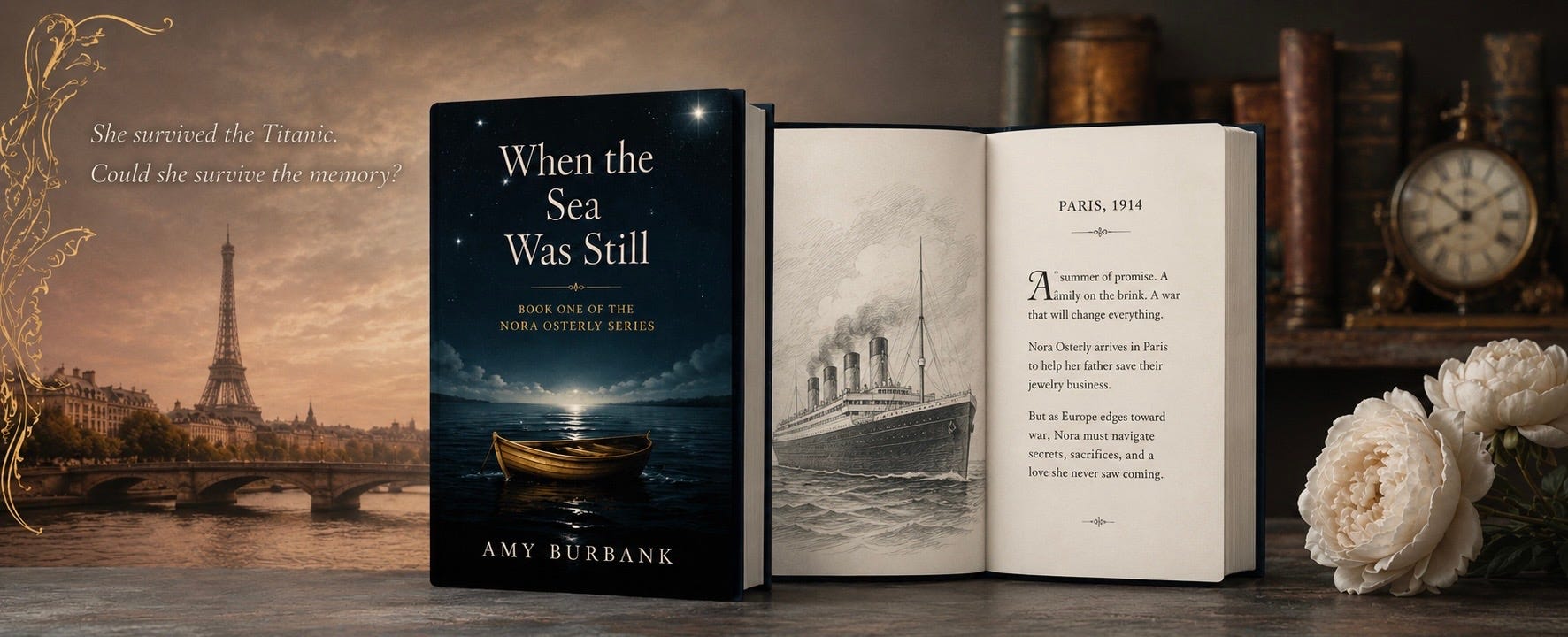

You are reading my weekly serial When the Sea Was Still.
When the Sea Was Still is a historical novel inspired by Titanic survivor Helen Ostby. While the heroine of the story, Nora Osterly, is entirely fictional, her journey draws on the incredible life of Helen Ostby. After surviving the Titanic disaster and losing her father, Helen went on to help run the family jewelry business, Ostby & Barton, which required her to face the sea again for business in Europe. Remarkably, she found herself in Germany on the eve of the First World War.
The novel starts two years after the sinking of the Titanic, when Nora Osterly is forced to cross the Atlantic again—this time aboard Titanic’s nearly identical sister ship, the Olympic. To save her father’s legacy, Nora must do the one thing she swore she never would: return to the sea that nearly killed her.

←Previous Episode | Story Index
Tea on the Rue de Varenne
Nora
4 July 1914
Paris
The last time Nora had seen Étienne was two years ago, only days before she boarded Titanic. It had been a warm day in April when she and her father stopped by Maison Moreau before leaving for Cherbourg. Étienne had walked them to the door himself, as he always did. But that afternoon, he seemed to lack some of his usual confidence. She had wondered if he was as reluctant to say goodbye as she was.
Her father had gone ahead to speak with the driver, leaving Nora and Étienne a few seconds alone in the narrow vestibule. He had handed her the wrapped sketches she’d admired earlier.
“For you,” he’d said. “A little inspiration for the journey.”
Their fingers brushed lightly. It was a faint touch of warmth that Nora had felt all the way to her knees.
When she looked up, he was smiling that crooked smile.
“Bon voyage, Mademoiselle Osterly.”
Then her father had called her name, and the moment had passed.
The brief exchange had belonged to the last days of her old life, yet it had never entirely left her. In the months after the sinking, her grief had buried moments like this beneath memories far more painful. There had been little room for thoughts of Paris, or the hours she had spent with Étienne during those visits with her father. Back in Paris and about to see him again, she recalled the warmth of that fleeting touch more clearly than she would have expected.
Now, alone in her room at the Crillon, Nora wrote to inform Étienne of her arrival and ask when he might receive her at Maison Moreau. With the letter finished, she brought out her sketchbook, hoping to capture an idea that had come to her during their stay in London after leaving the Olympic at Southampton. When the blank page refused to give way to inspiration, she drew another sheet of stationery and wrote a note to Astrid instead.
After dressing and gathering her things, she stepped outside into the early morning light and crossed the Place de la Concorde to the Tuileries Garden.
It was still quiet when Nora arrived. This was her favorite time in the gardens, before the gravel paths filled with Parisians taking their morning promenade. Soon enough the park would be filled with sightseers wandering among the marble statues and admiring the centuries-old grounds. Across the pond, a few early arrivals were already watching their children sailing toy boats on the water. Nora watched two small boats almost collide when a breeze caught them before turning her attention to the sketchbook on her lap.
What she had seen in a Bond Street window in London had given her an idea for a necklace design. Now, as she attempted to transfer the design from thought to paper, her charcoal moved over the page in quick, deliberate strokes. Taking shape in front of her was a teardrop gemstone surrounded by a scatter of small stones, meant to catch the light like water.
But as the sketch formed beneath her fingers, she could see it wasn’t right. The line was too rigid where it ought to have flowed; the central stone sat heavy where she wanted it to hover, lacking the sense of motion she was reaching for. She studied it a moment longer, then turned to a fresh page and began again.
She looked up periodically as she worked. A pair of birds fluttered in and out of the pond, their graceful movements the very quality she was trying to replicate. She watched them until the ease of their movement lived in her mind, then bent again to the paper, chasing the impression before it faded.
A second necklace began to form, this one more fluid but still not quite right. She softened the lines of the setting and allowed the smaller stones to fall less evenly around the central drop. It was closer to what she was imagining, but the design still felt too deliberate. She turned back to the birds, trying again to mimic the effortless flow of nature.
The morning slipped past her in this way. She lost herself in the work, filling one page after another, each time adjusting something small, hoping to find the finesse that continued to elude her. Several rejected pages lay folded beneath the others. None of them was quite able to capture the natural grace she had envisioned.
Nora was ready to try again when she noticed a dark shadow cross her sketchpad. She glanced up to see clouds gathering overhead. She had been so absorbed in the necklace that she hadn’t noticed the blue sky turn to gray. Around the pond, several of the parents had already begun gathering their things, calling their children away from the water. A breeze moved through the trees, lifting the edge of her page. Nora held it down with one hand and looked once more at the unfinished design. Her latest sketch would have to do for now. She collected her pad and pencils, pausing to watch as the birds took flight, seeking shelter from the coming storm.
Nora had barely reached the edge of the gardens when the wind picked up in earnest, tugging at her skirt. She quickened her step as distant thunder rumbled. By the time she crossed into the Place de la Concorde, the first drops began to fall, darkening the pale stones. As she approached the steps of the Hôtel de Crillon, a doorman came hurrying down beneath a broad umbrella to usher her inside.
That afternoon, Astrid and Nora’s carriage rattled through the slick streets toward the Rue de Varenne. The storm had softened to a steady drizzle. As the sky began to brighten, the townhomes of the 7th arrondissement took on a soft, luminous glow. Nora found herself studying their symmetry—the cream-colored façades and wrought-iron balconies. Haussmann’s order brought to life in stone, her father would have said.
At Clara’s, they stepped into the entrance hall, where the familiar checkerboard marble gleamed beneath a crystal chandelier. Nora knew every detail of this house, the carved alcoves along the cream walls, the fluted columns, the graceful curve of the stairs. She had passed through this hall countless times over the years, and its welcoming elegance felt like coming home.
The maid ushered them through to the drawing room, where nothing had changed. Pale damask chairs surrounded the low table, already set for tea. Clara’s favorite summer flower, white roses, filled the room with cheer.
Clara looked up from her settee and rose at once, a broad smile on her face.
“Nora, Mademoiselle Astrid, how delightful to see you safely arrived in Paris.” She extended her hand, which Nora took with a gentle squeeze, and they exchanged a kiss on each cheek.
“It’s such a pleasure to be here, Clara,” Nora replied.
Astrid offered a soft curtsy. “Your home is exquisite, Madame Wentworth. Thank you for receiving us.”
Clara gestured for them to sit.
As Nora took her chair, she felt a contentment she hadn’t known in some time. The simple pleasure of being in Clara’s salon again was a welcome relief after their long weeks of travel. She only wished that she didn’t half expect her father to walk through the door at any moment.
“Now, tell me everything. How was your journey?” Clara said as she poured the tea.
“Very smooth, and the Crillon is magnificent,” Nora replied. “Your recommendation was impeccable as always.”
“I’m delighted you approve.”
“And what of your own travels?” Nora asked. “You promised to tell me about North Africa.”
Clara’s face brightened. She described taking her new motorcar south to Marseille, where it had been loaded aboard the Timgad for the crossing to Algiers. From there, she and her chauffeur had traveled through Algeria and into Tunisia, following roads that grew less dependable the farther they ventured from the coast. There had been punctured tires, mechanical failures, and several occasions when the road ahead scarcely deserved to be called a road at all. Astrid listened with widening eyes, looking increasingly astonished with each new mishap Clara described. Clara related each difficulty with such pleasure that hardship seemed only to have increased the value of the journey.
“And this was the same motorcar you sent for us yesterday?” Nora asked.
“The very one.”
“You took a new motorcar across the Mediterranean?” Astrid asked.
“It seemed a pity to purchase it only to drive along the Champs-Élysées,” Clara replied with a wry smile.
Nora laughed. She could picture the long black motorcar being loaded onto the steamer at Marseille, its polished brass fittings appearing wholly out of place among the ship’s cargo. Clara spoke of transporting an automobile across the Mediterranean as though it required no more daring than arranging an afternoon carriage. Nora had always admired that quality in her.
Clara continued telling them of her journey with her infectious enthusiasm. She spoke of the crowded streets of Tunis and the ruins at Carthage, where broken columns stood high above the Mediterranean. Her story moved deftly between ancient ruins and unreliable engines, between the splendor of the landscape and the clouds of dust that had settled over their clothes.
Nora and Astrid listened with fascination.
“Have you begun writing about it?” Nora asked.
“Not yet. A place must be allowed to settle in the mind before one writes about it. Now, enough about me,” Clara said, turning to Astrid. “How are you finding Paris?”
“It certainly is lively.”
“You sound as though you don’t share Nora’s love of Paris,” Clara said.
“It has its fine points,” Astrid said. “Beauty is certainly all around, but the crimes I’ve been reading about in the papers are another matter.”
“You must be referring to the Caillaux scandal,” Clara said.
Astrid set down her cup with an emphatic clink. “It is outrageous. Imagine—a woman of her standing marching into an editor’s office with a pistol! I cannot fathom such audacity, nor how society tolerates it.”
The affair had captured Astrid’s attention from the moment she discovered it in that morning’s newspaper. Gaston Calmette, editor of Le Figaro, had spent weeks using his newspaper to publish accusations meant to destroy the political career of Madame Caillaux’s husband. Fearing that intimate letters would appear next, Madame Caillaux had decided to take matters into her own hands. She had hidden a Browning pistol inside her fur muff and gone to Calmette’s office, where she fired six shots. He died later that night. Nora found Astrid’s fascination almost as surprising as the crime itself.
“And yet you have remembered every detail,” Nora said, unable to hide her amusement.
“Only because each detail is more appalling than the last.”
“That is precisely why it fascinates,” Clara said. “The motives, the passions, the clash of reputation and politics—it is a novel unfolding before us.”
“It makes me wonder why she believed she must act in her husband’s place,” Nora replied.
“That is the question,” Clara said. “Half of France applauds her for defending his honor, while the other half calls her a disgrace.”
Astrid gave a small huff. “I should think young women are better guided by restraint than by passion.”
The discussion lingered a moment longer before turning to other topics. Clara told them about the short story she had recently completed. It was a departure for her, set during a bitter New England winter and touched with the supernatural, and would appear in Scribner’s the following month. She spoke of several ideas she had been considering for her next project, her enthusiasm growing with each one she described.
When the afternoon came to a close, Clara clasped Nora’s hand with familiar warmth. “You must come again soon. If nothing else, to discuss the latest developments in the trial of Madame Caillaux.”
Astrid shook her head. “Justice can’t be done soon enough if you ask me.”
Nora laughed and embraced Clara before following Astrid outside to their waiting carriage.